Propylene Glycol Viscosity Calculator with Mixture Percentages

Propylene Glycol Dynamic (Absolute) Viscosity Chart
Viscosity of Propylene Glycol vs Temperature Graph

Canvas Element Not Working, Please Check Browser Settings or Contact KasperCalc to fix the issue.

Data from "Propylene Glycol Industrial Grade", Carpemar 2016

Toggle data sets by clicking the legend. Y-axis is logarithmic.

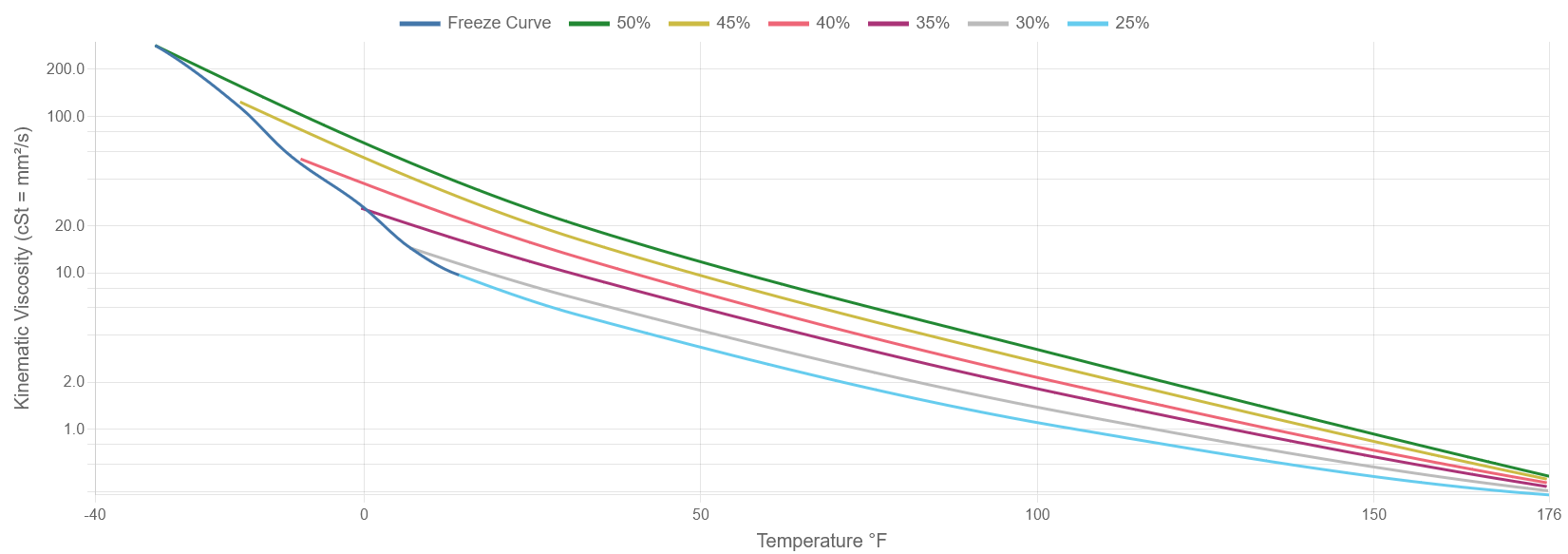
Propylene Glycol Kinematic Viscosity Chart

Canvas Element Not Working, Please Check Browser Settings or Contact KasperCalc to fix the issue.

Computed from dynamic (absolute) viscosity ÷ density (same source). Toggle data sets by clicking the legend. Y-axis is logarithmic.

Propylene Glycol Viscosity Calculator
Degrees (°F):
Degrees (°C):
Dynamic (Absolute) Viscosity
mPa·s (= cP):  
Centipoise (cP):  
Poise (g/(cm·s)):  
Pa·s (Poiseuille):  
lbm/(ft·s):  
kg/(m·h):  
Kinematic Viscosity
mm²/s (= cSt):  
Centistokes (cSt):  
Stokes (cm²/s):  
m²/s:  
in²/s:  
ft²/s:  
Dynamic (Absolute) Viscosity of Propylene Glycol
What Is Dynamic (Absolute) Viscosity?

Dynamic (absolute) viscosity (μ) measures a fluid's resistance to shear flow. It is measured in mPa·s (millipascal-seconds), equivalent to cP (centipoise). Newton's law of viscosity is:

τ = μ × (du / dy)

where τ is shear stress and du/dy is the velocity gradient perpendicular to flow.

Why It Matters for Propylene Glycol Systems

Viscosity drives pressure drop, pump power requirements, and — critically — flow regime. The Reynolds number determines whether flow is laminar or turbulent:

Re = ρ × v × D / μ

At low temperatures, propylene glycol viscosity increases dramatically — especially at higher concentrations — pushing systems into laminar flow (Re < 2300) where heat transfer efficiency drops sharply. Pump curves must be re-evaluated when glycol is added to a system that was originally sized for water.

Note: Viscosity is highly temperature-dependent in propylene glycol solutions. Always check viscosity at the lowest expected operating temperature, not just at design conditions.

Dynamic (Absolute) vs. Kinematic Viscosity
Dynamic (Absolute) Viscosity — μ

Dynamic viscosity (also called absolute viscosity or static viscosity) measures a fluid's resistance to shear — the internal force per unit area required to make one layer of fluid slide past another. It is independent of density. The SI unit is the pascal-second (Pa·s); the common engineering unit is the millipascal-second (mPa·s), numerically equal to centipoise (cP).

τ = μ × (du / dy)

where τ is shear stress [Pa] and du/dy is the velocity gradient [s⁻¹].

Kinematic Viscosity — ν

Kinematic viscosity is the ratio of dynamic viscosity to fluid density. It describes how easily a fluid flows under the influence of gravity or pressure, without needing to separately account for the applied force. The SI unit is m²/s; the common unit is mm²/s, numerically equal to centistokes (cSt).

ν = μ / ρ

Relationship and Unit Conversion

Kinematic viscosity is derived from dynamic viscosity and density:

ν [cSt] = μ [mPa·s] × 1000 / ρ [kg/m³]

Because denser fluids have higher internal inertia, a greater dynamic viscosity is required to produce the same kinematic viscosity. Glycol solutions are significantly denser than water, so their kinematic viscosity rises more slowly with concentration than their dynamic viscosity does.

When to Use Each

Use dynamic (absolute) viscosity for: pump power calculations, pipe pressure drop (Darcy–Weisbach), Reynolds number (Re = ρvD/μ), and any situation where force or stress is the driving input.

Use kinematic viscosity for: gravity-driven flow, lubrication ratings, most viscometer measurements, and flow calculations where density is already embedded in the formula (e.g., Stokes' law, ASTM oil viscosity grades).

Note: "Absolute viscosity" and "static viscosity" are synonyms for dynamic viscosity — they all refer to the same physical property. "Static" distinguishes it from apparent viscosity measured at elevated shear rates in non-Newtonian fluids.

Cite This Work