Carbon steels are those steels containing carbon up to about 1 percent and only residual quantities of other elements except those added for deoxidation.
The strength that carbon steels are capable of achieving is determined by carbon content and, to a much lesser extent, by the content of the residual elements. Through cold working or proper choice of heat treatments, these steels can be made to exhibit a wide range of strength properties.
The finish conditions most generally specified for carbon steels include hot-rolled, cold-rolled, cold-drawn, normalized, annealed, spheroidized, stress-relieved, and quenched-and-tempered. In addition, the low-carbon grades (up to 0.25 percent C) may be carburized to obtain high surface hardness and wear resistance with a tough core. Likewise, the higher carbon grades are amenable to selective flame hardening to obtain desired combinations of properties.
Forging: All of the carbon steels exhibit excellent forgeability in the austenitic state provided the proper forging temperatures are used. As the carbon content is increased, the maximum forging temperature is decreased. At high temperatures, these steels are soft and ductile and exhibit little or no tendency to work harden. The resulfurized grades (free-machining steels) exhibit a tendency to rupture when deformed in certain high-temperature ranges. Close control of forging temperatures is required.
Cold Forming: The very low-carbon grades have excellent cold-forming characteristics when in the annealed or normalized conditions. Medium-carbon grades show progressively poorer formability with higher carbon content, and more frequent annealing is required. The high-carbon grades require special softening treatments for cold forming. Many carbon steels are embrittled by warm working or prolonged exposure in the temperature range from 300 to 700°F.
Machining: The low-carbon grades (0.30 percent C and less) are soft and gummy in the annealed condition and are preferably machined in the cold-worked or the normalized condition. Medium-carbon (0.30 to 0.50 percent C) grades are best machined in the annealed condition, and high-carbon grades (0.50 to 0.90 percent C) in the spheroidized condition. Finish machining must often be done in the fully heat-treated condition for dimensional accuracy. The resulfurized grades are well known for their good machinability. Nearly all carbon steels are now available with 0.15 to 0.35 percent lead, added to improve machinability. However, resulfurized and leaded steels are not generally recommended for highly stressed aircraft and missile parts because of a drastic reduction in transverse properties.
Welding: The low-carbon grades are readily welded or brazed by all techniques. The medium-carbon grades are also readily weldable but may require preheating and postwelding heat treatment. The high-carbon grades are difficult to weld. Preheating and postwelding heat treatment are usually mandatory for the latter, and special care must be taken to avoid overheating. Furnace brazing has been used successfully with all grades.
Heat Treatment: Due to the poor oxidation resistance of carbon steels, protective atmospheres must be employed during heat treatment if scaling of the surface cannot be tolerated. Also, these steels are subject to decarburization at elevated temperatures and, where surface carbon content is critical, should be heated in reducing atmospheres.
Carbon steels have poor oxidation resistance above about 900 to 1000°F. Strength and oxidation-resistance criteria generally preclude the use of carbon steels above 900°F.
Carbon steels may undergo an abrupt transition from ductile to brittle behavior. This transition temperature varies widely for different carbon steels depending on many factors. Caution should be exercised in the application of carbon steels to assure that the transition temperature of the selected alloy is below the service temperature. Additional information is contained in References 2.2.0.3(a) and (b).
The corrosion resistance of carbon steels is relatively poor; clean surfaces rust rapidly in moist atmospheres. Simple oil film protection is adequate for normal handling. For aerospace applications, the carbon steels are usually plated to provide adequate corrosion protection.
AISI 1025 is an excellent general purpose steel for the majority of shop requirements, including jigs, fixtures, prototype mockups, low torque shafting, and other applications. It is not generally classed as an airframe structural steel. However, it is available in aircraft quality as well as commercial quality.
Manufacturing Considerations: Cold-finished flat-rolled products are supplied principally where maximum strength, good surface finish, or close tolerance is desirable. Reasonably good forming properties are found in AISI 1025. The machinability of bar stock is rated next to the sulfurized types of free-machining steels, but the resulting surface finish is poorer.
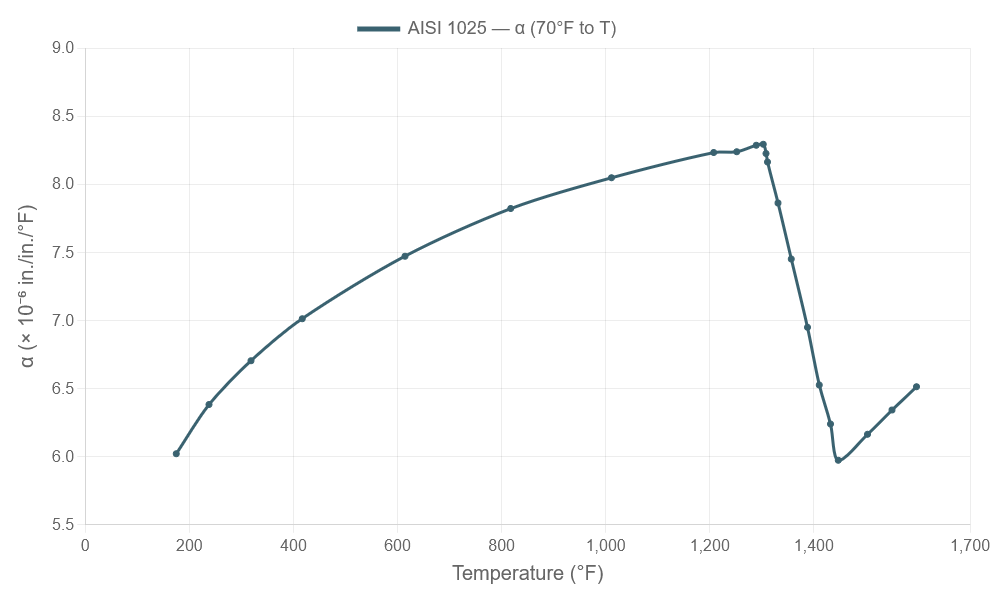
Specifications and Properties: Material specifications for AISI 1025 steel are presented in Table 2.2.1.0(a). The room-temperature mechanical and physical properties are shown in Table 2.2.1.0(b). The effect of temperature on thermal expansion is shown in Figure 2.2.1.0.
| Specification | Form |
|---|---|
| ASTM A 108 | Bar |
| AMS 5075 | Seamless tubing |
| AMS-T-5066a | Tubing |
| AMS 5077 | Tubing |
| AMS 5046 | Sheet, strip, and plate |
| AMS-S-7952 | Sheet and strip |
| a Noncurrent specification | |
| AMS 5046 and AMS-S-7952 |
AMS 5075, AMS 5077 and AMS-T-5066a |
ASTM A 108 | |
|---|---|---|---|
| Form | Sheet, strip, and plate | Tubing | Bar |
| Condition | Annealed | Normalized | All |
| Thickness, in. | … | … | … |
| Basis | S | S | Sb |
| Mechanical Properties: | |||
| Ftu, ksi: | |||
| L | 55 | 55 | 55 |
| LT | 55 | 55 | 55 |
| ST | … | … | 55 |
| Fty, ksi: | |||
| L | 36 | 36 | 36 |
| LT | 36 | 36 | 36 |
| ST | … | … | 36 |
| Fcy, ksi: | |||
| L | 36 | 36 | 36 |
| LT | 36 | 36 | 36 |
| ST | … | … | 36 |
| Fsu, ksi | 35 | 35 | 35 |
| Fbru, ksi: | |||
| (e/D = 1.5) | … | … | … |
| (e/D = 2.0) | 90 | 90 | 90 |
| Fbry, ksi: | |||
| (e/D = 1.5) | … | … | … |
| (e/D = 2.0) | … | … | … |
| e, percent: | |||
| L | … | c | c |
| LT | c | … | … |
| E, 103 ksi | 29.0 | ||
| Ec, 103 ksi | 29.0 | ||
| G, 103 ksi | 11.0 | ||
| μ | 0.32 | ||
| Physical Properties: | |||
| ω, lb/in.3 | 0.284 | ||
| C, Btu/(lb)(°F) | 0.116 (122 to 212°F) | ||
| K, Btu/[(hr)(ft2)(°F)/ft] | 30.0 (at 32°F) | ||
| α, 10−6 in./in./°F | See Figure 2.2.1.0 | ||
| a Noncurrent specification. | |||
| b Design values are applicable only to parts for which the indicated Ftu has been substantiated by adequate quality control testing. | |||
| c See applicable specification for variation in minimum elongation with ultimate strength. | |||
- 2.2.0.3(a) “Low Temperature Properties of Ferrous Materials,” Society of Automotive Engineers, Special Publication SP-61 (1950).
- 2.2.0.3(b) “The Selection of Steel for Notch Toughness,” ASM Metals Handbook, 8th Edition, Vol. I, pp. 225–243 (1961).