MIL-PRF-23699 Turbine Oil Viscosity Calculator

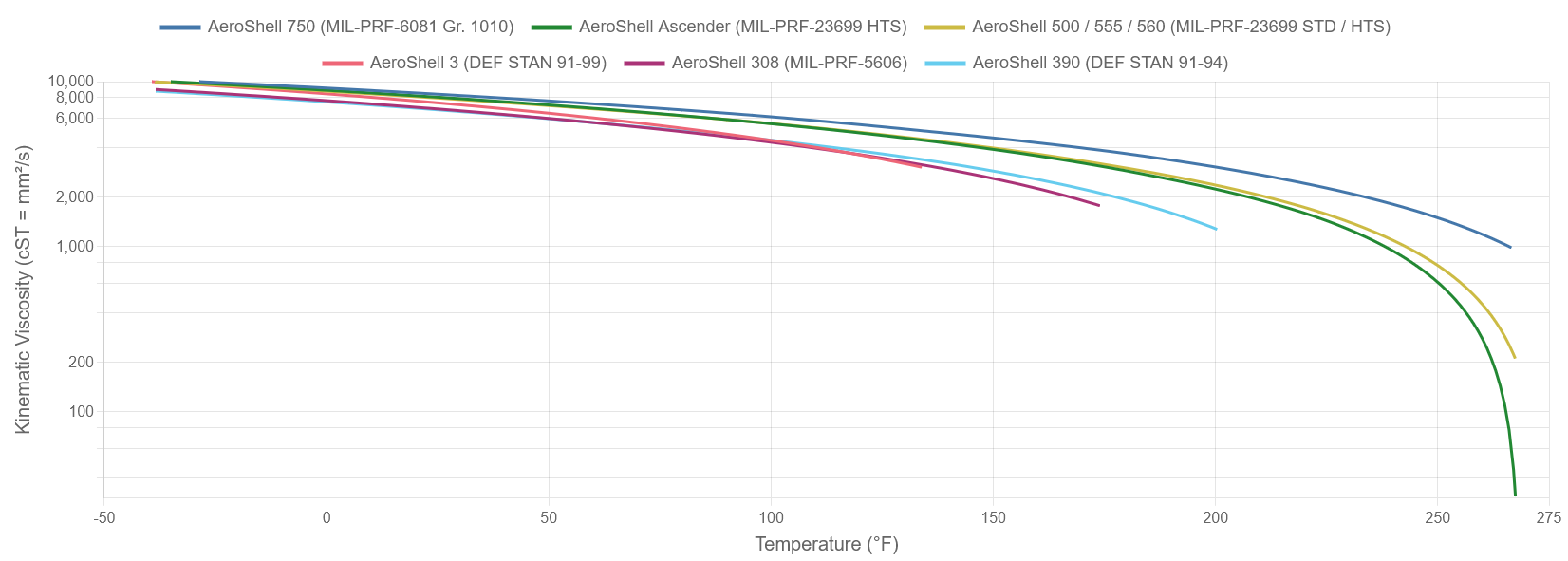
MIL-PRF-23699 Kinematic Viscosity Chart

Canvas Element Not Working, Please Check Browser Settings or Contact KasperCalc to fix the issue.

Toggle data sets by clicking the legend. Y-axis is logarithmic.

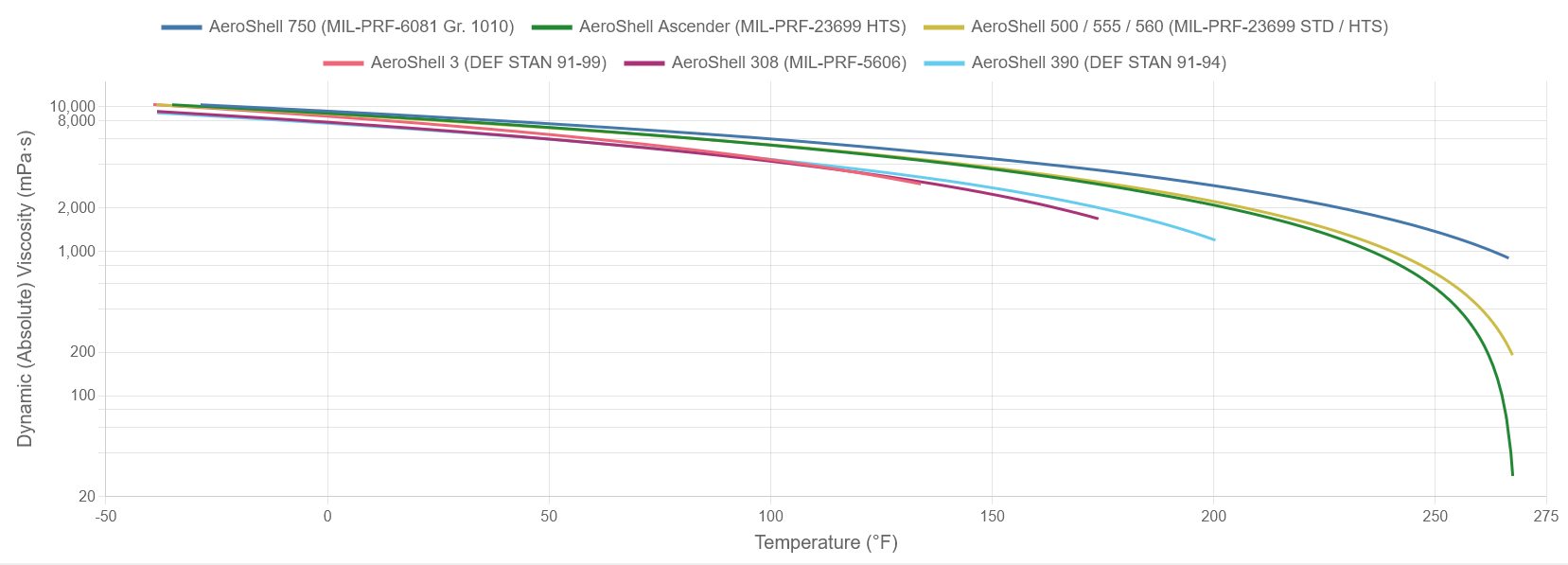
MIL-PRF-23699 Dynamic (Absolute) Viscosity Chart

Canvas Element Not Working, Please Check Browser Settings or Contact KasperCalc to fix the issue.

Computed from kinematic viscosity × density (μ = ν × ρ). Toggle data sets by clicking the legend. Y-axis is logarithmic.

Density source: NIST IR 8263 (Fortin et al.), Table 23 — MIL-PRF-23699 at ambient pressure, 5 °C – 70 °C. Dynamic viscosity is only computed within that temperature range.

MIL-PRF-23699 Viscosity Calculator
Degrees (°F):
Degrees (°C):
Kinematic Viscosity
mm²/s (= cSt):  
Centistokes (cSt):  
Stokes (cm²/s):  
m²/s:  
in²/s:  
ft²/s:  
Dynamic (Absolute) Viscosity
mPa·s (= cP):  
Centipoise (cP):  
Poise (g/(cm·s)):  
Pa·s (Poiseuille):  
lbm/(ft·s):  
kg/(m·h):  
Viscosity of MIL-PRF-23699 Turbine Oil
Kinematic Viscosity

MIL-PRF-23699 is defined as a 5 mm²/s class oil. The specification sets a narrow kinematic viscosity band at 100 °C (4.90–5.40 mm²/s) to ensure consistent lubrication film thickness across qualified products. At cold temperatures the viscosity rises steeply — the spec allows up to 13 000 mm²/s at −40 °C — which governs engine cold-start and ground-start limits.

Why Viscosity Matters in Turbine Lubrication

Turbine bearing systems operate over an extreme temperature range, from arctic ground starts (−54 °C) to bearing compartment temperatures that can exceed 200 °C. Too high a viscosity at cold temperatures means the oil cannot be pumped to bearings during start-up; too low a viscosity at high temperatures means inadequate hydrodynamic film thickness and accelerated wear. The narrow 100 °C band ensures all qualified oils deliver predictable film thickness in the normal operating regime.

Dynamic (Absolute) vs. Kinematic Viscosity
Dynamic (Absolute) Viscosity — μ

Dynamic viscosity measures a fluid's resistance to shear — the internal force per unit area required to make one layer slide past another. It is independent of density. The SI unit is the pascal-second (Pa·s); the common engineering unit is the millipascal-second (mPa·s), numerically equal to centipoise (cP).

τ = μ × (du / dy)

Kinematic Viscosity — ν

Kinematic viscosity is the ratio of dynamic viscosity to fluid density. The SI unit is m²/s; the common unit is mm²/s, numerically equal to centistokes (cSt). Most turbine oil specifications grade viscosity kinematically because viscometers measure time-of-flow under gravity, which naturally yields kinematic viscosity.

ν = μ / ρ     ⇒     μ [mPa·s] = ν [mm²/s] × ρ [kg/m³] / 1000

Cite This Work