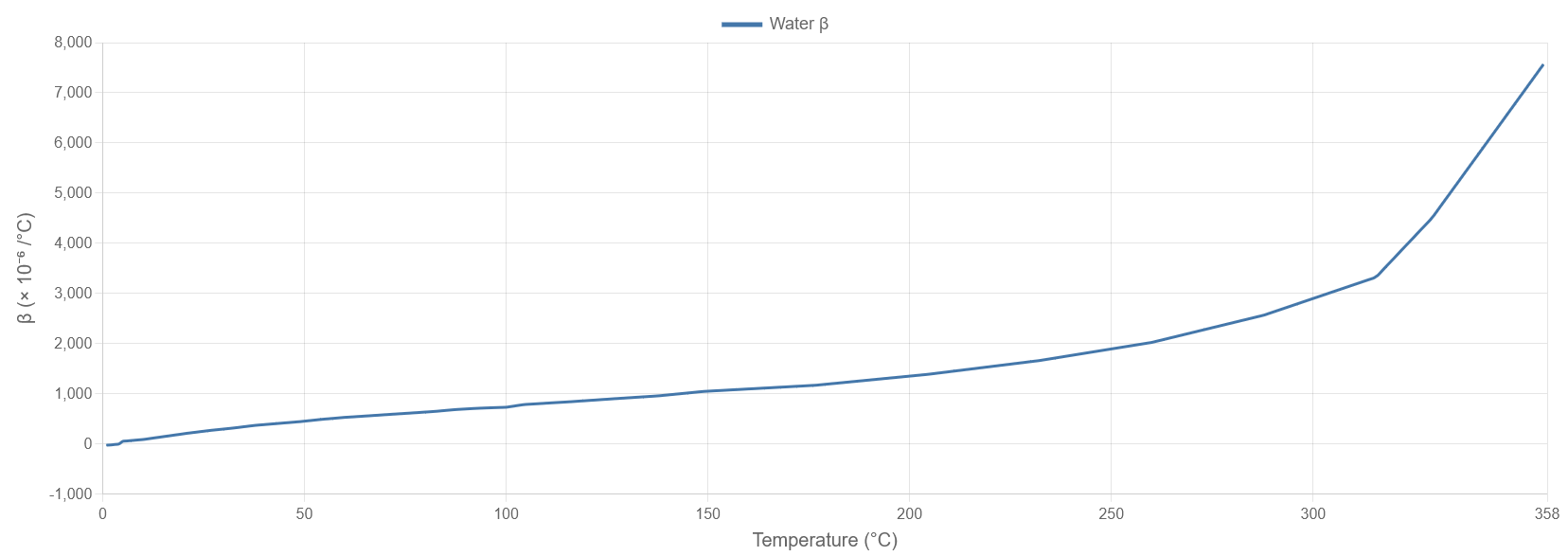
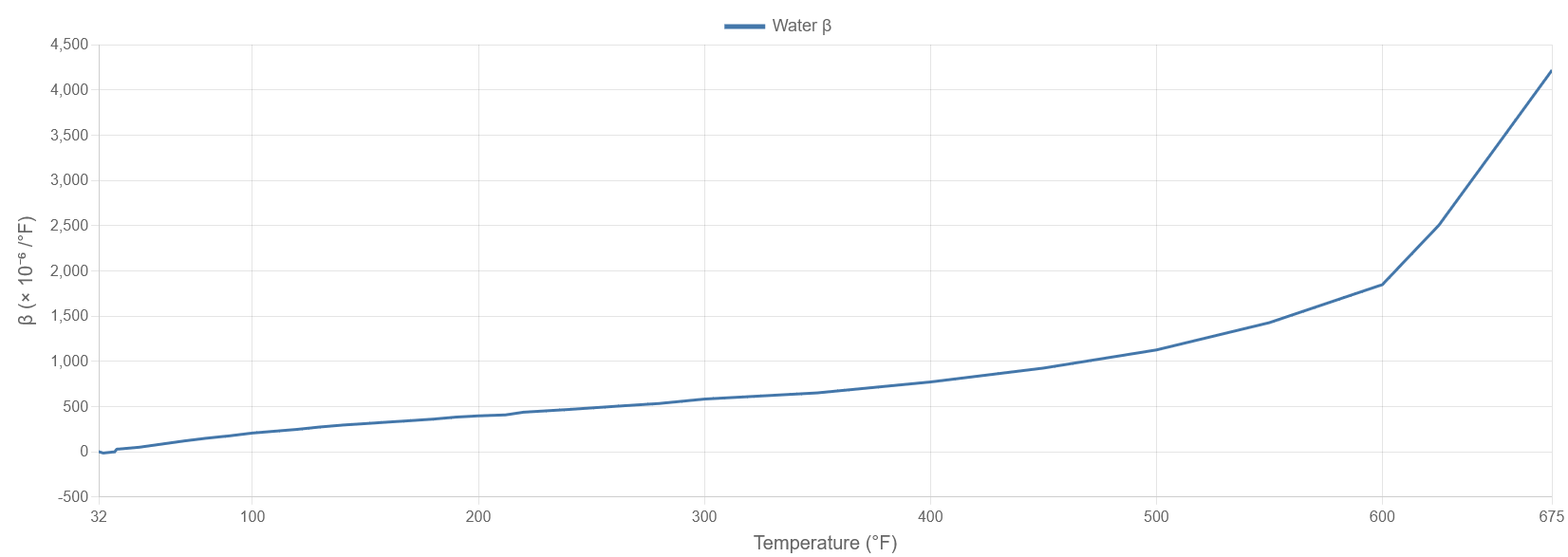
.png)
The volumetric thermal expansion coefficient (β, beta) describes how much a substance's volume changes per unit temperature change at constant pressure:
A positive β means the fluid expands when heated (density decreases); negative β means it contracts. β is typically expressed in units of 10−6/°C (or equivalently 10−6/K). The values on this page are derived by numerical differentiation of the density data from Water Density.
Water is unique in that its density increases as it warms from 32 °F (0 °C) to 39.2 °F (4 °C), then decreases above 4 °C. Consequently, β is negative below 4 °C and zero at 4 °C (the temperature of maximum density), before becoming positive at higher temperatures. This behavior arises from the hydrogen-bond network in liquid water, which partially breaks down as temperature rises above 4 °C, allowing molecules to pack more loosely.
Thermal expansion of water must be accounted for in closed piping and vessel systems. A sealed water line heated from 60 °F to 200 °F expands roughly 3.7% by volume. Without pressure relief or an expansion tank, this can generate extremely high pressures. At temperatures near the critical point (674 °F / 357 °C), β rises steeply to over 7,500 × 10−6/°C, making accurate expansion calculations critical for high-pressure steam systems.
Note: β values near 32–40 °F (0–4 °C) are approximate due to limited data resolution in the source density table at this temperature range. Above 212 °F, values are at saturation pressure.