NSWC-11 Dynamic Seal Reliability Model

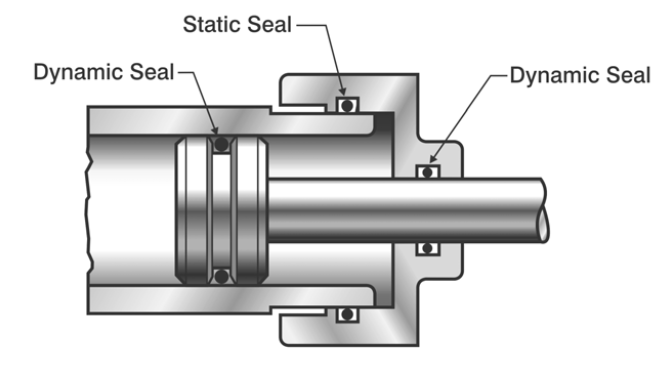
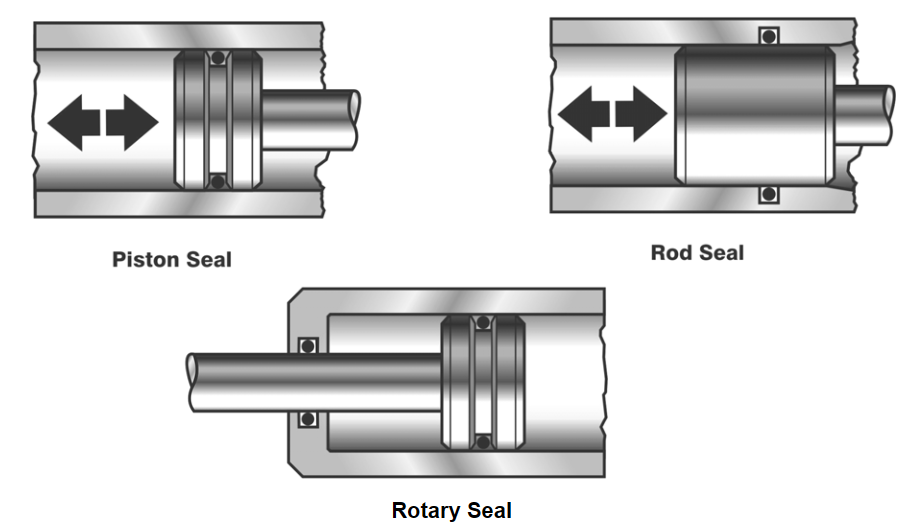
This tool estimates the failure rate of dynamic seals — reciprocating, rotary, oscillating, and mechanical face seals — using the model from the Naval Surface Warfare Center Handbook of Reliability Prediction Procedures for Mechanical Equipment (NSWC-11, Chapter 3, Sections 3.3 and 3.4). Unlike static seals, dynamic seals experience sliding contact between mating surfaces, so wear rate, surface speed (PV factor), and surface finish play a dominant role.

The model uses two equations. Eq. 3-14 covers reciprocating, rotary, and oscillating O-ring/lip seals. At speeds below 800 rpm or 600 ft/min, all nine factors apply; at higher speeds CP, CDL, and CH are set to 1.0 and the pressure-velocity factor CPV governs. Eq. 3-16 covers mechanical (face) seals and always uses CPV without CP, CDL, or CH. The base failure rate for dynamic seals is 22.8 failures per million hours (vs 2.4 for static seals).

Select the seal mode, enter operating conditions, then press Calculate. Results include λSE, MTBF, all multiplying factors, and a computed PV value ready for FMECA use.

NSWC-11 Chapter 3 Dynamic Seal Failure Rate Calculator
Dynamic Seal Reliability (NSWC-11 Eq. 3-14 / Eq. 3-16)
Seal Mode
Low-speed dynamic seal (reciprocating / oscillating / slow rotary). All nine factors apply: CP × CQ × CDL × CH × CF × Cν × CT × CN. CPV = 1.0.
Speed & PV Inputs
Seal Geometry
Pressure
Seal Material & Contact Stress — CH
Leakage & Surface Finish
Dynamic seals use Fig. 3.17 (not Fig. 3.15). Optimum finish is 10–20 μin. Below 8 μin increases frictional drag; above 20 μin accelerates wear.
Fluid Viscosity — Cν
Fluid Contaminants — CN
Optional Overrides
The Failure-Rate Models (NSWC-11 Eq. 3-14 & Eq. 3-16)

Dynamic seals experience sliding contact between mating surfaces, so wear rate, surface speed, and surface finish dominate reliability. NSWC-11 provides two equations for dynamic seals. Both share the same base failure rate of λSE,B = 22.8 failures/106 h (roughly 9.5× higher than the 2.4 used for static seals), reflecting the additional wear mechanisms present.

Eq. 3-14 — Reciprocating, Rotary & Oscillating Seals
\[ \lambda_{SE} \;=\; \lambda_{SE,B}\;\cdot\; C_P \cdot C_Q \cdot C_{DL} \cdot C_H \cdot C_F \cdot C_\nu \cdot C_T \cdot C_N \cdot C_{PV} \]

Speed regime governs which factors are active: below 800 rpm or 600 ft/min — all factors apply, CPV = 1.0;  at or above that threshold — CP = CDL = CH = 1.0 and CPV is active.

Eq. 3-16 — Mechanical (Face) Seals
\[ \lambda_{SE} \;=\; \lambda_{SE,B}\;\cdot\; C_Q \cdot C_F \cdot C_\nu \cdot C_T \cdot C_N \cdot C_{PV} \]

Mechanical seals do not use CP, CDL, or CH at any speed. CPV always applies. The failure rate equation assumes a balanced seal (k = 0.4).

SymbolMeaningEq. 3-14Eq. 3-16
λSE,B = 22.8Base failure rate (failures / 106 h)
CPFluid pressure factor — active only at low speedLow speed
CQAllowable-leakage factor
CDLSeal size factor — active only at low speedLow speed
CHContact stress and seal hardness factor — active only at low speedLow speed
CFSurface finish factor (Fig. 3.17 — dynamic formula)
CνFluid viscosity factor
CTOperating temperature factor
CNFluid contaminant factor
CPVPressure-velocity factor — active only at high speedHigh speed

Surface finish note: Dynamic seals use Fig. 3.17 (optimum 10–20 μin), not Fig. 3.15 used for static seals. The two curves are fundamentally different — using the wrong one will give incorrect results.

Multiplying Factor Reference Guide
NSWC-11 Chapter 3 — Dynamic Seals (Sections 3.3 & 3.4)
CP

Fluid Pressure Factor — CP

Equation — NSWC-11 Figure 3.10
Eq. CP \[ C_P = \begin{cases} 0.25 & P_S \le 1500\ \text{psi}\\[4pt] \left(\dfrac{P_S}{3000}\right)^{2} & P_S > 1500\ \text{psi} \end{cases} \] \[ P_S = P_1 - P_2 \]

Higher fluid pressure increases the load trying to extrude the seal into the clearance gap and raises the pressure gradient driving leakage. Below 1,500 psi the effect is weak; above it grows with the square of pressure.

Speed regime: CP applies only when seal movement is < 800 rpm or < 600 ft/min. At higher speeds, CP = 1.0 (pressure effects are captured instead by CPV). CP is never used for mechanical seals (Eq. 3-16).
CP vs Pressure Differential (NSWC-11 Fig. 3.10)
CQ

Allowable Leakage Factor — CQ

Equation — NSWC-11 Figure 3.11
Eq. CQ \[ C_Q = \begin{cases} \dfrac{0.055}{Q_f} & Q_f > 0.03\ \text{in}^3/\text{min}\\[8pt] 4.2 - 79\,Q_f & Q_f \le 0.03\ \text{in}^3/\text{min} \end{cases} \]

“Failure” for a seal means leaking more than the application tolerates — and that threshold is a design decision. The tighter the allowable leakage Qf, the sooner degradation counts as failure. The two branches meet at Qf = 0.03 in³/min. A zero-leakage requirement gives the maximum value CQ = 4.2.

CQ vs Leakage Rate (NSWC-11 Fig. 3.11)
CDL

Seal Size Factor — CDL

Equation — NSWC-11 Figure 3.12
Eq. CDL — Circular dynamic seal (Fig. 3.12) \[ C_{DL} = 1.1\,D_{SL} + 0.32 \]

A larger seal presents a longer leakage perimeter and more surface area exposed to wear and degradation. DSL is the seal inner diameter in inches.

Speed regime: CDL applies only when seal movement is < 800 rpm or < 600 ft/min. At higher speeds, CDL = 1.0. Never used for mechanical seals (Eq. 3-16).
CDL vs Inner Diameter (NSWC-11 Fig. 3.12)
CH

Contact Stress & Hardness Factor — CH

Speed regime: CH applies only when seal movement is < 800 rpm or < 600 ft/min. At higher speeds CH = 1.0. Never used for mechanical seals (Eq. 3-16). Additionally, CH varies as (M/C)4.3 — small changes in the M/C ratio swing the predicted failure rate by orders of magnitude. Use the design ideal M/C = 0.55 as a sanity check.
Equation — NSWC-11 Figure 3.14
Eq. CH \[ C_H = \left(\frac{M/C}{0.55}\right)^{4.3} \]
Contact Pressure — Eqs. 3-9 / 3-10
Eq. Contact Pressure C \[ C = \frac{F_C - P_1 \pi r_i^{2} - (P_1{-}P_2)\tfrac{r_o{+}r_i}{2}(r_o{-}r_i)} {\pi(r_o^{2} - r_i^{2})} \]

FC = compression force (default: 2.5×M); ri, ro = inner/outer seal radii.

CH vs M/C Ratio (log scale) — NSWC-11 Fig. 3.14
Durometer vs Young’s Modulus M — NSWC-11 Fig. 3.4
CF

Surface Finish Factor — CF (Dynamic — Fig. 3.17)

Equation — NSWC-11 Figure 3.17 (dynamic seals)
Eq. CF — Dynamic (Fig. 3.17) \[ C_F = \begin{cases} 1.00 & f \le 10\ \mu\text{in}\\[6pt] \dfrac{1}{2^{\,(10-f)/38}} & f > 10\ \mu\text{in} \end{cases} \]
Dynamic seals use Fig. 3.17, NOT Fig. 3.15 (static seal formula). The two equations are entirely different. The static formula has a minimum of 0.25 at smooth surfaces; the dynamic formula equals 1.0 at the optimum (10 μin) and rises above 1.0 as finish degrades.

In dynamic applications the shaft or gland must mate smoothly with the seal lip. Maximum seal efficiency and life are obtained in the 10–20 μin range. Below 8 μin increases frictional drag; above ~40 μin accelerates abrasive wear.

For f > 10: the exponent (10−f)/38 is negative, so 2(10−f)/38 < 1, giving CF > 1 — a penalty factor that grows with roughness. At f = 50 μin, CF ≈ 2.1; at f = 100 μin, CF ≈ 5.2.
CF vs Surface Finish (NSWC-11 Fig. 3.17 — dynamic)
Static CF (Fig. 3.15) shown for comparison
Cν

Fluid Viscosity Factor — Cν

Equation — NSWC-11 Table 3-3
Eq. Cν \[ C_\nu = \frac{\nu_0}{\nu}, \qquad \nu_0 = 2{\times}10^{-8}\ \text{lbf}{\cdot}\text{min}/\text{in}^2 \]

Thin fluids find their way through residual leak paths far more readily than thick ones. ν0 = 2×10⁻⁸ lbf·min/in² is the MIL-H-83282 datum the field data was normalized against. Use the viscosity at operating temperature. The calculator accepts three viscosity input modes — see the calculator above.

Kinematic conversion: νdyn [cP] = νkin [cSt] × SG;   1 cP = 2.41737×10⁻⁹ lbf·min/in².
Viscosity Input Modes
  1. Fluid + temperature. All 14 NSWC-11 Table 3-3 fluids are available; Cν is interpolated directly from the table.
  2. Direct dynamic viscosity in lbf·min/in² or mPa·s (handbook native units).
Table 3-3 — Fluid Viscosity / Temperature Multiplying Factor Cν
Fluid Temperature (°F)
−50050100150200250300350
Air554.0503.4462.9430.1402.6379.4359.5
Oxygen504.6457.8420.6390.2365.9343.6325.3
Nitrogen580.0528.0486.5452.6424.3400.0379.6
Carbon Dioxide599.9510.7449.7395.9352.1
Water6.30912.1519.4327.30
SAE 10 Oil0.0600.2500.7501.6902.650
SAE 20 Oil0.03140.1670.4921.1832.2132.8615.204
SAE 30 Oil0.02970.11290.35190.85111.7682.8614.309
SAE 40 Oil0.01220.05340.24620.67181.3252.2213.387
SAE 50 Oil0.00370.03260.12510.39860.85091.6572.654
SAE 90 Oil0.00120.01890.09730.33220.78551.5152.591
Diesel Fuel0.16170.74922.0893.8476.2289.16912.7816.31
MIL-H-832820.00310.04320.21370.66431.4212.5854.0630.6114*0.7766*
MIL-H-56060.01880.09510.28290.62281.1081.7832.7193.6284.880

— = data unreliable at this temperature per NSWC-11. * The 300/350 °F values for MIL-H-83282 break the rising trend and appear to be source typos; reproduced as published.

CT

Temperature Factor — CT

Equation — NSWC-11 Eq. 3-11
Eq. CT \[ C_T = \begin{cases} \dfrac{1}{2^{\,t}},\quad t = \dfrac{T_R - T_O}{18} & \Delta T \le 40\ ^\circ\text{F}\\[10pt] 0.21 & \Delta T > 40\ ^\circ\text{F} \end{cases} \]

Heat ages elastomers: operating near the material’s rated temperature TR continues vulcanization, hardening and embrittling the seal. Operating at the rating gives CT = 1; every 18 °F of margin halves the factor, flooring at 0.21 once the margin exceeds 40 °F.

Table 3-5 — Typical Rated Temperatures TR
MaterialTR (°F)
Natural rubber160
Leather200
Urethane210
Ethylene propylene250
Neoprene250
Nitrile250
Butyl rubber250
Impregnated poromeric250
Polyacrylate300
Fluorosilicon450
Silicon rubbers450
Fluorocarbon475
Fluoroelastomers500
Fluoroplastics500
CT vs Temperature Margin TR−TO (NSWC-11 Fig. 3.16)
CN

Fluid Contaminant Factor — CN

Equation — NSWC-11 Table 3-4
Eq. CN \[ C_N = \left(\frac{C_0}{C_{10}}\right)^{3} F_R\, N_{10}, \qquad C_{10} = 10\ \mu\text{m} \]

Hard particles embed in the soft seal and abrade the mating surface, opening leak paths. C0 = system filter size (μm); FR = rated flow rate (GPM); N10 = particles <10 μm per hour per rated GPM generated by the upstream component (Table 3-4).

The source engineering analysis used CN = 1.0 (“based on other analyses” — i.e. a clean, filtered system). This is the default when no contaminant inputs are given to the calculator.
Table 3-4 — N10 Particle-Generation Factors
Upstream componentParticlesN10
Piston pumpsteel0.017
Gear pumpsteel0.019
Vane pumpsteel0.006
Cylindersteel0.008
Sliding action valvesteel0.0004
Hoserubber0.0013

N10 units: particles <10 μm / hour / rated GPM.

CN vs Filter Size — 5 GPM, various components
CPV

Pressure-Velocity Factor — CPV

PV Calculation — NSWC-11 Eq. 3-13
Eq. 3-13 — PV factor (rpm input) \[ PV = \frac{\pi}{12}\, DP \cdot d \cdot V_{\text{rpm}} \cdot k \] Eq. 3-13 — PV factor (ft/min input) \[ PV = DP \cdot V_{\text{ft/min}} \cdot k \]

DP = pressure differential (psi); d = seal diameter (in); V = speed; k = 1.0 for unbalanced seals, 0.4 for balanced seals. PV units: lbf/in² · ft/min.

CPV — NSWC-11 Eq. 3-15
Eq. 3-15 \[ C_{PV} = \frac{PV_{\text{OP}}}{PV_{\text{DS}}} \]

PVOP is the operating PV computed from Eq. 3-13. PVDS is the manufacturer’s design limit for the seal face material combination. CPV = 1.0 means operating at exactly the design limit; values above 1.0 indicate the limit is exceeded.

Speed regime: CPV applies to rotary seals, lip seals, and any dynamic seal at ≥ 800 rpm or ≥ 600 ft/min (and always for mechanical seals). Below that threshold, CPV = 1.0 for Eq. 3-14.
Heat Input — NSWC-11 Eq. 3-12
Eq. 3-12 — Heat generated at seal face \[ Q_S = 0.077 \cdot PV \cdot \mu \cdot a_o \]

μ = coefficient of friction (see Table 3-6 below); ao = seal face area (in²); QS in BTU/hour.

Typical PV Limits — NSWC-11 Table 3-7
Face Material CombinationPV Limit (lbf/in² · ft/min)
Carbon vs. hard-faced stainless steel543,000
Carbon vs. ceramic543,000
Carbon vs. leaded bronze992,000
Carbon vs. nickel iron1,142,000
Carbon vs. tungsten carbide2,570,000
Coefficient of Friction μ — NSWC-11 Table 3-6
Rotating (seal head)Stationary (mating ring)μ
Carbon-graphite (resin filled)Cast iron0.07
Ceramic0.07
Tungsten carbide0.07
Silicon carbide0.02
Silicon carbide converted carbon0.015
Silicon carbideTungsten carbide0.02
Silicon carbide converted carbon0.05
Silicon carbide0.02
Tungsten carbide0.08
CPV vs PVOP/PVDS Ratio
Dynamic Seal Failure Modes — NSWC-11 Table 3-2
TABLE

Failure Mechanisms & Causes for Dynamic Seals (Table 3-2)

Failure ModeFailure MechanismsFailure Causes
Excessive leakage — Wear Abrasive wear of sealing surfaces Misalignment
Shaft out-of-roundness
Excessive shaft end play
Excessive torque
Poor surface finish
Excessive leakage — Dynamic instability Vibration / shaft whip Contaminants
Inadequate lubrication
Excessive leakage — Embrittlement Thermal / chemical degradation Excessive rubbing speed (high PV)
Shaft misalignment
Fluid / seal material incompatibility
Fracture Stress-corrosion cracking Thermal degradation; idle periods between use
Excessive leakage — Edge chipping Brittle fracture of seal face Excessive PV value
Excessive fluid pressure on seal
Excessive shaft deflection; faces out-of-square
Excessive leakage — Axial shear Seal face separation Excessive pressure loading; shaft whip
Excessive leakage — Torsional shear Rotational overload Excessive torque due to improper lubrication
Fluid seepage — Compression set Permanent deformation of elastomer Extreme temperature operation
Insufficient seal squeeze
Excessive leakage — Seal face distortion Thermal or mechanical distortion Foreign material trapped between faces
Excessive fluid pressure; insufficient lubrication
Slow mechanical response — Excessive friction Friction / stick-slip Excessive seal squeeze or swell
Seal extrusion
Metal-to-metal contact (misalignment)
Mechanical spring failure Spring fatigue / corrosion See NSWC-11 Chapter 4, Table 4-1
Worked Example

A 70-durometer O-ring, 0.778 in inner / 0.886 in outer diameter, sealing 180 psi against atmospheric with a zero-leakage requirement. Gland finish 32 μin; fluid dynamic viscosity 4.461×10⁻⁹ lbf·min/in² at 150 °F; seal material rated to 300 °F.

Step-by-step
  • M = 925 psi (from Figure 3.4 at 70 Shore A)
  • FC = 2.5 × 925 = 2312.5 lbf (default rule)
  • C ≈ 15,749 psi (Eqs. 3-9/3-10); M/C ≈ 0.059 (far from ideal 0.55)
  • CP = 0.25 (180 psi < 1,500 psi threshold)
  • CQ = 4.2 (Qf = 0, maximum value)
  • CDL = 1.1 × 0.778 + 0.32 = 1.176
  • CH = (0.059/0.55)4.3 ≈ 6.65×10⁻⁵
  • CF = 321.65/353 ≈ 0.862
  • Cν = (2×10⁻⁸) / (4.461×10⁻⁹) ≈ 4.48
  • CT = 1/2(300−150)/18 = 1/28.33 ≈ 0.21 (margin > 40 °F floor)
  • CN = 1.0 (default)

λSE = 2.4 × 0.25 × 4.2 × 1.176 × 6.65×10−5 × 0.862 × 4.48 × 0.21 × 1.0 ≈ 1.6×10⁻⁴ failures / 106 h (calculated CH).

With CH = 1: λSE2.41 failures / 106 h. Because M/C = 0.059 is far from the 0.55 design ideal, the conservative CH = 1 figure is the value to carry in an analysis.

Important Notices
  • Not an official DoD document. NSWC-11 is the product of a Naval Surface Warfare Center research program, approved for public release. The handbook cautions that limited funding prevented full validation of every prediction equation and that it should not be treated as an official Department of Defense standard.
  • No Navy affiliation or endorsement. The Naval Surface Warfare Center, Carderock Division and the U.S. Navy have not participated in the development of this calculator and do not approve or endorse it.
  • Use with the full procedure. NSWC-11 warns against extracting equations without regard to application procedures and parameter limits. This calculator reproduces applicability limits alongside each factor and flags out-of-range inputs — but results are a design screening tool, not a substitute for engineering analysis, testing, or the judgment of a qualified engineer.
  • Static seals only. This model applies to gaskets and static seals with no relative motion. Dynamic seals use a different base failure rate; mechanical face seals use a separate procedure entirely.
  • Time-varying results. Seal hardness and gland surface finish degrade with service. Re-evaluate at intervals (with aged hardness and worn finish) to estimate reliability across equipment life.

Cite This Work