Converts LBS/HR (mass flow rate) for any Fluid into a volumetric flow rate (gallons/hour)
*S.G. based on water @ 70°F = 998kg/m³*
*Click here to use density of 999kg/m³*
PPH vs. GPM: Mass Flow and Volume Flow
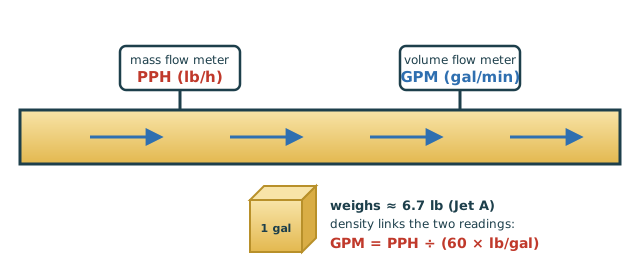
Fuel flow is measured two ways. Mass flow, in pounds per hour (PPH), is what an engine burns, because the energy in fuel comes from its mass. Volume flow, in gallons per minute (GPM), is what pumps, valves and many flow meters handle.
Density links the two. It is the weight of one gallon, about 6.7 lb for jet fuel. Density changes with temperature: warm fuel is lighter, so the same PPH takes more GPM.
Every Unit Cancels
Written out with every unit, the conversion is a chain of factors that each equal one. Every unit cancels except gallons per minute:
None of the constants is a rounded measurement. The pound and the inch are defined exactly in SI units (1 lb = 0.45359237 kg and 1 in = 0.0254 m), the US gallon is defined as exactly 231 in³, and an hour is 60 minutes. That makes 27,679.90471 kg/m³ exactly one pound per cubic inch:
The only inputs that carry real uncertainty are the specific gravity and the water density it is referenced to.
Converting PPH ↔ GPM
With the density in pounds per gallon, the factor of 60 converts hours to minutes:
10,000 PPH of jet fuel with SG = 0.80, referenced to water at 60 °F (999.0 kg/m³):
Density & Specific Gravity Conversions
Specific gravity (SG) is the fluid's density divided by the density of water. It has no units, which makes it easy to quote, but it is only exact once you know which water it is compared to.
Water is 999.0 kg/m³ at 60 °F and 1,000.0 kg/m³ at 4 °C. Fuel specifications usually quote SG at 60 °F. The water-density-compensated calculators compare against water at the fluid's own temperature instead. See why specific gravity is a contentious unit.
| Unit | Equals |
|---|---|
| 1 lb/in³ | 27,679.9 kg/m³ |
| 1 lb/gal (US) | 119.83 kg/m³ |
| 1 lb/ft³ | 16.018 kg/m³ |
| 1 US gallon | 231 in³ = 3.7854 L |