.png)
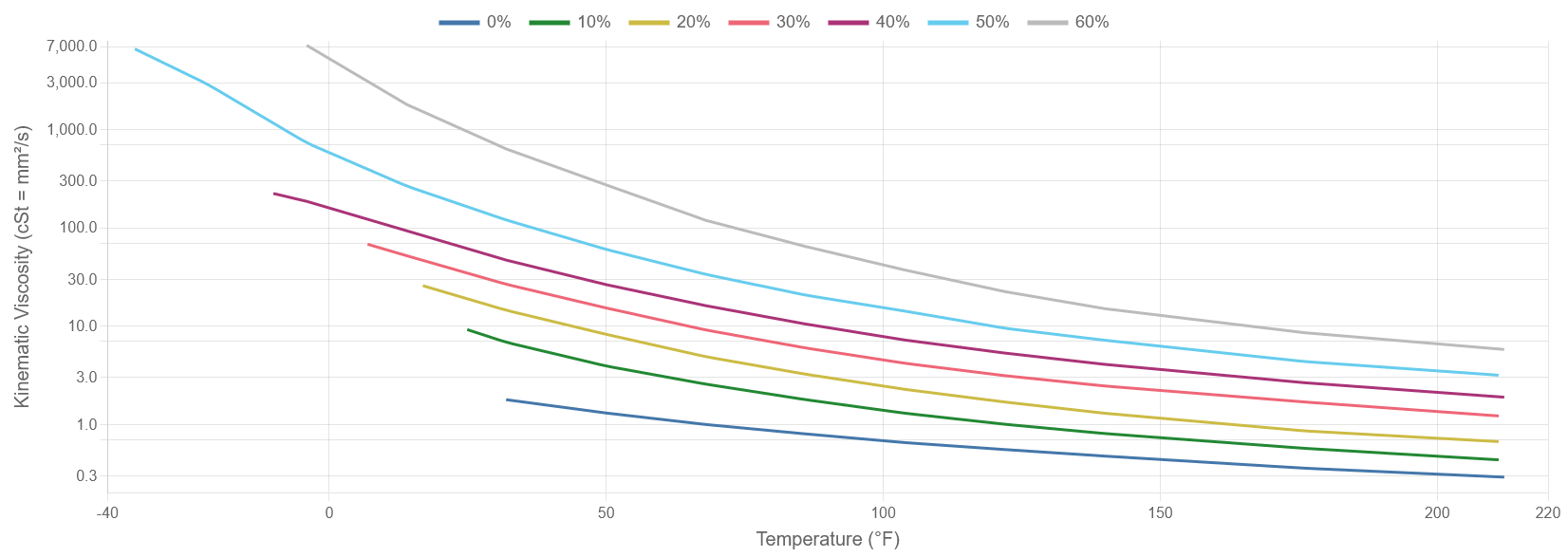
Dynamic (absolute) viscosity (μ) measures a fluid's resistance to shear flow. It is reported in mPa·s (millipascal-seconds), equivalent to cP (centipoise). Newton's law of viscosity is:
τ = μ × (du / dy)
where τ is shear stress and du/dy is the velocity gradient perpendicular to flow.
Ethylene glycol viscosity increases dramatically at low temperatures, especially at higher concentrations. This affects pressure drop, pump power requirements, and — critically — flow regime. The Reynolds number determines whether flow is laminar or turbulent:
Re = ρ × v × D / μ
At low temperatures, high viscosity pushes systems into laminar flow (Re < 2300), where heat transfer efficiency drops sharply. Ethylene glycol is more viscous than propylene glycol at equivalent concentrations below 0 °C, so pump curves must be re-evaluated whenever glycol is added to a system sized for water.
Note: Viscosity is highly temperature-dependent. Always check viscosity at the lowest expected operating temperature, not just at design conditions.