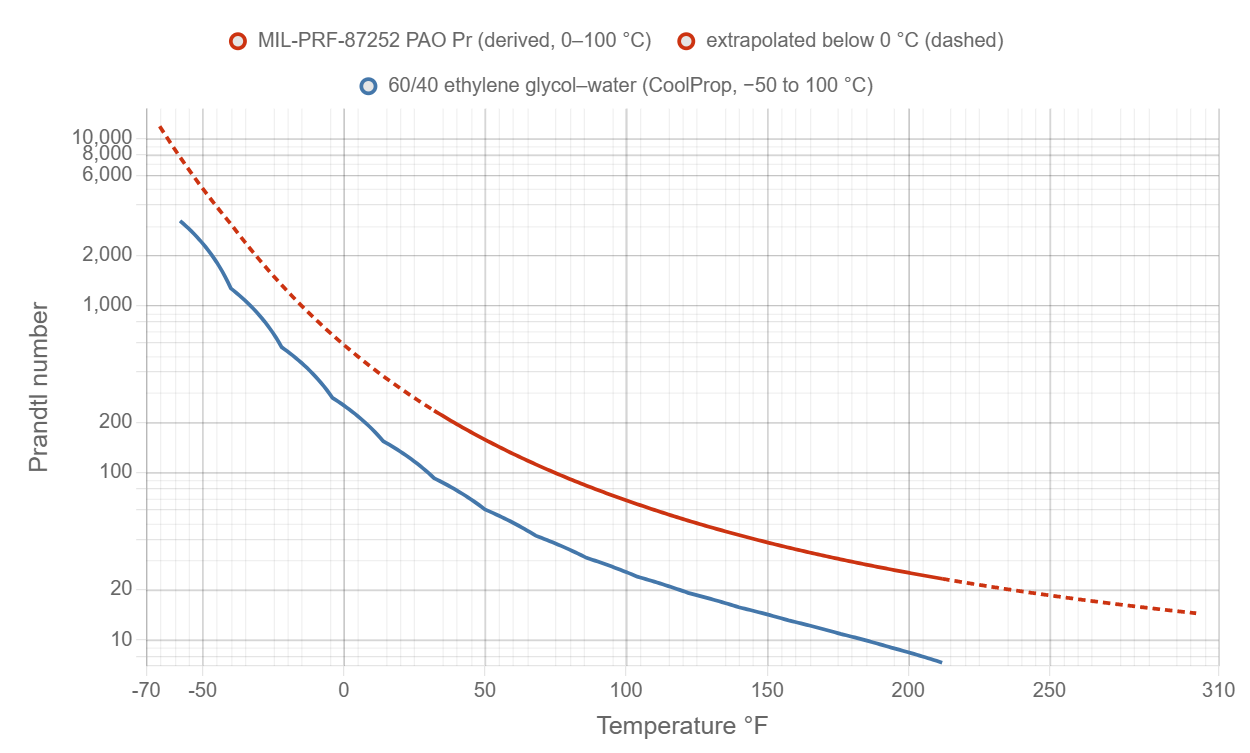
MIL-PRF-87252 Prandtl Number Chart
MIL-PRF-87252 PAO coolant Prandtl number versus temperature chart compared with 60/40 ethylene glycol and water

Canvas Element Not Working, Please Check Browser Settings or Contact KasperCalc to fix the issue.

About the data: no government report or journal paper with measured MIL-PRF-87252 properties was found. The Prandtl number is derived from manufacturer typical viscosity, density, specific heat and thermal conductivity values from one table (ROYCO 602 data sheet, identical in the AeroShell Fluid 602 listing). There are no measured Prandtl values, and no uncertainty is stated.

The Y axis is logarithmic. The solid red line is valid only from 0 to 100 °C (32 to 212 °F), where density, viscosity, specific heat and conductivity all come from sheet data. The dashed parts are extrapolated: below 0 °C (density, then cp and k below −17.8 °C) and above 100 °C (viscosity). Pr at −40 °C is therefore an estimate.

The blue line is 60/40 ethylene glycol–water from CoolProp, drawn from −50 °C to 100 °C only.

Data from: ROYCO 602 data sheet (ANDEROL, 2004) and AeroShell Fluid 602 (AeroShell Book, 2003); comparison from CoolProp 7.2.0 (Melinder 2010).

Toggle data sets by clicking the legend.

MIL-PRF-87252 Prandtl Number Calculator
Degrees (°F):
Degrees (°C):
Prandtl Number (Pr):  
μ (mPa·s):  
cp (kJ/kg·K):  
λ (W/m·K):  
Data basis:  
60/40 EG-water Pr:  

Calculator valid −54 °C to 150 °C (−65.2 °F to 302 °F), atmospheric pressure. Pr = μ·cp/k. The “Data basis” row says Extrapolated outside 0–100 °C. The glycol row is shown only from −50 to 100 °C.

Prandtl Number of MIL-PRF-87252 PAO Coolant
What Is the Prandtl Number?

The Prandtl number compares how fast momentum diffuses with how fast heat diffuses: Pr = μ·cp / k = ν / αIt appears in every convection correlation, such as the Dittus-Boelter and Sieder-Tate equations for flow in tubes. A high Pr means the fluid is viscous compared with how well it conducts heat, so you need turbulence or a high flow rate to get good heat transfer.

About This Data

Pr here is computed from the ROYCO 602 sheet: μ from the kinematic viscosity and density, cp and k from their linear fits. See the viscosity, specific heat, thermal conductivity and density pages for each input and its limits. All inputs are manufacturer typical values for one product.

Pr is 112 at 20 °C, 65 at 40 °C and 23 at 100 °C. It rises steeply as the fluid cools, about 27 times higher at −40 °C than at 20 °C (an estimate that relies on extrapolated density, cp and k). Use it with pipe velocity and the LMTD calculator when you size a cold plate or heat exchanger.

MIL-PRF-87252 PAO Coolant — Prandtl Number vs. Temperature
Temp (°C)Temp (°F)ν (cSt)ρ (kg/m³)μ (mPa·s)cp (kJ/(kg·K))k (W/(m·K))Pr
-54-65.21087.0840.6*913.697*1.9338*0.1500*11779*
-40-40.0277.0831.6*230.363*1.9820*0.1486*3072*
-20-4.058.27818.8*47.708*2.0510*0.1466*667.3*
032.019.95805.816.0722.11990.1446235.6
2068.09.23792.77.3202.18880.1426112.3
40104.05.19779.54.0462.25770.140664.9
60140.03.30766.22.5292.32670.138742.4
80176.02.30752.81.7342.39560.136730.4
100212.01.72739.21.2712.46450.134723.3
120248.01.35*725.50.980*2.53340.132718.7*
150302.01.01*704.80.712*2.63680.129714.5*

Pr = μ·cp/k, all inputs from the ROYCO 602 sheet fits. “*” marks an input or result that rests on extrapolation: ρ below 0 °C, cp and k below −17.8 °C, ν above 100 °C. Pr is measured-range only from 0 to 100 °C. There are no measured Pr values; the sheets give none.

MIL-PRF-87252 vs 60/40 Ethylene Glycol–Water

At 20 °C the PAO coolant has Pr = 112 and 60/40 glycol–water has Pr = 42. Both are high, so the thermal boundary layer is much thinner than the velocity boundary layer. The PAO coolant is about 2.7 times higher, mostly because of its low thermal conductivity and its stronger viscosity rise in the cold.

Temp (°C)Temp (°F)PAO coolant PrMEG-60 PrPAO / MEG-60
-50-58.07712*32072.4×
-40-40.03072*12652.4×
-20-4.0667.3*280.72.4×
032.0235.692.92.5×
2068.0112.342.12.7×
40104.064.923.92.7×
60140.042.415.72.7×
80176.030.410.92.8×
100212.023.37.33.2×

“*” marks PAO values outside 0–100 °C. MEG-60 values are CoolProp 7.2.0 (Melinder 2010), valid here from −50 to 100 °C only.

Sources
  • ANDEROL Inc., ROYCO 602 Coolant for Aircraft Avionics Systems data sheet (edited 19 Oct 2004). Royco602.pdf. Manufacturer typical values: viscosity, density, specific heat and thermal conductivity used to derive Pr.. Opened and read 25 Oct 2026.
  • Shell Aviation, AeroShell Fluid 602, The AeroShell Book, Edition 18 (2003), pp. 240–243. AeroShellfluid602.pdf. same property tables. Opened and read 25 Oct 2026.
  • CoolProp 7.2.0, incompressible fluid INCOMP::MEG[0.6] (60 % ethylene glycol in water by mass), 1 atm. coolprop.org/fluid_properties/Incompressibles.html. The CoolProp page cites Å. Melinder, Properties of Secondary Working Fluids for Indirect Systems, IIF-IIR Publishing, 2010, as the source of the MEG data (Tmin −100 °C, Tmax 100 °C, mass fraction 0 to 0.60). The Melinder book itself was not opened. Pr of the comparison fluid.

No measured Prandtl numbers exist for this fluid in the sources used. Values are derived from typical inputs and are extrapolated outside 0–100 °C.

Cite This Work