MIL-PRF-87252 Density Chart
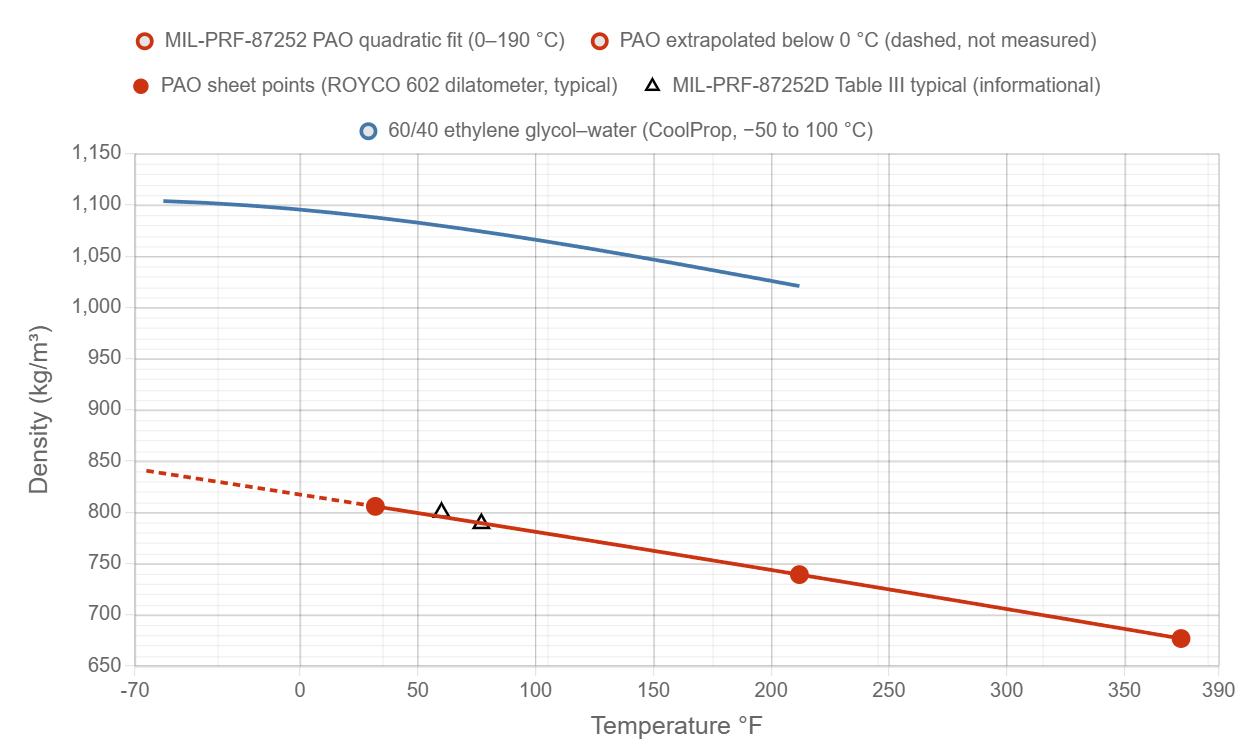
MIL-PRF-87252 PAO coolant density versus temperature chart in kg/m3 compared with 60/40 ethylene glycol and water

Canvas Element Not Working, Please Check Browser Settings or Contact KasperCalc to fix the issue.

About the data: no government report or journal paper with measured MIL-PRF-87252 properties was found. All density values on this page are manufacturer typical values from one table (ROYCO 602 data sheet, identical in the AeroShell Fluid 602 listing). They are not specification limits and carry no stated uncertainty. MIL-PRF-87252D itself only gives informational “typical” values.

Sheet values: 0 °C to 190 °C (32 °F to 374 °F), three dilatometer points. The solid red line is a quadratic through those points. The dashed red line below 0 °C (32 °F) is extrapolated and is not measured data.

Circles are the three ROYCO 602 dilatometer points. Triangles are MIL-PRF-87252D Table III typical specific gravities (informational). The blue line is 60/40 ethylene glycol–water by mass from CoolProp, drawn from −50 °C to 100 °C only.

Data from: ROYCO 602 data sheet (ANDEROL, 2004) and AeroShell Fluid 602 (AeroShell Book, 2003); MIL-PRF-87252D Table III; comparison from CoolProp 7.2.0 (Melinder 2010).

Toggle data sets by clicking the legend.

MIL-PRF-87252 Density Calculator
Degrees (°F):
Degrees (°C):
Density (kg/m³):  
Density (g/cm³):  
Density (lb/in³):  
Density (lb/gal):  
Density (lb/ft³):  
Specific Gravity*:  
Data basis:  
60/40 EG-water (kg/m³):  

Calculator valid −54 °C to 190 °C (−65.2 °F to 374 °F), atmospheric pressure. Below 0 °C the “Data basis” row says Extrapolated. The glycol row is shown only from −50 to 100 °C.

Specific Gravity is a Contentious Unit

* SG based on a static water density of 1000 (kg/m³) *

Density of MIL-PRF-87252 PAO Dielectric Coolant
About This Data

MIL-PRF-87252 covers a hydrolytically stable, dielectric synthetic-hydrocarbon coolant for electronics, radar and avionics. It is a polyalphaolefin (PAO) fluid, NATO code S-1748, for use from −54 °C to 200 °C. The specification sets no density limit. It lists a typical specific gravity of 0.800 at 15.6 °C in Table III, as information only.

The temperature data are the three dilatometer densities printed on the ROYCO 602 data sheet: 0.8058, 0.7392 and 0.6768 g/cm³ at 0, 100 and 190 °C. The AeroShell Fluid 602 listing repeats the same numbers. They are typical values for one product, with no uncertainty stated.

The curve is the exact quadratic through those three points, ρ = 805.80 − 0.65161·T − 1.439e-04·T² kg/m³. It is solid from 0 to 190 °C. Below 0 °C it is an extrapolation of the same quadratic. Coolant systems often run at −40 °C, so expect the real density there to differ a little from the dashed line.

Use density to convert flow rates. A volumetric flow in gal/min times the density gives a mass flow, which you then multiply by the specific heat and the temperature rise to get the heat load. See also viscosity, thermal expansion (how much the fluid grows when it warms) and pipe velocity.

MIL-PRF-87252 PAO Coolant — Density vs. Temperature
Temp (°C)Temp (°F)Sheet density (g/cm³)Sheet density (kg/m³)Quadratic fit (kg/m³)
032.00.8058805.8805.8
100212.00.7392739.2739.2
190374.00.6768676.8676.8

Sheet columns are the ROYCO 602 “Density, gm/cc, Dilatometer” entries, repeated in the AeroShell Fluid 602 listing. They are manufacturer typical values with no stated uncertainty. The fit is exact at these three points.

Temp (°C)Temp (°F)Density (kg/m³)Density (g/cm³)Density (lb/gal)Density (lb/ft³)Basis
-54-65.2840.6*0.8406*7.015*52.47*Extrapolated
-40-40.0831.6*0.8316*6.940*51.92*Extrapolated
-20-4.0818.8*0.8188*6.833*51.11*Extrapolated
032.0805.80.80586.72550.30Measured range (fit)
2068.0792.70.79276.61549.49Measured range (fit)
40104.0779.50.77956.50548.66Measured range (fit)
60140.0766.20.76626.39447.83Measured range (fit)
80176.0752.80.75286.28246.99Measured range (fit)
100212.0739.20.73926.16946.15Measured range (fit)
120248.0725.50.72556.05545.29Measured range (fit)
150302.0704.80.70485.88244.00Measured range (fit)

“*” marks values extrapolated below the lowest dilatometer point (0 °C). Fit: ρ = 805.80 − 0.65161·T − 1.439e-04·T² kg/m³ (T in °C), measured range 0–190 °C.

Manufacturer and Specification Typical Values (not measurements)
SourcePrinted valueTemp (°C)Density (kg/m³)
ROYCO 602 (ANDEROL 2004)Specific gravity 0.7999 (ASTM D1298); API gravity 45.315.6799.9 (SG × 1000)
AeroShell Fluid 602 (2003)Relative density 0.799 at 15.6/15.6 °C15.6799 (SG × 1000)
ROYCO 602 (LANXESS 2020)6.66 lb/gal; API gravity 45.4 (temperature not stated)not stated798.0
MIL-PRF-87252D Table IIISpecific gravity 0.800 at 15.6 °C (60 °F)15.6800 (SG × 1000)
MIL-PRF-87252D Table IIISpecific gravity 0.789 at 25 °C (77 °F)25789 (SG × 1000)

These are typical values, not limits. MIL-PRF-87252D sets no density requirement. SG values are multiplied by 1000 here and not corrected for the density of water (a difference below 0.3 %). The fit gives 795.6 kg/m³ at 15.6 °C and 789.4 at 25 °C, so it agrees with the sheet within 0.6 %.

MIL-PRF-87252 vs 60/40 Ethylene Glycol–Water

The PAO coolant is about 26 % lighter than 60/40 glycol–water at 20 °C (793 vs 1077 kg/m³). The glycol mixture is a common alternative coolant, see ethylene glycol properties. This matters when you size pumps and when you convert a flow in gallons per minute into a mass flow.

Temp (°C)Temp (°F)PAO coolant (kg/m³)MEG-60 (kg/m³)MEG-60 minus PAO (kg/m³)PAO lighter by
-50-58.0838.0*1103.8265.824.1 %
-40-40.0831.6*1102.1270.424.5 %
-20-4.0818.8*1096.3277.525.3 %
032.0805.81087.9282.125.9 %
2068.0792.71077.1284.426.4 %
40104.0779.51064.6285.126.8 %
60140.0766.21050.8284.627.1 %
80176.0752.81036.0283.327.3 %
100212.0739.21020.8281.627.6 %

PAO values use the quadratic fit; “*” marks extrapolation below 0 °C. MEG-60 values are CoolProp 7.2.0 (Melinder 2010), 1 atm, valid here from −50 to 100 °C only.

Sources
  • ANDEROL Inc., ROYCO 602 Coolant for Aircraft Avionics Systems data sheet (edited 19 Oct 2004). Royco602.pdf. Manufacturer typical values: dilatometer density at 0, 100 and 190 °C; specific gravity 0.7999.. Opened and read 25 Oct 2026.
  • Shell Aviation, AeroShell Fluid 602, The AeroShell Book, Edition 18 (2003), pp. 240–243. AeroShellfluid602.pdf. same density table; relative density 0.799. Opened and read 25 Oct 2026.
  • LANXESS, ROYCO 602 Aviation Performance Fluid Product Data Sheet, edition 2020-10-26. LANXESS_ROYCO_602_EMEA_EN.pdf. density 6.66 lb/gal (no temperature given). Opened and read 25 Oct 2026.
  • US Department of Defense, MIL-PRF-87252D, Performance Specification: Coolant Fluid, Hydrolytically Stable, Dielectric, 23 November 2015. everyspec.com. Table III (p.8) typical specific gravity; no density limit in Table I. Opened and read 25 Oct 2026.
  • CoolProp 7.2.0, incompressible fluid INCOMP::MEG[0.6] (60 % ethylene glycol in water by mass), 1 atm. coolprop.org/fluid_properties/Incompressibles.html. The CoolProp page cites Å. Melinder, Properties of Secondary Working Fluids for Indirect Systems, IIF-IIR Publishing, 2010, as the source of the MEG data (Tmin −100 °C, Tmax 100 °C, mass fraction 0 to 0.60). The Melinder book itself was not opened. Density of the comparison fluid.

No measured density series from a government report or journal paper was found for this fluid. The sheet gives no uncertainty. Values below 0 °C are extrapolated.

Cite This Work