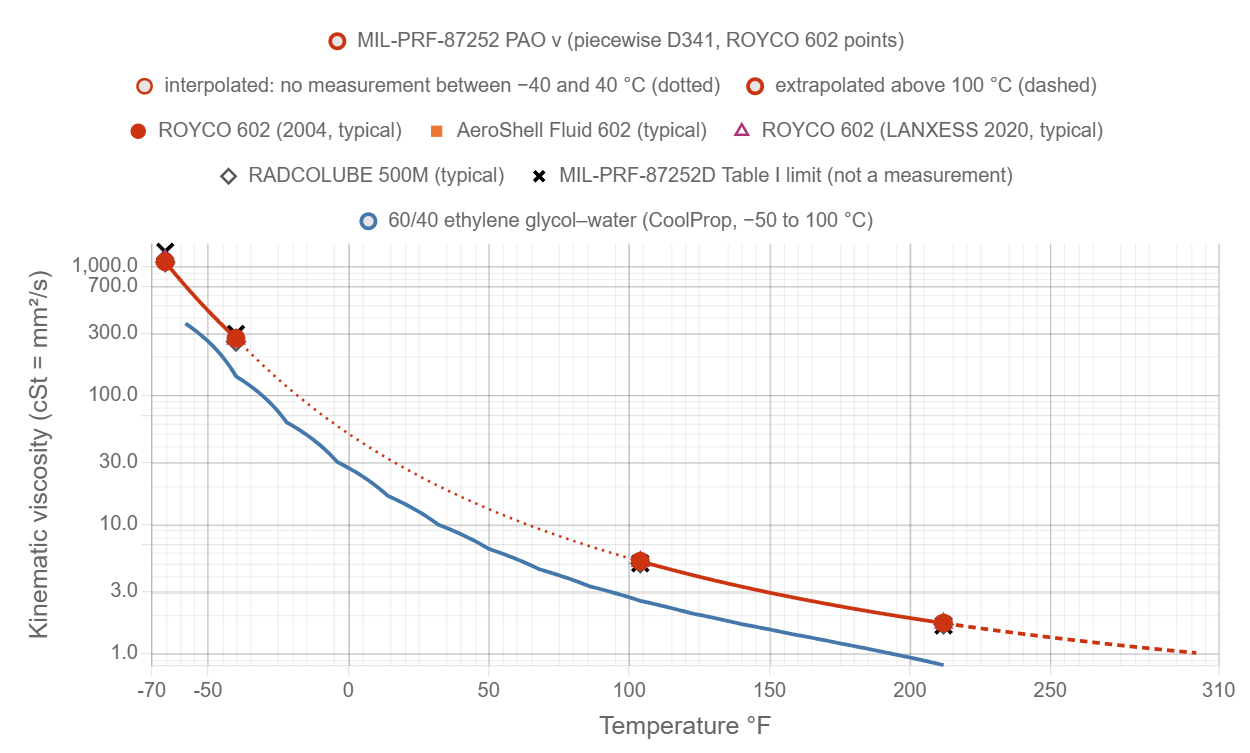
MIL-PRF-87252D limits the kinematic viscosity to 1300 mm²/s at −54 °C and 300 at −40 °C (maximums), with minimums of 5.0 at 40 °C and 1.65 at 100 °C (Table I, p.5). The fluid is a low-viscosity PAO, about 5 mm²/s at 40 °C with a viscosity index near 145, so it stays pumpable at −54 °C.
Four product data sheets give typical values at those same four temperatures: ROYCO 602 (ANDEROL 2004 and LANXESS 2020), AeroShell Fluid 602 and RADCOLUBE 500M (qualified to MIL-PRF-87252E). They are single-lot typical values with no uncertainty. The curve follows the 2004 ROYCO 602 sheet because it is the same sheet that gives density, specific heat and conductivity.
The curve is a piecewise ASTM D341 interpolation: between neighbouring sheet points it is a straight line in Y = log10(log10(ν + 0.7)) against X = log10(T°C + 273.15), with ν in cSt. It passes exactly through the four points. A single D341 line through all four misfits by up to 9 %, so it is not used. Between −40 and 40 °C there is no measurement, so values there are interpolation only. Above 100 °C the last segment is extended and marked as extrapolated.
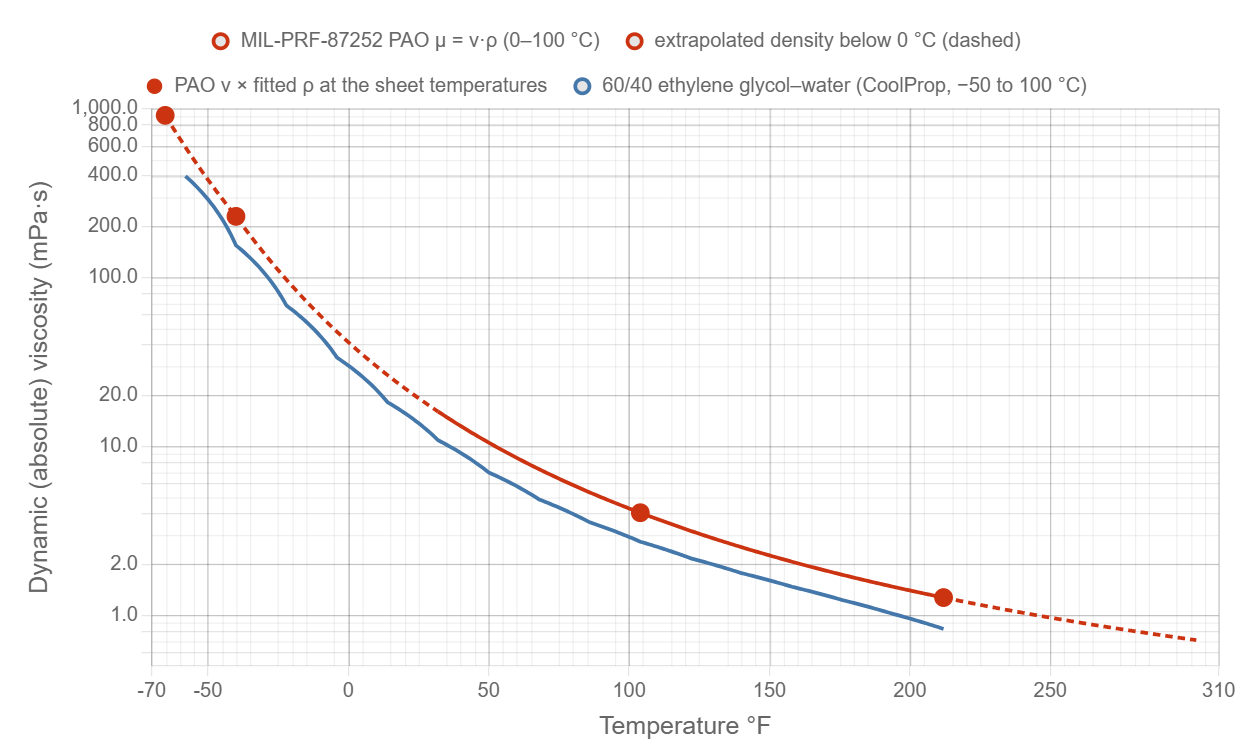
Dynamic viscosity is ν times density. The density fit starts at 0 °C, so dynamic viscosity below 0 °C is flagged as extrapolated. See density, the Prandtl number, and pipe velocity and orifice flow for line sizing. For glycol–water see ethylene glycol viscosity.