Fluid Velocity in Pipe Calculator — Flow Rate and Pipe Diameter to Velocity
*Velocity = Flow Rate ÷ Pipe Cross-Sectional Area. Assumes the pipe is flowing full (no dead air space).*
Flow Velocity in a Pipe
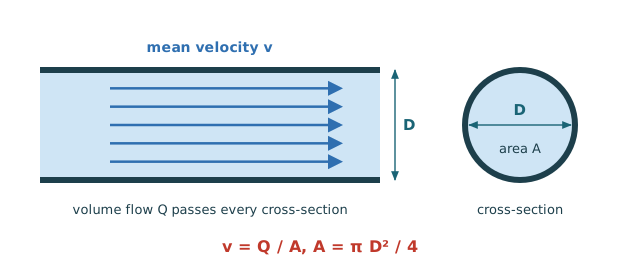
Liquid moving through a full pipe has to pass through the pipe's open cross-section. For a given volume flow, a smaller pipe means a smaller area, so the liquid must move faster to get the same volume through each second.
\(v\) is the mean velocity across the pipe, \(Q\) the volumetric flow rate, \(A\) the open area and \(D\) the pipe's inside diameter. Use the actual ID from the pipe schedule, not the nominal size.
Every Unit Cancels
In US units, with flow in gallons per minute and the inside diameter in inches, every unit cancels down to feet per second:
The inch units cancel as \(\text{in}^3 / (\text{in}^2 \cdot \text{in}) = 1\), leaving feet per second.
Collecting the constants gives a handy shortcut, exact to the digits shown because 231 in³, 60 s and 12 in are all exact:
What Does a Given Velocity Feel Like?
A velocity by itself (2 ft/sec, 20 ft/sec) is hard to picture. The table below lines up this calculator's default unit, feet per second, against things people have actually felt hit their hand. The first few rows are ordinary supply-line velocities, the same kind of number this calculator solves for. Everything from the squirt gun down is a nozzle exit velocity — the same fluid, moving much faster because it's being forced through a much smaller opening (this is the same v = Q/A relationship the calculator above uses, just with a tiny A). Ranges are rough, physics-based estimates from typical operating pressures, not manufacturer specs.
| Example | Typical velocity (ft/s) | Notes |
|---|---|---|
| Municipal water main | 2 – 5 | Typical distribution-system design velocity, in the actual supply pipe |
| Bathroom/kitchen faucet | 3 – 6 | Ordinary indoor plumbing fixture flow, in the supply pipe |
| Human walking pace (for scale, not a fluid) | ~4.5 | A brisk walk is about 3 mph — useful as a gut-check reference speed |
| Garden hose (5/8″ hose, spigot flow, no nozzle) | 5 – 8 | Full flow straight from the spigot, before any nozzle narrows it further |
| Aircraft jet fuel transfer/feed line | 3 – 10 | Kept moderate in part to limit electrostatic charge generation in the fuel |
| Squirt gun / water pistol nozzle | ~50 – 80 | A hand-pumped reservoir at ~20–40 psi, forced through a pinhole nozzle |
| Water flosser tip (e.g. Waterpik-style) | ~40 – 115 | Spans the full low-to-high pressure dial, ~10–90 psi through a fine tip |
| Pump-action toy water blaster (e.g. Super Soaker–style) | ~75 – 110 | A pressurized air/water chamber pushes harder than a simple hand-pump squirt gun |
| Fire hose attack line nozzle | ~85 – 120 | Nozzle pressure around 50–100 psi — enough to knock a person down |
| Consumer electric pressure washer nozzle | ~440 – 545 | Roughly 1,300–2,000 psi — this is what strips paint and skin |
| Commercial/gas pressure washer nozzle | ~630 – 770 | Roughly 3,000–4,000 psi, used for stripping concrete and heavy equipment |
| Ultra-high-pressure waterjet cutting stream | ~2,500 – 3,000 | ~60,000 psi water jet exiting the nozzle — roughly Mach 2–3, cuts steel |