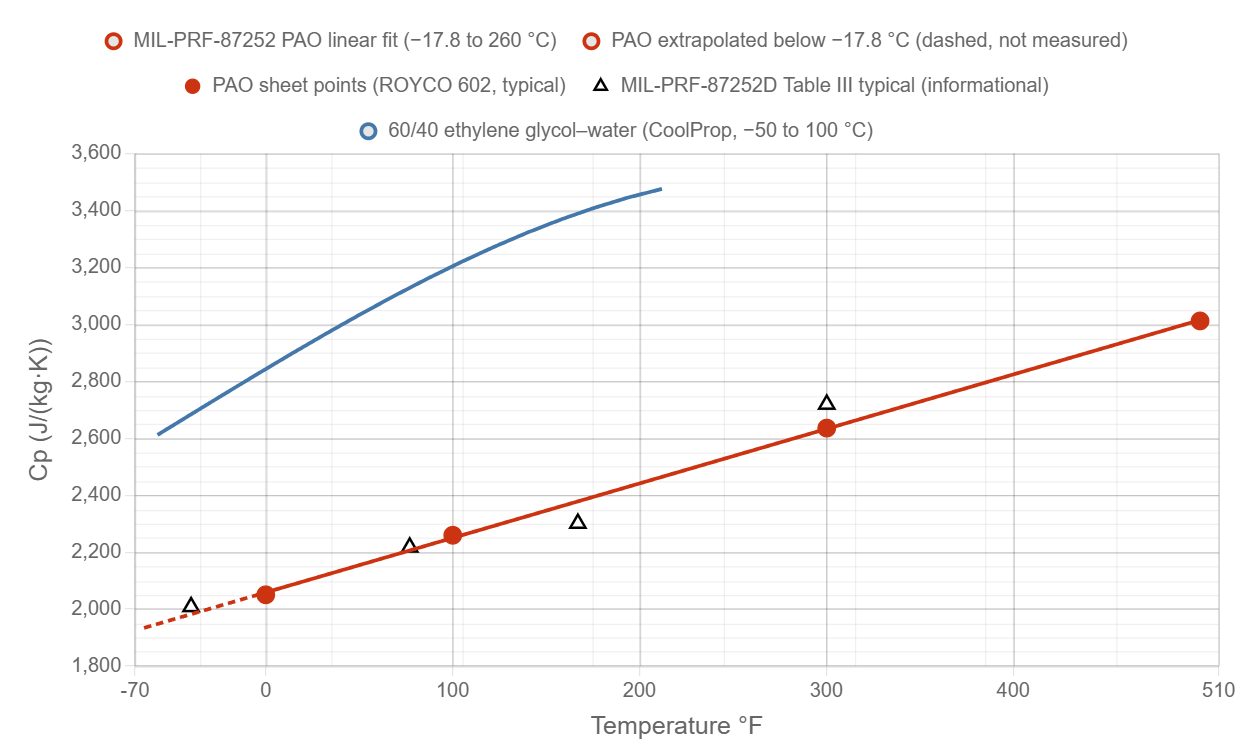
Specific heat capacity (Cp) is the heat needed to raise the temperature of one unit of mass by one degree at constant pressure. For this coolant it is given in J/(kg·K) [SI] or Btu/(lbm·°F) [US]. For a coolant it is the most important property, because it sets how much fluid you must pump to carry away a heat load:
Q = ṁ · Cp · ΔT
where Q is the heat flow (W or Btu/h), ṁ is the mass flow (kg/s or lb/h) and ΔT is the temperature rise of the coolant (K or °F).
Example. An avionics rack puts 5 kW (17,060 Btu/h) into the coolant, and the loop is designed for a 10 K (18 °F) rise at a mean temperature of 40 °C (104 °F). At 40 °C the Cp is 2258 J/(kg·K) (0.539 Btu/(lb·°F)) and the density is 780 kg/m³. The mass flow is ṁ = 5000 / (2258 × 10) = 0.221 kg/s (797 kg/h, 1758 lb/h). The volume flow is 0.284 L/s, or 4.5 gal/min. 60/40 glycol–water needs only 0.155 kg/s and 2.3 gal/min for the same job. Use the same method with the LMTD calculator to size the heat exchanger that rejects the load.
The specific heat values are the four entries of the ROYCO 602 data sheet, tested by ASTM D2766: 0.49, 0.54, 0.63 and 0.72 cal/(g·°C) at −17.8, 37.8, 149 and 260 °C (0, 100, 300 and 500 °F). The AeroShell Fluid 602 listing repeats the same table. They are manufacturer typical values for one product with no stated uncertainty. No government or journal measurement was found.
The curve is the straight-line fit Cp = 2119.89 + 3.4461·T J/(kg·K), solid from −17.8 to 260 °C and dashed (extrapolated) below. It departs from the sheet values by at most 9.2 J/(kg·K). Cp rises almost linearly with temperature, from about 1982 at −40 °C to 2464 at 100 °C.
MIL-PRF-87252D Table III gives its own typical values (0.48 at −40 °C, 0.53 at 25 °C, 0.55 at 75 °C, 0.65 at 149 °C). They are shown as separate markers and are not averaged with the sheet values. See also density, thermal conductivity, Prandtl number and the general properties page. For glycol–water see ethylene glycol heat capacity.