MIL-PRF-87252 Thermal Conductivity Chart
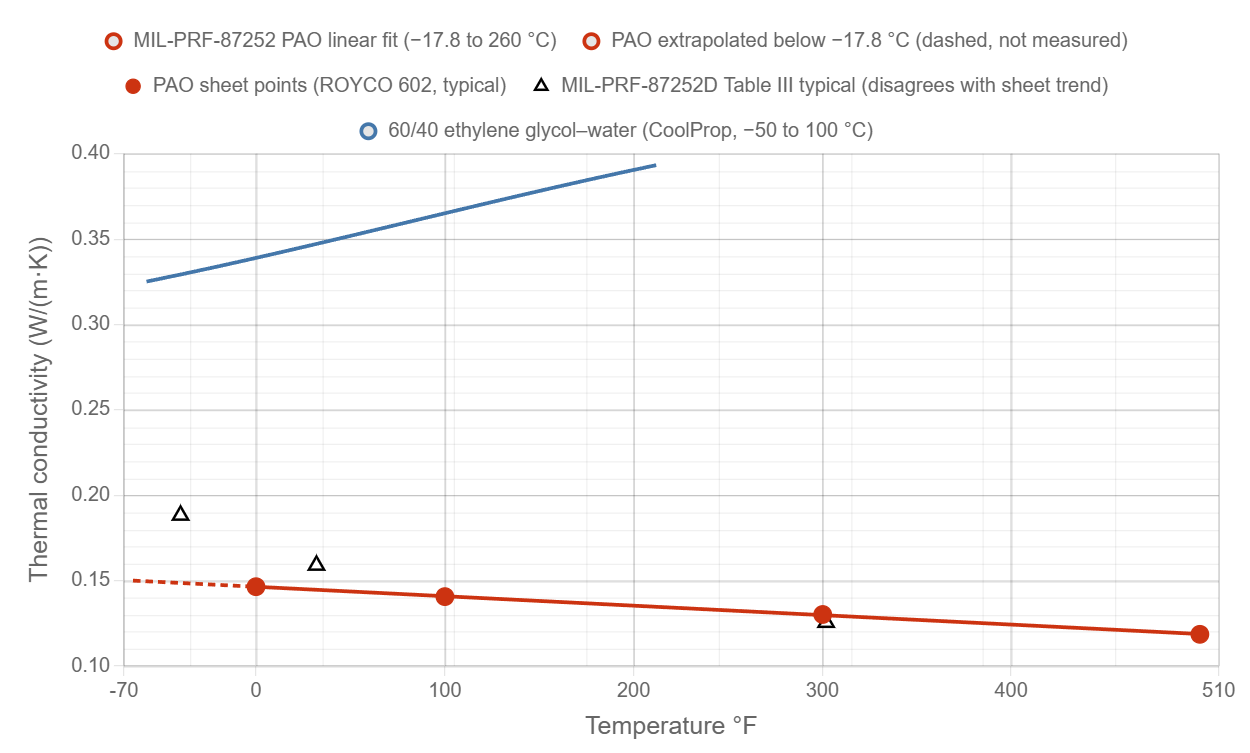
MIL-PRF-87252 PAO coolant thermal conductivity versus temperature chart in W/m-K compared with 60/40 ethylene glycol and water

Canvas Element Not Working, Please Check Browser Settings or Contact KasperCalc to fix the issue.

About the data: no government report or journal paper with measured MIL-PRF-87252 properties was found. All thermal conductivity values on this page are manufacturer typical values from one table (ROYCO 602 data sheet, identical in the AeroShell Fluid 602 listing). They are not specification limits and carry no stated uncertainty. MIL-PRF-87252D itself only gives informational “typical” values.

Sheet values: −17.8 °C to 260 °C (0 °F to 500 °F), four points. The solid red line is a straight-line fit. The dashed red line below −17.8 °C (0 °F) is extrapolated.

Circles are the ROYCO 602 sheet points. Triangles are the MIL-PRF-87252D Table III typical values (informational). Table III disagrees with the sheet trend at low temperature (0.188 W/(m·K) at −40 °C against about 0.15 from the sheet fit). The two are not averaged. The blue line is 60/40 ethylene glycol–water from CoolProp, drawn from −50 °C to 100 °C only.

Data from: ROYCO 602 data sheet (ANDEROL, 2004) and AeroShell Fluid 602 (AeroShell Book, 2003); MIL-PRF-87252D Table III; comparison from CoolProp 7.2.0 (Melinder 2010).

Toggle data sets by clicking the legend.

MIL-PRF-87252 Thermal Conductivity Calculator
Degrees (°F):
Degrees (°C):
W / (m·K):  
mW / (m·K):  
BTU / (h·ft·°F):  
BTU·in / (h·ft²·°F):  
W / (cm·K):  
Data basis:  
60/40 EG-water (W / (m·K)):  

Calculator valid −54 °C to 260 °C (−65.2 °F to 500 °F), atmospheric pressure, using the linear fit to the sheet values. Below −17.8 °C the “Data basis” row says Extrapolated. The specification Table III values are not used in the calculator. The glycol row is shown only from −50 to 100 °C.

Thermal Conductivity of MIL-PRF-87252 PAO Coolant
About This Data

The conductivity values are the four entries of the ROYCO 602 data sheet: 1.26, 1.21, 1.12 and 1.02 cal/(hr·cm·°C) at −17.8, 37.8, 149 and 260 °C. In SI units that is 0.146, 0.141, 0.130 and 0.119 W/(m·K). The AeroShell Fluid 602 listing repeats the table and names a heat probe method. They are manufacturer typical values for one product. No government or journal measurement was found.

The curve is the straight line k = 0.14463 -9.962e-05·T W/(m·K). It is solid from −17.8 to 260 °C and dashed below. The conductivity falls slowly as the fluid warms, which is normal for a hydrocarbon oil.

MIL-PRF-87252D Table III lists its own typical values: 4.5×10⁻⁴, 3.8×10⁻⁴ and 3.0×10⁻⁴ cal·cm/(s·cm²·°C) at −40, 0 and 150 °C, which is 0.188, 0.159 and 0.126 W/(m·K). At −40 °C that is about 27 % above the sheet-fit extrapolation. We do not know which is closer to the truth, so both are shown and neither is adjusted. Use density and specific heat with these values to get the thermal diffusivity.

MIL-PRF-87252 PAO Coolant — Thermal Conductivity vs. Temperature
Temp (°C)Temp (°F)Sheet k (cal/(hr·cm·°C))Sheet k (W/(m·K))Sheet k (Btu/(hr·ft·°F))Linear fit (W/(m·K))
-17.8-0.01.260.14640.08460.1464
37.8100.01.210.14060.08130.1409
149300.21.120.13020.07520.1298
260500.01.020.11850.06850.1187

Sheet values are printed as cal/hr/cm²(°C/cm), which is the same as cal/(hr·cm·°C). The AeroShell Book listing names the method (heat probe). 1 cal/(hr·cm·°C) = 0.11622 W/(m·K). Fit: k = 0.14463 -9.962e-05·T W/(m·K). Typical values, no uncertainty stated.

Specification Typical Values
Temp (°C)Temp (°F)Table III (cal·cm/(s·cm²·°C))Table III (W/(m·K))Sheet-fit k (W/(m·K))Table III vs sheet fit
-40-40.04.5e-040.18830.1486*+26.7 %
032.03.8e-040.15900.1446+9.9 %
150302.03.0e-040.12550.1297-3.2 %

Table III of MIL-PRF-87252D (printed p.8) gives “typical (inherent)” values, informational only. They disagree with the ROYCO sheet trend at low temperature. The two sets are shown separately and are not averaged. The difference is large at −40 °C (27 %, where the sheet fit is extrapolated) and small at 150 °C. Treat low-temperature conductivity as uncertain by 20 % or more. 1 cal·cm/(s·cm²·°C) = 418.4 W/(m·K).

Temp (°C)Temp (°F)k (W/(m·K))k (mW/(m·K))k (Btu/(h·ft·°F))k (Btu·in/(h·ft²·°F))Basis
-54-65.20.1500*150.0*0.0867*1.040*Extrapolated
-40-40.00.1486*148.6*0.0859*1.030*Extrapolated
-20-4.00.1466*146.6*0.0847*1.017*Extrapolated
032.00.1446144.60.08361.003Measured range (fit)
2068.00.1426142.60.08240.989Measured range (fit)
40104.00.1406140.60.08130.975Measured range (fit)
60140.00.1387138.70.08010.961Measured range (fit)
80176.00.1367136.70.07900.948Measured range (fit)
100212.00.1347134.70.07780.934Measured range (fit)
120248.00.1327132.70.07670.920Measured range (fit)
150302.00.1297129.70.07490.899Measured range (fit)

“*” marks values extrapolated below the lowest sheet temperature (−17.8 °C).

MIL-PRF-87252 vs 60/40 Ethylene Glycol–Water

60/40 glycol–water conducts heat about 2.5 times as well as the PAO coolant at 20 °C (0.357 vs 0.143 W/(m·K)). Low conductivity, together with a high Prandtl number, makes the PAO coolant a weaker heat-transfer fluid in laminar flow.

Temp (°C)Temp (°F)PAO coolant (W/(m·K))MEG-60 (W/(m·K))MEG-60 minus PAO (W/(m·K))MEG-60 higher by
-50-58.00.1496*0.32510.1755117 %
-40-40.00.1486*0.32930.1807122 %
-20-4.00.1466*0.33800.1914131 %
032.00.14460.34720.2026140 %
2068.00.14260.35670.2140150 %
40104.00.14060.36620.2256160 %
60140.00.13870.37560.2370171 %
80176.00.13670.38470.2481182 %
100212.00.13470.39330.2586192 %

“*” marks extrapolated PAO values. MEG-60 values are CoolProp 7.2.0 (Melinder 2010), valid here from −50 to 100 °C only.

Sources
  • ANDEROL Inc., ROYCO 602 Coolant for Aircraft Avionics Systems data sheet (edited 19 Oct 2004). Royco602.pdf. Manufacturer typical values: thermal conductivity at −17.8, 37.8, 149 and 260 °C.. Opened and read 25 Oct 2026.
  • Shell Aviation, AeroShell Fluid 602, The AeroShell Book, Edition 18 (2003), pp. 240–243. AeroShellfluid602.pdf. same table; method stated as heat probe. Opened and read 25 Oct 2026.
  • US Department of Defense, MIL-PRF-87252D, Performance Specification: Coolant Fluid, Hydrolytically Stable, Dielectric, 23 November 2015. everyspec.com. Table III (p.8) typical thermal conductivity at −40, 0 and 150 °C; no requirement. Opened and read 25 Oct 2026.
  • CoolProp 7.2.0, incompressible fluid INCOMP::MEG[0.6] (60 % ethylene glycol in water by mass), 1 atm. coolprop.org/fluid_properties/Incompressibles.html. The CoolProp page cites Å. Melinder, Properties of Secondary Working Fluids for Indirect Systems, IIF-IIR Publishing, 2010, as the source of the MEG data (Tmin −100 °C, Tmax 100 °C, mass fraction 0 to 0.60). The Melinder book itself was not opened. Thermal conductivity of the comparison fluid.

The sheets give no uncertainty. Specification Table III and the sheet disagree at low temperature. Values below −17.8 °C are extrapolated.

Cite This Work