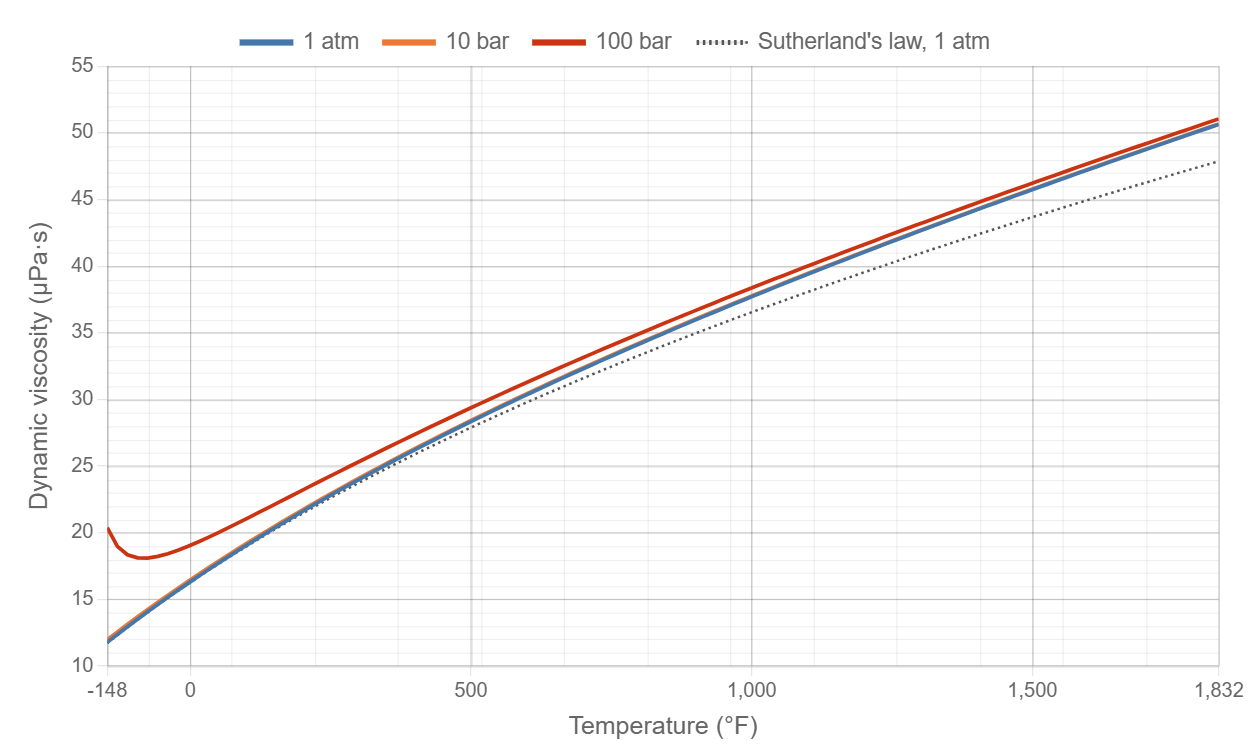
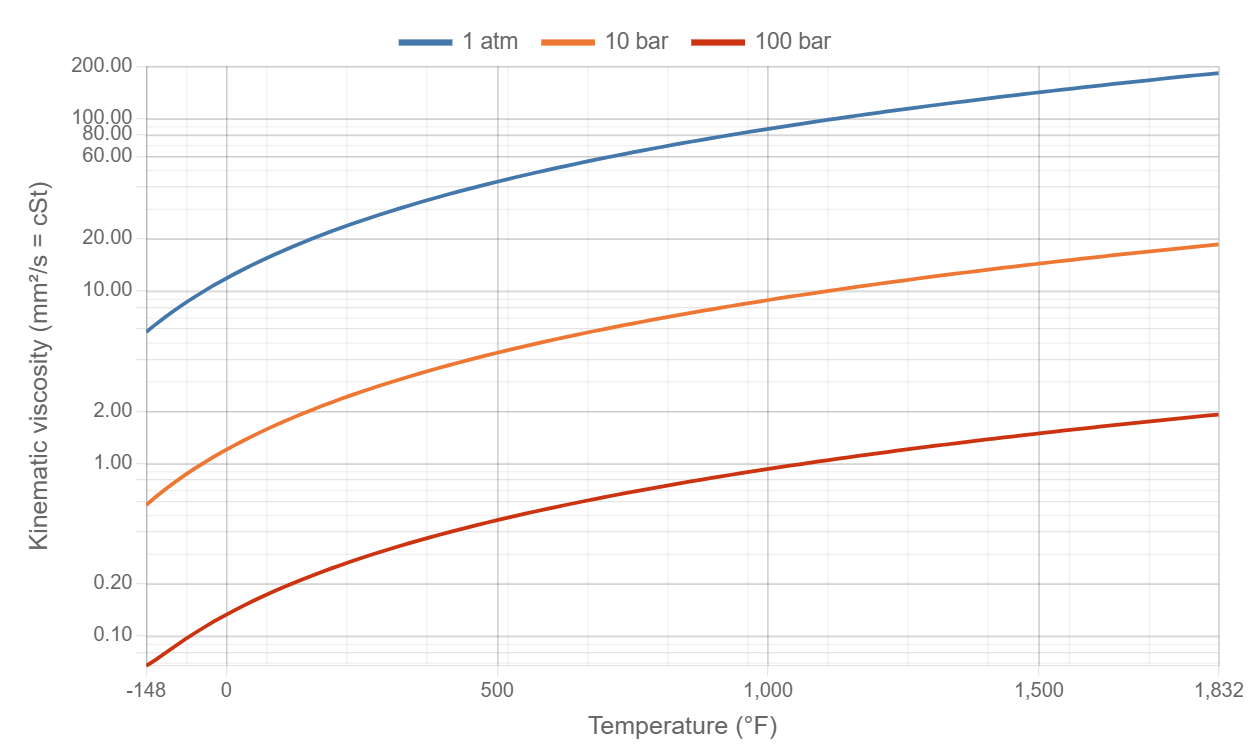
Dry air at 20 °C and 1 atm has a dynamic viscosity of 18.21 µPa·s (0.01821 cP) and a kinematic viscosity of 15.11 mm²/s. This page is for dry air.
Unlike a liquid, a gas gets more viscous as it gets hotter. Air viscosity rises with temperature by a factor of about 4 between −100 and 1000 °C. It barely changes with pressure below about 10 bar.
Dynamic (absolute) viscosity μ is the resistance to shear. Kinematic viscosity is μ divided by density:
ν = μ / ρ
Because air density changes with pressure and temperature, kinematic viscosity changes much more than dynamic viscosity. At 100 bar the kinematic viscosity is about 100 times lower than at 1 atm. Use μ for pressure drop and the Reynolds number in pipe velocity work. Use ν for flow around bodies and boundary layers. Density comes from the air density page.
Sutherland's law is a two-constant formula for gas viscosity:
μ = μ0 (T/T0)3/2 (T0 + S) / (T + S)
with μ0 = 1.716×10⁻⁵ Pa·s at T0 = 273.15 K and S = 110.4 K. S = 110.4 K and β = 1.458×10⁻⁶ kg/(s·m·K1/2) are the U.S. Standard Atmosphere 1976 constants (eq. 51). μ0 follows from them. Against CoolProp, Sutherland is -0.56 % at −100 °C, -0.40 % at 20 °C and -5.5 % at 1000 °C. It is good near ambient and drifts at high temperature. The Standard Atmosphere itself says the law fails at very high and very low temperatures.
Accuracy. Lemmon et al. (2000) state an uncertainty of about 0.1 % in density, 0.2 % in speed of sound and 1 % in heat capacity from the solidification point to 873 K (600 °C) and up to 70 MPa. Above 873 K there were no reliable air data, so nitrogen data were used and the paper gives about 0.5 % for density. Lemmon & Jacobsen (2004) state about 5 % for the viscosity and thermal conductivity of air, and more near the critical point. Viscosity and conductivity above about 600 °C, and the 1000 °C end of the range, are less certain than that. CoolProp uses a molar mass of 28.96546 g/mol, the U.S. Standard Atmosphere uses 28.9644 g/mol. That is the main reason CoolProp density at 15 °C and 1 atm is 0.04 % above the Standard Atmosphere value.