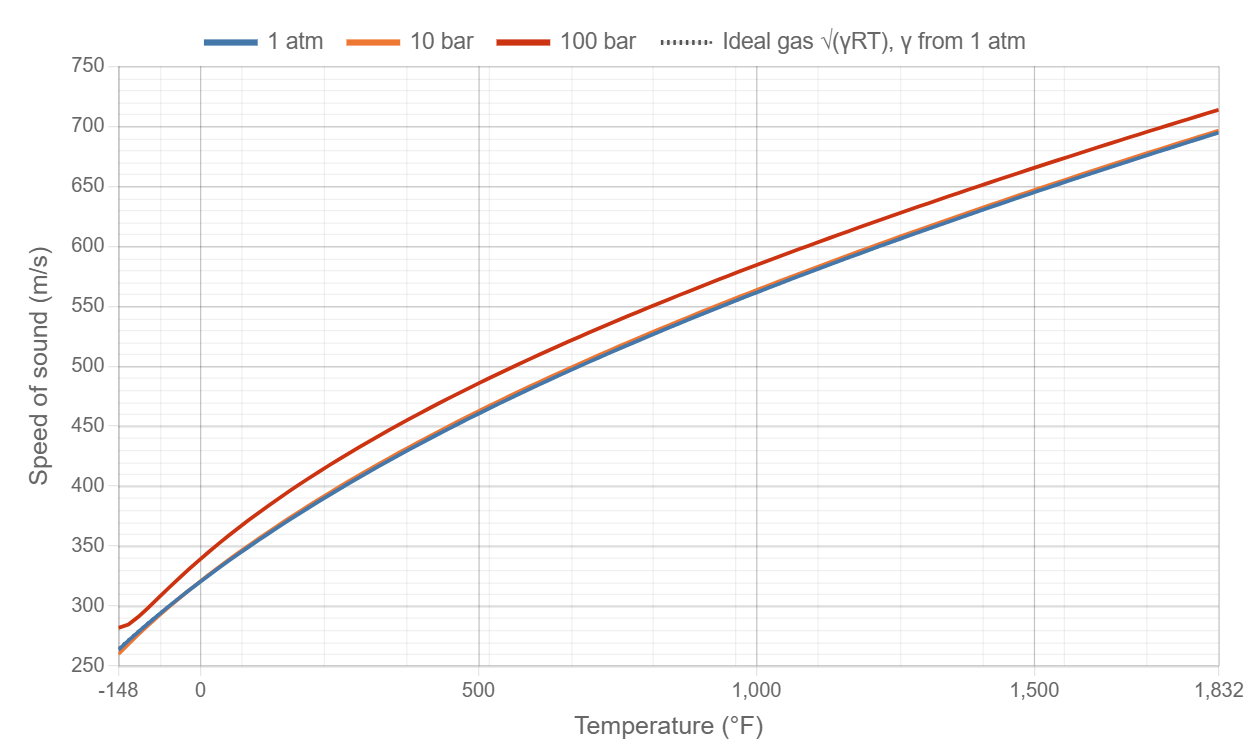
The speed of sound in dry air at 15 °C (59 °F) and 1 atm is 340.41 m/s (1116.8 ft/s, 661.7 knots). The U.S. Standard Atmosphere 1976 gives 340.294 m/s, a difference of 0.034 %. At 20 °C it is 343.34 m/s. This page is for dry air.
For an ideal gas, the speed of sound depends on temperature only:
a = √(γ R T)
with γ = 1.4, R = 287.05 J/(kg·K) and T in kelvin. That gives a ≈ 20.05√T (m/s). The ideal-gas value here uses γ = cp/cv from the 1 atm calculation, so it depends on temperature only. At 1 atm it agrees with the real value to within 0.39 % over the whole range. At 100 bar and −100 °C it is -6.12 % off, so use the real-gas value at high pressure. cp and cv are on the specific heat page.
The Mach number is the flight speed divided by the local speed of sound:
M = V / a
The speed of sound depends on air temperature, so Mach 1 is a lower speed at altitude, where the air is colder. At 15 °C (sea level, ISA) Mach 1 is 340.3 m/s (1116 ft/s, 661 knots). Use this calculator for the air temperature at your altitude. For the pressure, temperature and density of the standard atmosphere at altitude, use the density altitude calculator. For humid air see the wet bulb calculator.
Accuracy. Lemmon et al. (2000) state an uncertainty of about 0.1 % in density, 0.2 % in speed of sound and 1 % in heat capacity from the solidification point to 873 K (600 °C) and up to 70 MPa. Above 873 K there were no reliable air data, so nitrogen data were used and the paper gives about 0.5 % for density. Lemmon & Jacobsen (2004) state about 5 % for the viscosity and thermal conductivity of air, and more near the critical point. Viscosity and conductivity above about 600 °C, and the 1000 °C end of the range, are less certain than that. CoolProp uses a molar mass of 28.96546 g/mol, the U.S. Standard Atmosphere uses 28.9644 g/mol. That is the main reason CoolProp density at 15 °C and 1 atm is 0.04 % above the Standard Atmosphere value.