MIL-PRF-87252 Thermal Diffusivity Chart
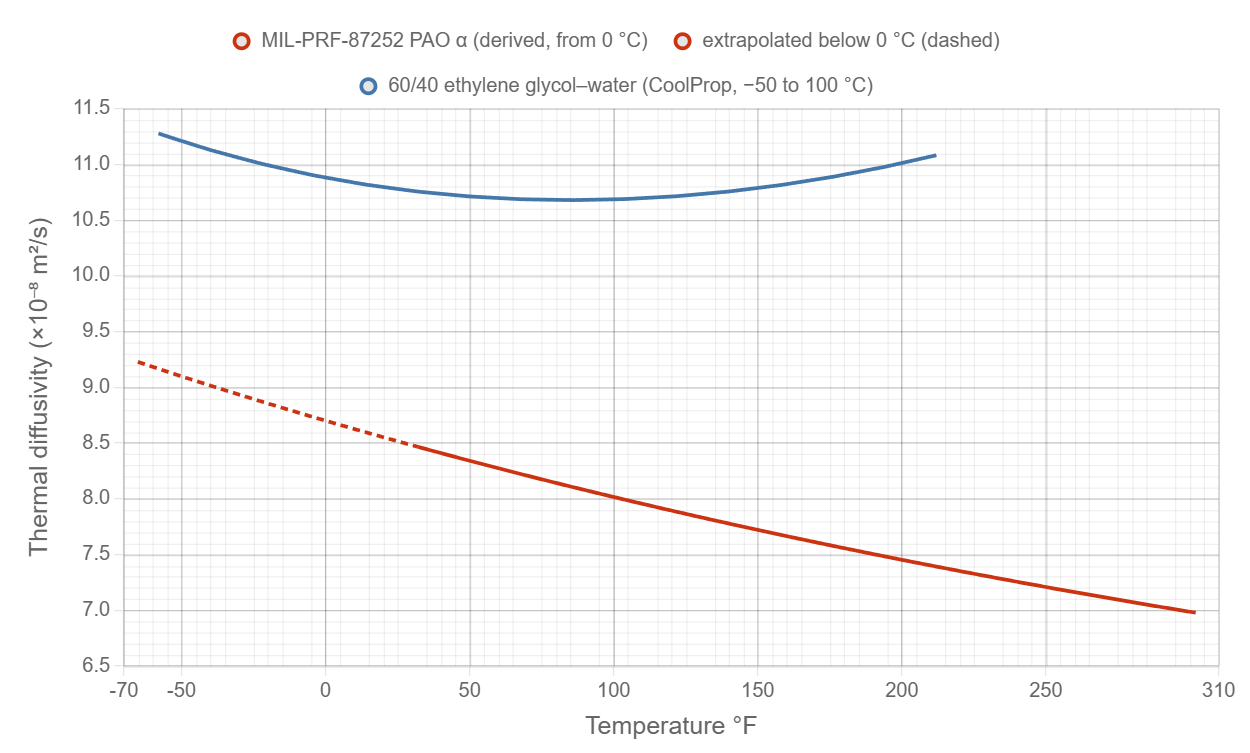
MIL-PRF-87252 PAO coolant thermal diffusivity versus temperature chart compared with 60/40 ethylene glycol and water

Canvas Element Not Working, Please Check Browser Settings or Contact KasperCalc to fix the issue.

About the data: no government report or journal paper with measured MIL-PRF-87252 properties was found. Thermal diffusivity is derived (α = k/(ρ·cp)) from manufacturer typical density, specific heat and thermal conductivity values from one table (ROYCO 602 data sheet, identical in the AeroShell Fluid 602 listing). No uncertainty is stated.

The solid red line is valid from 0 °C (32 °F) upward, where all three inputs are measured. The dashed line below 0 °C is extrapolated (density below 0 °C, cp and k below −17.8 °C). The chart ends at 150 °C (302 °F).

The blue line is 60/40 ethylene glycol–water from CoolProp, drawn from −50 °C to 100 °C only.

Data from: ROYCO 602 data sheet (ANDEROL, 2004) and AeroShell Fluid 602 (AeroShell Book, 2003); comparison from CoolProp 7.2.0 (Melinder 2010).

Toggle data sets by clicking the legend.

MIL-PRF-87252 Thermal Diffusivity Calculator
Degrees (°F):
Degrees (°C):
α (m²/s):  
α (mm²/s):  
α (cm²/s):  
α (ft²/s):  
α (ft²/h):  
Data basis:  
60/40 EG-water (m²/s):  

Calculator valid −54 °C to 150 °C (−65.2 °F to 302 °F), atmospheric pressure. α = k/(ρ·cp). Below 0 °C the “Data basis” row says Extrapolated. The glycol row is shown only from −50 to 100 °C.

Thermal Diffusivity of MIL-PRF-87252 PAO Coolant
What Is Thermal Diffusivity?

Thermal diffusivity (α) is how quickly heat spreads through a material: α = k / (ρ·cp)It sets the time a cold plate or a thick fluid layer takes to follow a change in temperature. Units are m²/s [SI] or ft²/h [US].

About This Data

α is computed from three ROYCO 602 sheet fits: density, specific heat and thermal conductivity. All three are manufacturer typical values for one product. The result falls from about 8.5 ×10−8 m²/s at 0 °C to 7.4 at 100 °C. It is the same quantity as ν/Pr, so it links the viscosity and Prandtl number pages.

MIL-PRF-87252 PAO Coolant — Thermal Diffusivity vs. Temperature
Temp (°C)Temp (°F)ρ (kg/m³)cp (kJ/(kg·K))k (W/(m·K))α (×10−8 m²/s)α (mm²/s)
-54-65.2840.6*1.9338*0.1500*9.229*0.0923*
-40-40.0831.6*1.9820*0.1486*9.016*0.0902*
-20-4.0818.8*2.0510*0.1466*8.731*0.0873*
032.0805.82.11990.14468.4670.0847
2068.0792.72.18880.14268.2210.0822
40104.0779.52.25770.14067.9920.0799
60140.0766.22.32670.13877.7780.0778
80176.0752.82.39560.13677.5790.0758
100212.0739.22.46450.13477.3920.0739
120248.0725.52.53340.13277.2180.0722
150302.0704.82.63680.12976.9780.0698

α = k / (ρ·cp). “*” marks values that use extrapolated inputs: ρ below 0 °C, cp and k below −17.8 °C. The fits are measured-range from 0 °C up (to 190 °C for ρ, 260 °C for cp and k). No measured diffusivity values exist in the sources.

MIL-PRF-87252 vs 60/40 Ethylene Glycol–Water

Diffusivity tells you how fast a temperature change spreads through the fluid. The PAO coolant has about 8 ×10−8 m²/s at 20 °C. 60/40 glycol–water has about 11 ×10−8 m²/s. They are within about 30 % because glycol–water conducts better but also stores more heat per volume.

Temp (°C)Temp (°F)PAO coolant (×10−8 m²/s)MEG-60 (×10−8 m²/s)MEG-60 higher by
-50-58.09.167*11.27823 %
-40-40.09.016*11.13023 %
-20-4.08.731*10.90225 %
032.08.46710.75727 %
2068.08.22110.68830 %
40104.07.99210.69034 %
60140.07.77810.75838 %
80176.07.57910.88944 %
100212.07.39211.08350 %

“*” marks PAO values with extrapolated inputs. MEG-60 values are CoolProp 7.2.0 (Melinder 2010), valid here from −50 to 100 °C only.

Sources
  • ANDEROL Inc., ROYCO 602 Coolant for Aircraft Avionics Systems data sheet (edited 19 Oct 2004). Royco602.pdf. Manufacturer typical values: density, specific heat and thermal conductivity used to derive α.. Opened and read 25 Oct 2026.
  • Shell Aviation, AeroShell Fluid 602, The AeroShell Book, Edition 18 (2003), pp. 240–243. AeroShellfluid602.pdf. same property tables. Opened and read 25 Oct 2026.
  • CoolProp 7.2.0, incompressible fluid INCOMP::MEG[0.6] (60 % ethylene glycol in water by mass), 1 atm. coolprop.org/fluid_properties/Incompressibles.html. The CoolProp page cites Å. Melinder, Properties of Secondary Working Fluids for Indirect Systems, IIF-IIR Publishing, 2010, as the source of the MEG data (Tmin −100 °C, Tmax 100 °C, mass fraction 0 to 0.60). The Melinder book itself was not opened. Thermal diffusivity of the comparison fluid.

No measured thermal diffusivity exists in the sources used. Values are derived from typical inputs and extrapolated below 0 °C.

Cite This Work