What Is Wet-Bulb Temperature?
Wet-bulb temperature is the lowest temperature air can reach by evaporating water into it. Wrap a thermometer bulb in a wet wick and move air past it. Water evaporates from the wick, and the heat needed for that evaporation comes from the bulb, so the bulb cools. It settles where the heat flowing in from the warmer air balances the heat carried away by evaporation.
Dry air soaks up water quickly, so the wick cools a lot and the wet bulb reads far below the air temperature. Humid air takes up little more water, so the wet bulb reads only a little lower. Saturated air (100% relative humidity) takes up none, and the wet bulb equals the air temperature.
The gap between the two readings is the wet-bulb depression. With the dry bulb, the depression and the air pressure, every other moisture property can be calculated. That is what this calculator does.
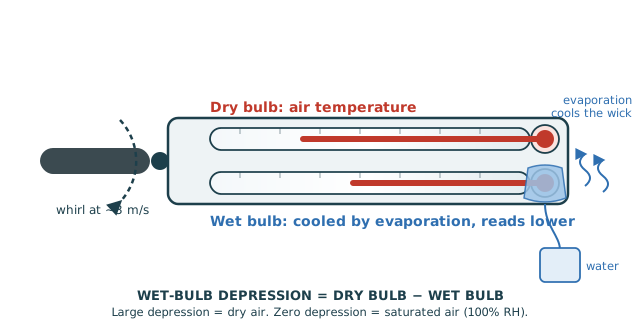
Dry Bulb, Wet Bulb & Dew Point
| Temperature | What it means |
|---|---|
| Dry bulb | The ordinary air temperature, read by a dry thermometer shielded from sun and radiation. |
| Wet bulb | The temperature reached by cooling the air while evaporating water into it, until it is saturated. Moisture is added. |
| Dew point | The temperature at which the air's existing moisture starts to condense when the air is cooled. Nothing is added or removed. |
For any unsaturated air: dew point < wet bulb < dry bulb. At 100% RH all three are equal.
Relative humidity (RH) compares the water vapor pressure in the air to the most it could hold at that temperature. It changes when the air warms or cools, even if no water is added.
Humidity ratio (W), also called moisture content or mixing ratio, is the mass of water per unit mass of dry air. It only changes if water is added or removed, so it is the property engineers use for mass and energy balances. In US units it is often given in grains per pound (7,000 grains = 1 lb).
How to Read a Psychrometric Chart
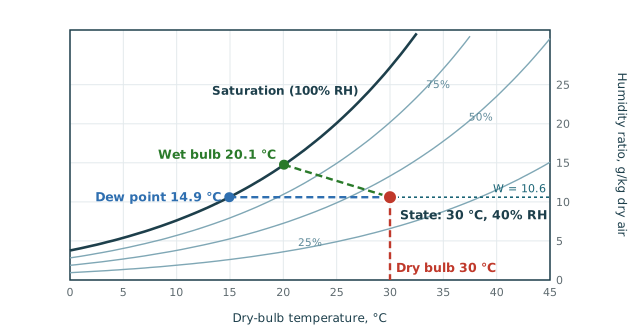
A psychrometric chart plots every property of moist air on one sheet. Any two lines that cross fix the state, and every other property can be read at that point.
- Dry bulb runs along the bottom. Lines of constant dry bulb are vertical.
- Humidity ratio runs up the right side. Lines of constant W are horizontal.
- The saturation curve (100% RH) is the upper left edge. Air cannot hold more water than this.
- RH curves sit below the saturation curve, like it but flatter.
- Wet-bulb lines slope down to the right from the saturation curve. Enthalpy lines are almost parallel to them.
To find the dew point, move left horizontally (constant W) to the saturation curve. To find the wet bulb, follow the sloped wet-bulb line up to the saturation curve. The interactive chart above does both for your inputs.
The Psychrometric Equations
ASHRAE gives a second set of constants for saturation over ice below 0 °C. Saturation pressure roughly doubles for every 11 °C (20 °F) rise in temperature, which is why warm air holds so much more water.
0.621945 is the ratio of the molar masses of water and dry air. \(p\) is total pressure and \(p_w\) the partial pressure of the water vapor. The dew point is the temperature where \(p_{ws}(t_d) = p_w\).
\(t^*\) is the wet bulb and \(W_s^*\) the saturation humidity ratio at \(t^*\). When the wick is frozen, 2501 becomes 2830 and the water terms use ice properties. The equation cannot be solved directly for \(t^*\), so the calculator iterates.
Why Altitude Matters
Saturation pressure depends only on temperature, but humidity ratio depends on the total pressure \(p\). At altitude, \(p\) is lower, so the same vapor pressure is a larger share of the air and W rises. Water also evaporates more easily, so the wick cools further and the wet bulb drops.
A standard sea-level psychrometric chart is fine up to about 1,000 ft. Above that, use a chart drawn for the site pressure or a calculator like this one.
| 95 °F, 40% RH | Sea level | 5,280 ft |
|---|---|---|
| Pressure | 14.696 psia | 12.100 psia |
| Wet bulb | 75.1 °F | 74.1 °F |
| Dew point | 66.9 °F | 66.9 °F |
| Humidity ratio | 98.9 gr/lb | 120.7 gr/lb |
The dew point does not change with pressure for a given vapor pressure, but the wet bulb and humidity ratio do.
Worked Example: 95 °F at 40% RH
Air at 95 °F and 40% RH at sea level (14.696 psia). This is the calculator's Load Example.
- Saturation pressure at 95 °F: \(p_{ws} = 0.8162\) psia.
- Vapor pressure: \(p_w = 0.40 \times 0.8162 = 0.3265\) psia.
- \( W = 0.621945 \times \dfrac{0.3265}{14.696 - 0.3265} \) = 0.01413 lb/lb = 98.9 gr/lb
- Dew point: the temperature where \(p_{ws} = 0.3265\) psia, which is 66.9 °F.
- Wet bulb: iterate the adiabatic saturation equation until it returns W = 0.01413. Result: 75.1 °F.
- \( h = 0.240(95) + 0.01413\,(1061 + 0.444 \times 95) \) = 38.39 Btu/lb
- The wet-bulb depression is 19.9 °F. An ideal evaporative cooler could bring this air down toward 75 °F.
- A well-designed direct evaporative cooler reaches about 80 to 90% of the depression, so its supply air would be roughly 77 to 79 °F.
- Any surface colder than 66.9 °F, such as a chilled-water pipe, will sweat.
- A cooling tower in this air cannot make water colder than 75.1 °F. Typical towers reach within 5 to 10 °F of it.
Where Wet Bulb Is Used
A cooling tower cools water by evaporation, so the entering-air wet bulb is the floor for the cold-water temperature. The difference between them is the approach. Tower sizing is based on a design wet bulb for the site, not the dry bulb.
Swamp coolers follow a constant wet-bulb line on the chart: the dry bulb falls while W rises. They work well in hot, dry climates with a large wet-bulb depression and poorly in humid ones.
Cooling coil loads come from the enthalpy difference between entering and leaving air. Enthalpy is set almost entirely by the wet bulb, so coil ratings are quoted at an entering wet bulb.
People cool themselves by sweating, which is evaporation. When the wet bulb nears skin temperature, sweat no longer cools. A sustained wet bulb of 35 °C (95 °F) has long been called the survival limit. Recent laboratory studies put the practical limit for healthy young adults nearer 31 °C (88 °F).
The wet-bulb globe temperature (WBGT) used for work and sports guidance is a different index. It combines a natural (unventilated) wet bulb with sun and wind effects. This calculator gives the thermodynamic wet bulb, not WBGT.
Snow guns need a low wet bulb, typically below about 28 °F (−2 °C), regardless of the dry bulb. When the dew point is below freezing, the calculator reports it as a frost point.
Wet-Bulb Temperature Tables (Sea Level)
| Dry bulb | 10% | 20% | 30% | 40% | 50% | 60% | 70% | 80% | 90% |
|---|---|---|---|---|---|---|---|---|---|
| 70 °F | 46.8 | 50.0 | 53.0 | 55.8 | 58.5 | 61.0 | 63.4 | 65.7 | 67.9 |
| 80 °F | 52.5 | 56.4 | 60.1 | 63.5 | 66.7 | 69.6 | 72.5 | 75.1 | 77.6 |
| 90 °F | 58.0 | 62.8 | 67.2 | 71.2 | 74.9 | 78.3 | 81.5 | 84.5 | 87.4 |
| 100 °F | 63.3 | 69.1 | 74.3 | 79.0 | 83.2 | 87.1 | 90.7 | 94.0 | 97.1 |
| 110 °F | 68.6 | 75.5 | 81.5 | 86.8 | 91.6 | 95.9 | 99.8 | 103.5 | 106.9 |
Wet bulb in °F by relative humidity, at 14.696 psia.
| Dry bulb | 10% | 20% | 30% | 40% | 50% | 60% | 70% | 80% | 90% |
|---|---|---|---|---|---|---|---|---|---|
| 20 °C | 7.6 | 9.3 | 10.9 | 12.4 | 13.8 | 15.1 | 16.4 | 17.7 | 18.9 |
| 25 °C | 10.5 | 12.5 | 14.4 | 16.2 | 17.9 | 19.5 | 21.0 | 22.4 | 23.7 |
| 30 °C | 13.2 | 15.7 | 18.0 | 20.1 | 22.0 | 23.8 | 25.5 | 27.1 | 28.6 |
| 35 °C | 15.9 | 18.9 | 21.5 | 23.9 | 26.1 | 28.2 | 30.1 | 31.8 | 33.5 |
| 40 °C | 18.6 | 22.0 | 25.1 | 27.8 | 30.3 | 32.6 | 34.6 | 36.6 | 38.3 |
| 45 °C | 21.2 | 25.2 | 28.7 | 31.8 | 34.5 | 37.0 | 39.2 | 41.3 | 43.2 |
Wet bulb in °C by relative humidity, at 101.325 kPa. Both tables were generated with this calculator's equations.
Measuring Wet Bulb Accurately
- Move the air. The wick needs air at about 3 to 5 m/s (600 to 1,000 ft/min). In still air, a wet bulb reads high.
- Use clean, distilled water and a clean cotton wick. Mineral deposits slow evaporation.
- Shade the thermometers from sun and from hot surfaces. Radiation makes both read high.
- Read the wet bulb first and right away, once it stops falling. Whirl, read, and repeat until two readings agree.
- Below freezing, let the wick freeze fully before reading. Supercooled water reads differently from ice.
- Electronic RH sensors are easier but drift with age and contamination. Check them against a psychrometer or a salt standard.
Frequently Asked Questions
- What is wet-bulb temperature?
- The lowest temperature air can be cooled to by evaporating water into it. A thermometer with a wet wick in moving air reads it.
- What is the difference between wet bulb and dew point?
- Dew point is where existing moisture starts to condense when the air is cooled. Wet bulb is where the air ends up when cooled by evaporating water into it. For unsaturated air the dew point is always lower than the wet bulb.
- How do I calculate wet bulb from relative humidity?
- Calculate the humidity ratio from dry bulb and RH, then solve the adiabatic saturation equation for the wet bulb by iteration. Pick "Dry bulb + relative humidity" above. One-line approximations such as Stull's formula are only good to about 1 °C, and only at sea level.
- Can the wet bulb be higher than the dry bulb?
- No. Evaporation can only cool the wick. If a measurement shows otherwise, the wick is dry or the thermometers disagree.
- Does altitude change the wet bulb?
- Yes. At lower pressure the wet bulb is lower and the humidity ratio higher for the same dry bulb and RH. The dew point stays the same for a given vapor pressure.
- What is a dangerous wet-bulb temperature?
- Sweat stops cooling the body as the wet bulb approaches skin temperature. 35 °C (95 °F) is the commonly quoted theoretical limit; laboratory studies suggest about 31 °C (88 °F) for healthy young adults.
- Why do the US and SI enthalpy values not convert directly?
- They use different zero points. US tables set dry air at 0 °F to zero; SI tables use 0 °C. Enthalpy differences between two states convert normally (1 Btu/lb = 2.326 kJ/kg).