Standard Resistor Values (E3 to E192), Resistor Color Code for 3, 4, 5 and 6 Band Resistors, and SMD Resistor Codes (3-Digit, 4-Digit, EIA-96)
Every standard resistor value from E3 to E192. The colour code for 3-, 4-, 5- and 6-band resistors. The 3-digit, 4-digit and EIA-96 codes printed on SMD resistors. Calculators go both ways, find the nearest standard value, and build two-resistor combinations and divider pairs. Print a wall chart, and find out why the values are 1.0, 2.2 and 4.7 instead of 1, 2 and 5.
Calculators
For capacitor and inductor bands too, use the Colour Band Calculator.
Standard resistor values: E3, E6, E12, E24, E48, E96, E192
Each series repeats in every decade: E12 has 1.0, 1.2, 1.5, 1.8, 2.2, 2.7, 3.3, 3.9, 4.7, 5.6, 6.8 and 8.2, so it has 10 Ω, 12 Ω … 82 Ω, then 100 Ω, 120 Ω … and so on up. Pick a series to see every value from 1 Ω to 9.x MΩ, the digit bands, the multiplier band for each decade, and which other series share the value.
| Series | Values per decade | Step | Tolerance | Values (×1, ×10, ×100 …) |
|---|---|---|---|---|
| E3 | 3 | ×2.15 | >±20% (usually ±40%) | 1.0, 2.2, 4.7 |
| E6 | 6 | ×1.47 | ±20% | 1.0, 1.5, 2.2, 3.3, 4.7, 6.8 |
| E12 | 12 | ×1.21 | ±10% | 1.0, 1.2, 1.5, 1.8, 2.2, 2.7, 3.3, 3.9, 4.7, 5.6, 6.8, 8.2 |
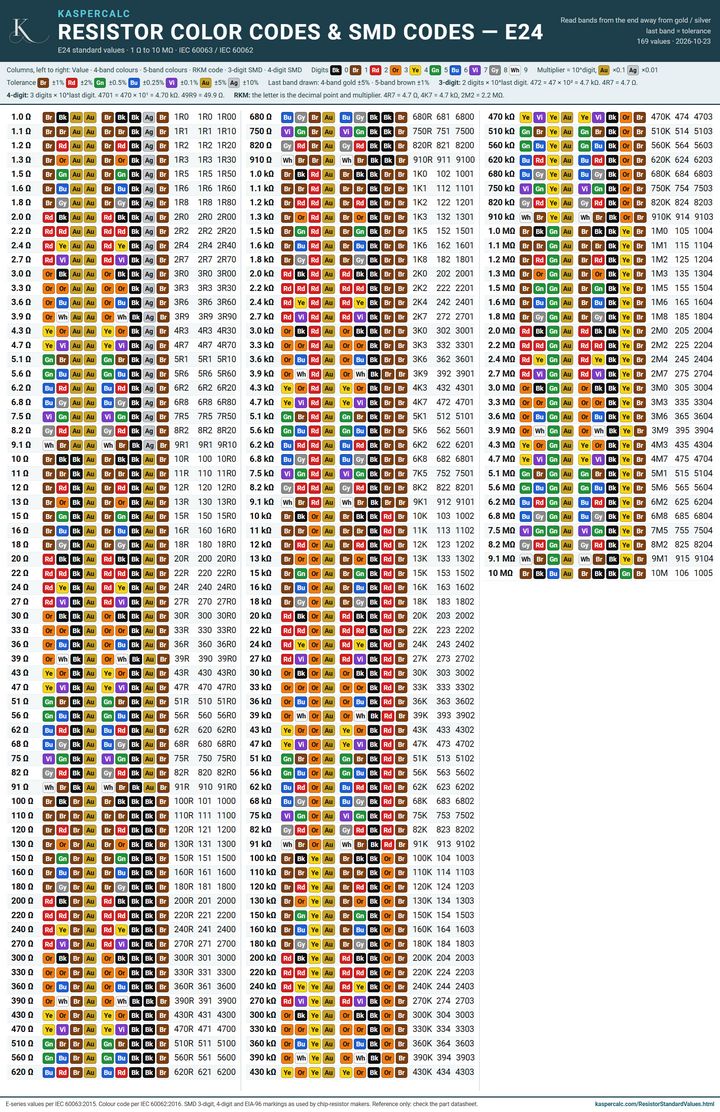
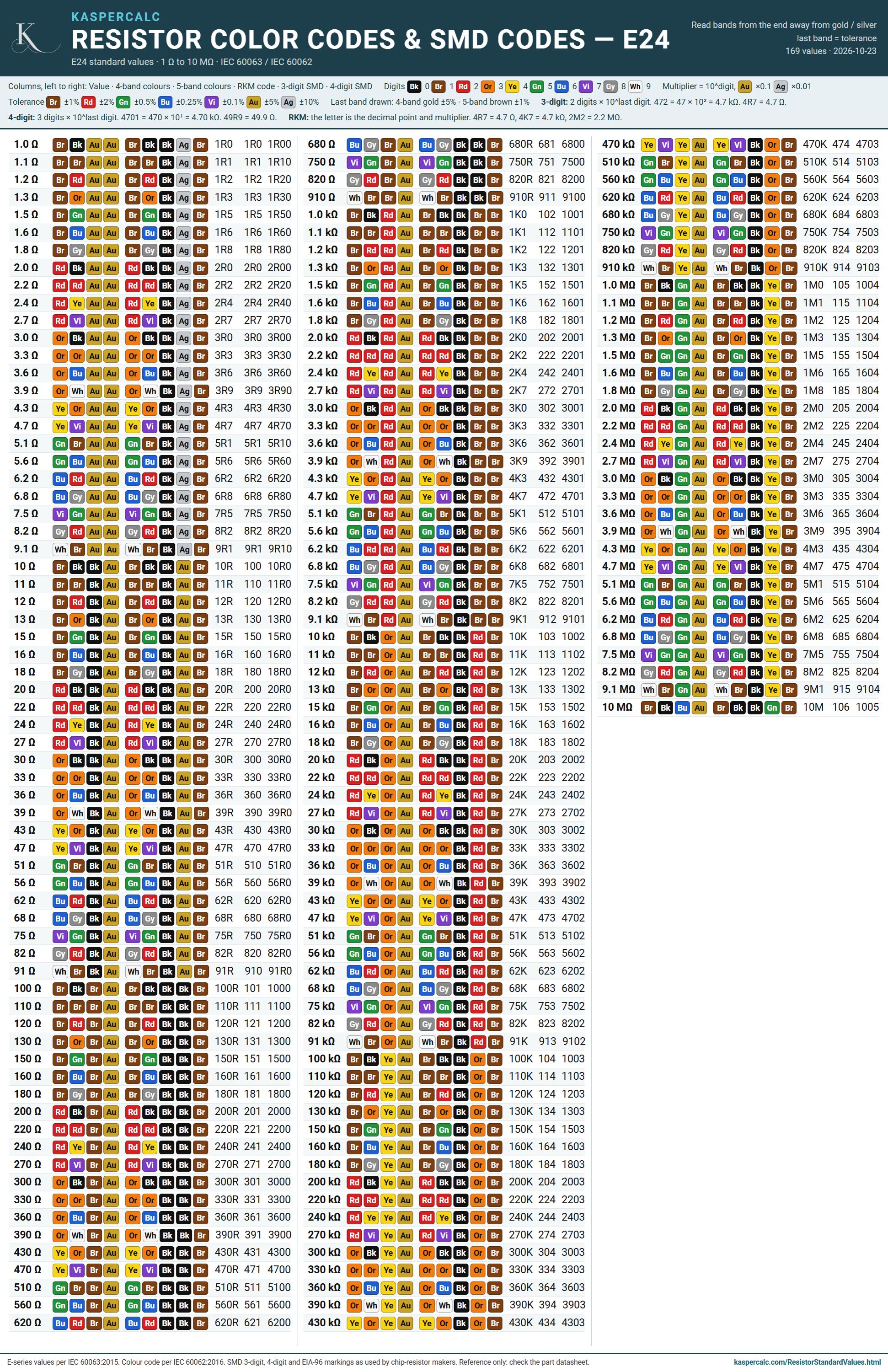
| E24 | 24 | ×1.10 | ±5% (also sold at ±2%, ±1%) | 1.0, 1.1, 1.2, 1.3, 1.5, 1.6, 1.8, 2.0, 2.2, 2.4, 2.7, 3.0, 3.3, 3.6, 3.9, 4.3, 4.7, 5.1, 5.6, 6.2, 6.8, 7.5, 8.2, 9.1 |
| E48 | 48 | ×1.049 | ±2% | 1.00, 1.05, 1.10, 1.15, 1.21, 1.27, 1.33 … every other E96 value |
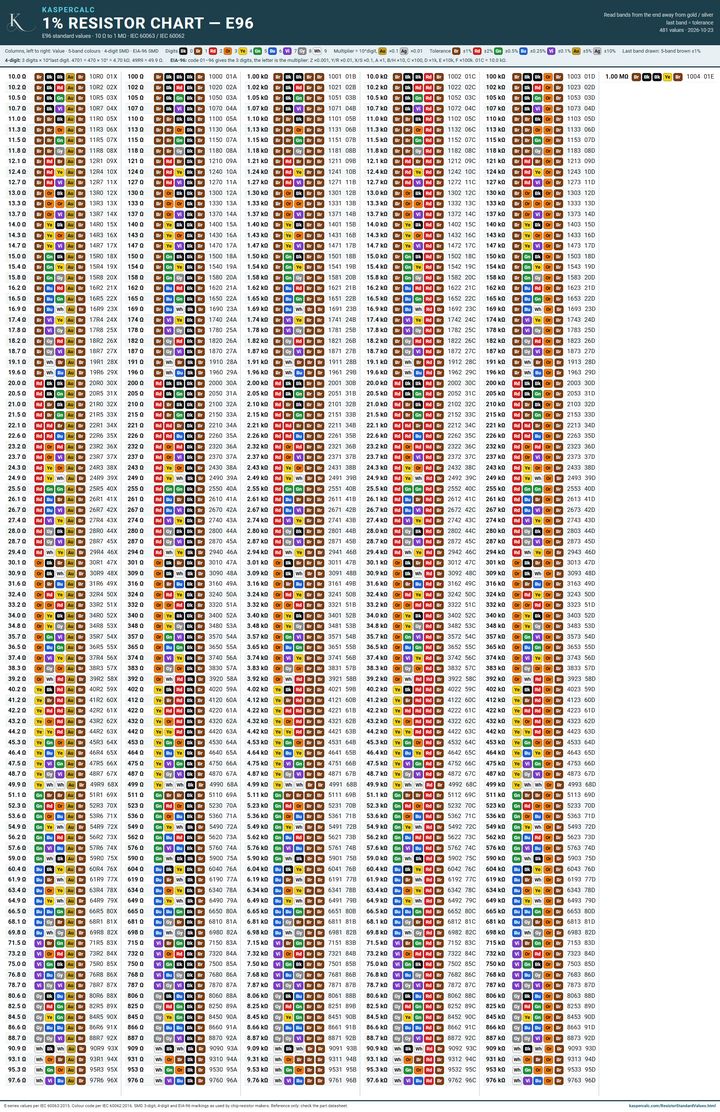
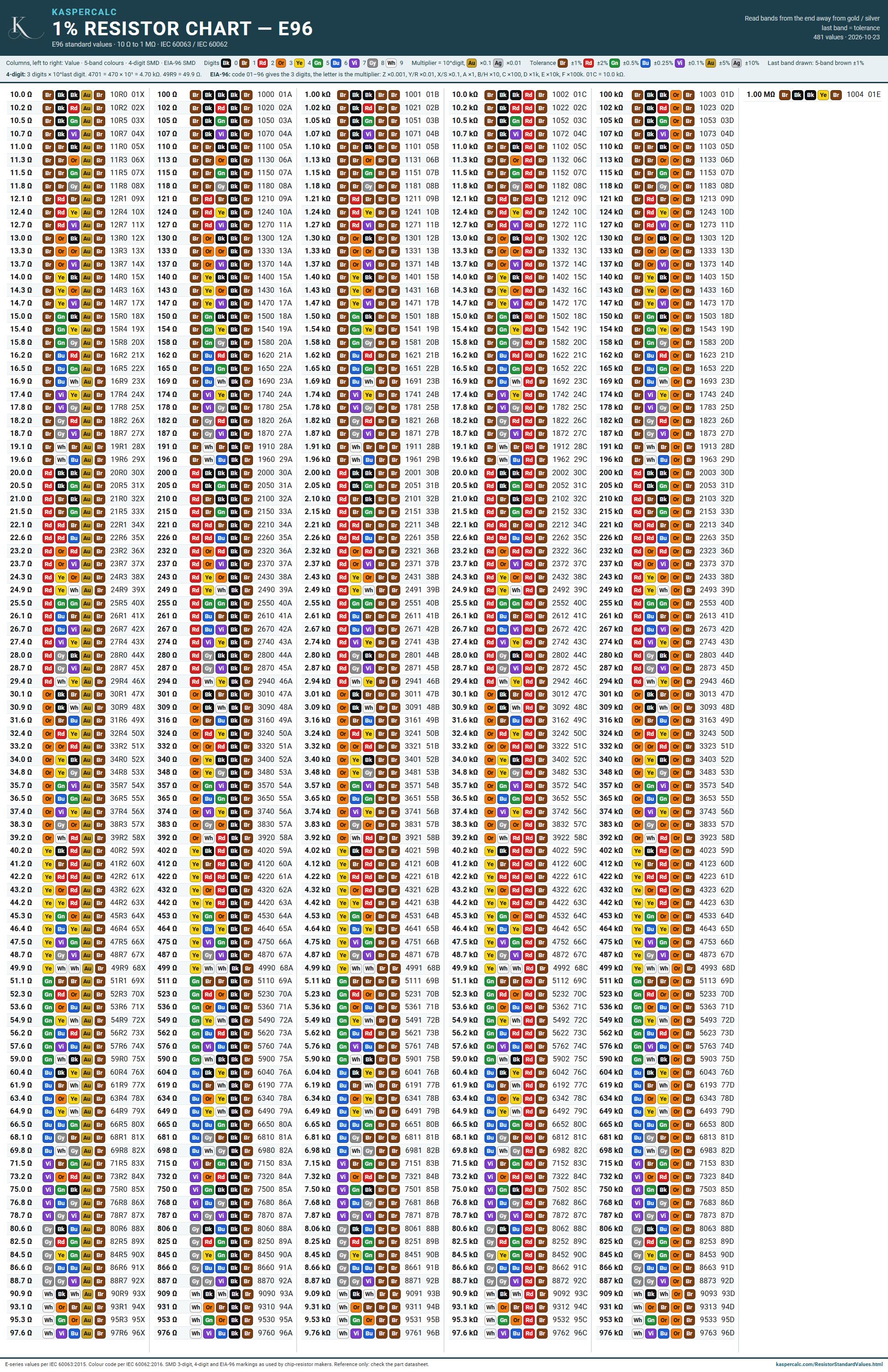
| E96 | 96 | ×1.024 | ±1% | 1.00, 1.02, 1.05, 1.07, 1.10, 1.13, 1.15, 1.18, 1.21 … 9.53, 9.76 |
| E192 | 192 | ×1.012 | ±0.5%, ±0.25%, ±0.1% | 1.00, 1.01, 1.02, 1.04, 1.05, 1.06, 1.07 … 9.76, 9.88 |
Resistor colour code chart (3, 4, 5 and 6 bands)
Per IEC 60062:2016. Read from the end away from the gold or silver band (on 5- and 6-band parts the tolerance band is set apart and often wider). 3 and 4 bands: two digits, then the multiplier. 5 and 6 bands: three digits, then the multiplier. The band after the multiplier is the tolerance; a 6th band is the temperature coefficient. A 3-band resistor has no tolerance band and is ±20%.
| Colour | Digit | Multiplier | Tolerance (letter) | Temp. coefficient |
|---|---|---|---|---|
| Bk Black | 0 | ×1 | — | 250 ppm/K |
| Br Brown | 1 | ×10 | ±1% (F) | 100 ppm/K |
| Rd Red | 2 | ×100 | ±2% (G) | 50 ppm/K |
| Or Orange | 3 | ×1k | ±0.05% (W) | 15 ppm/K |
| Ye Yellow | 4 | ×10k | ±0.02% (P) | 25 ppm/K |
| Gn Green | 5 | ×100k | ±0.5% (D) | 20 ppm/K |
| Bu Blue | 6 | ×1M | ±0.25% (C) | 10 ppm/K |
| Vi Violet | 7 | ×10M | ±0.1% (B) | 5 ppm/K |
| Gy Grey | 8 | ×100M | ±0.01% (L); ±0.05% on older parts | 1 ppm/K |
| Wh White | 9 | ×1G | — | — |
| Au Gold | — | ×0.1 | ±5% (J) | — |
| Ag Silver | — | ×0.01 | ±10% (K) | — |
| Pk Pink | — | ×0.001 | — | — |
| (no band) | — | — | ±20% (M) | — |
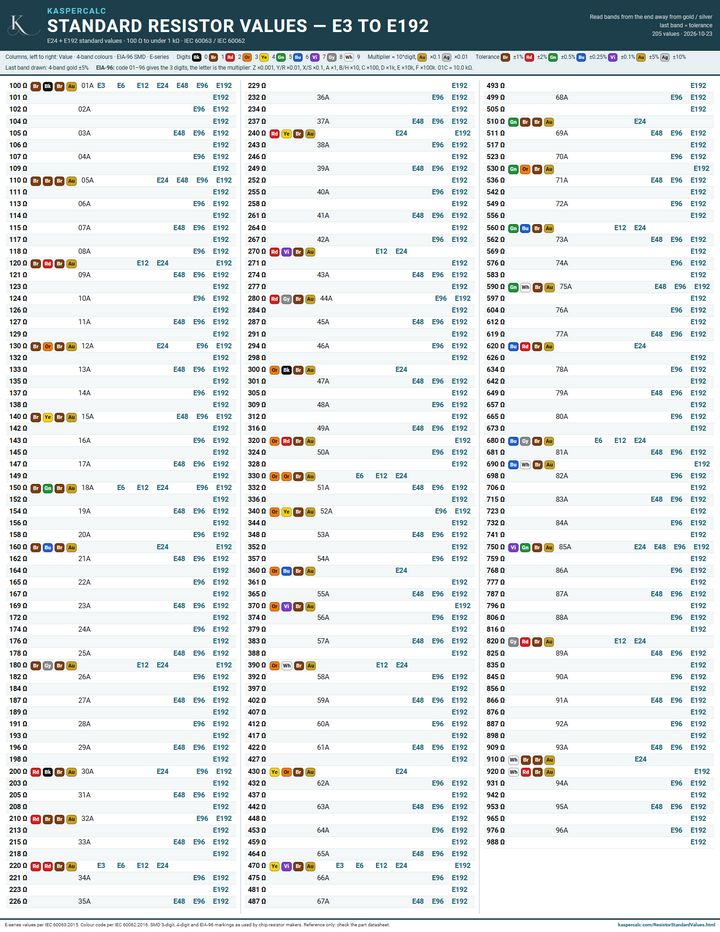
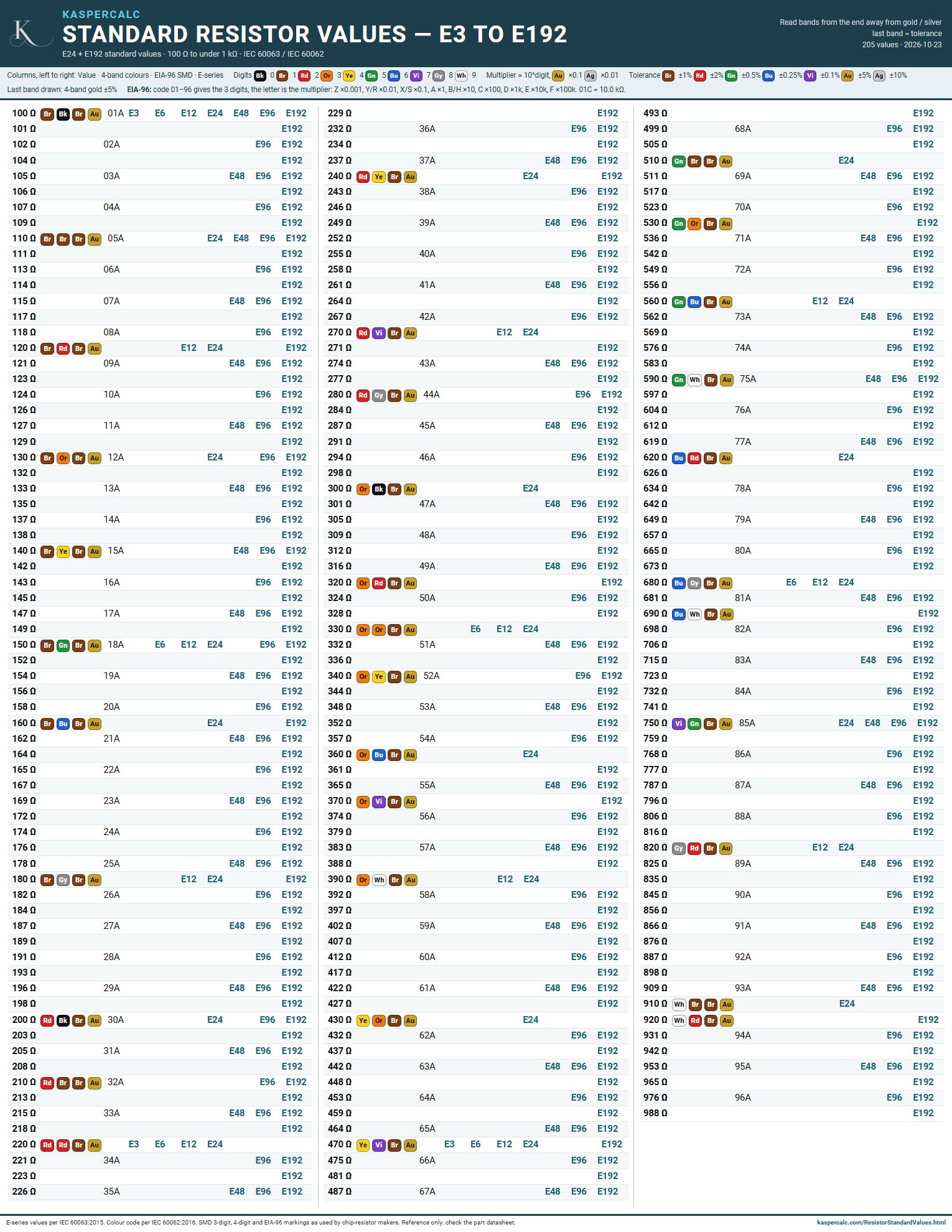
Printable resistor colour code & SMD code posters
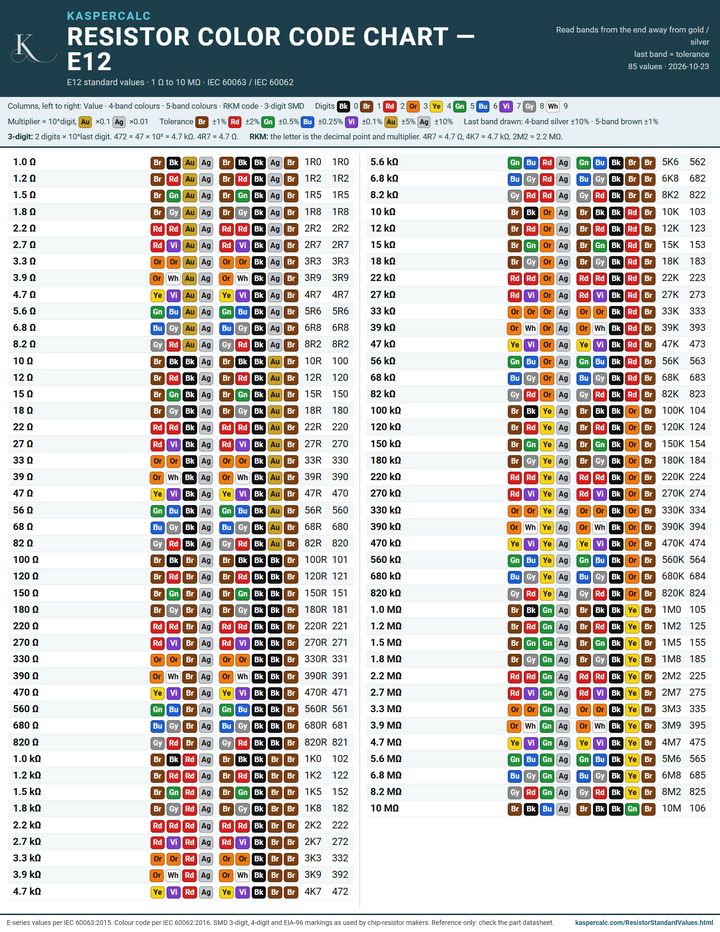
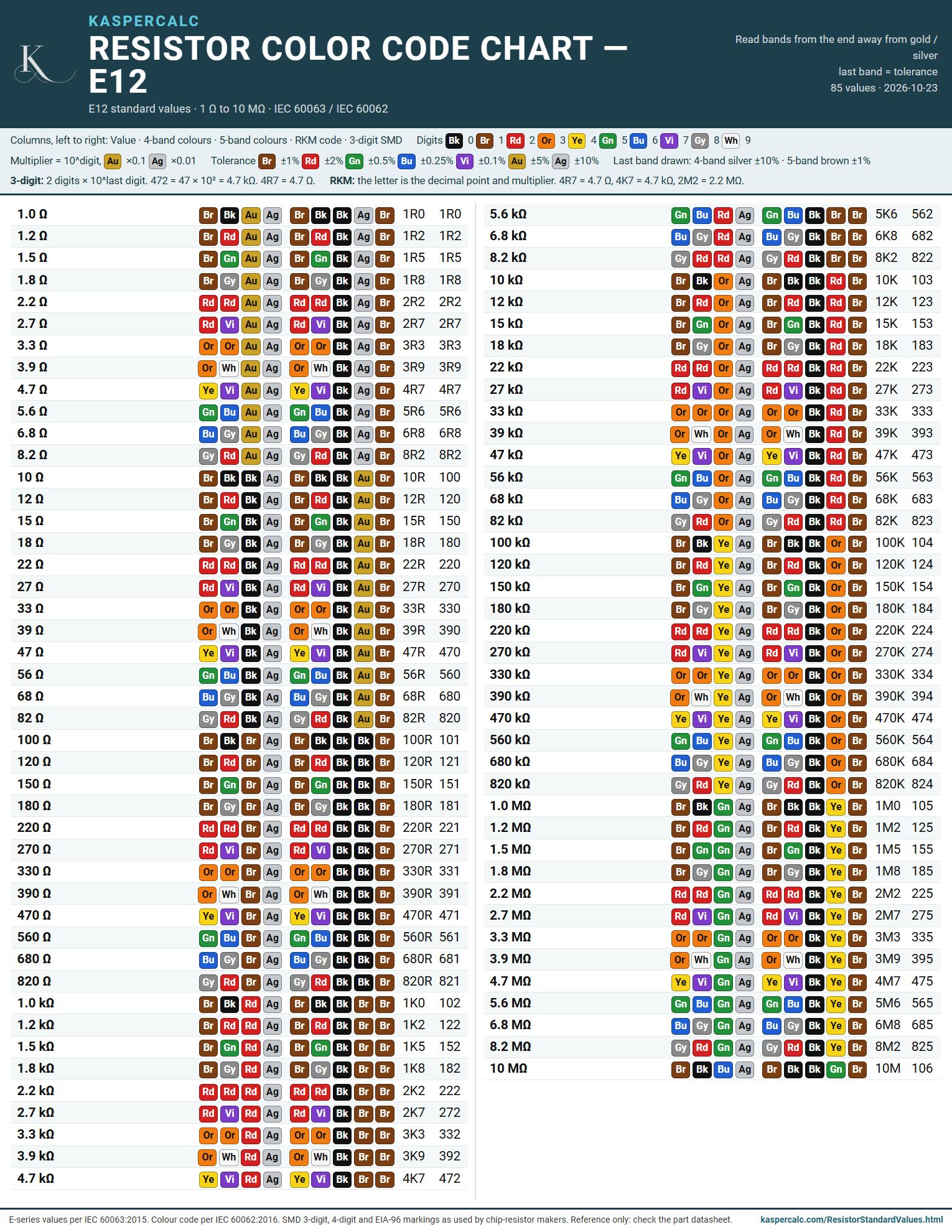
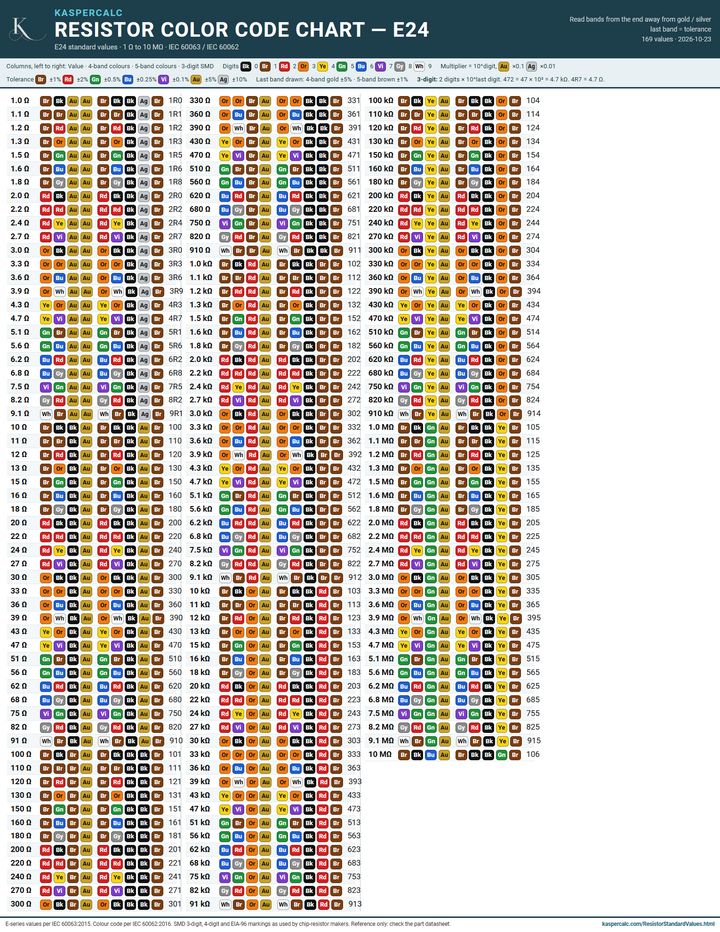
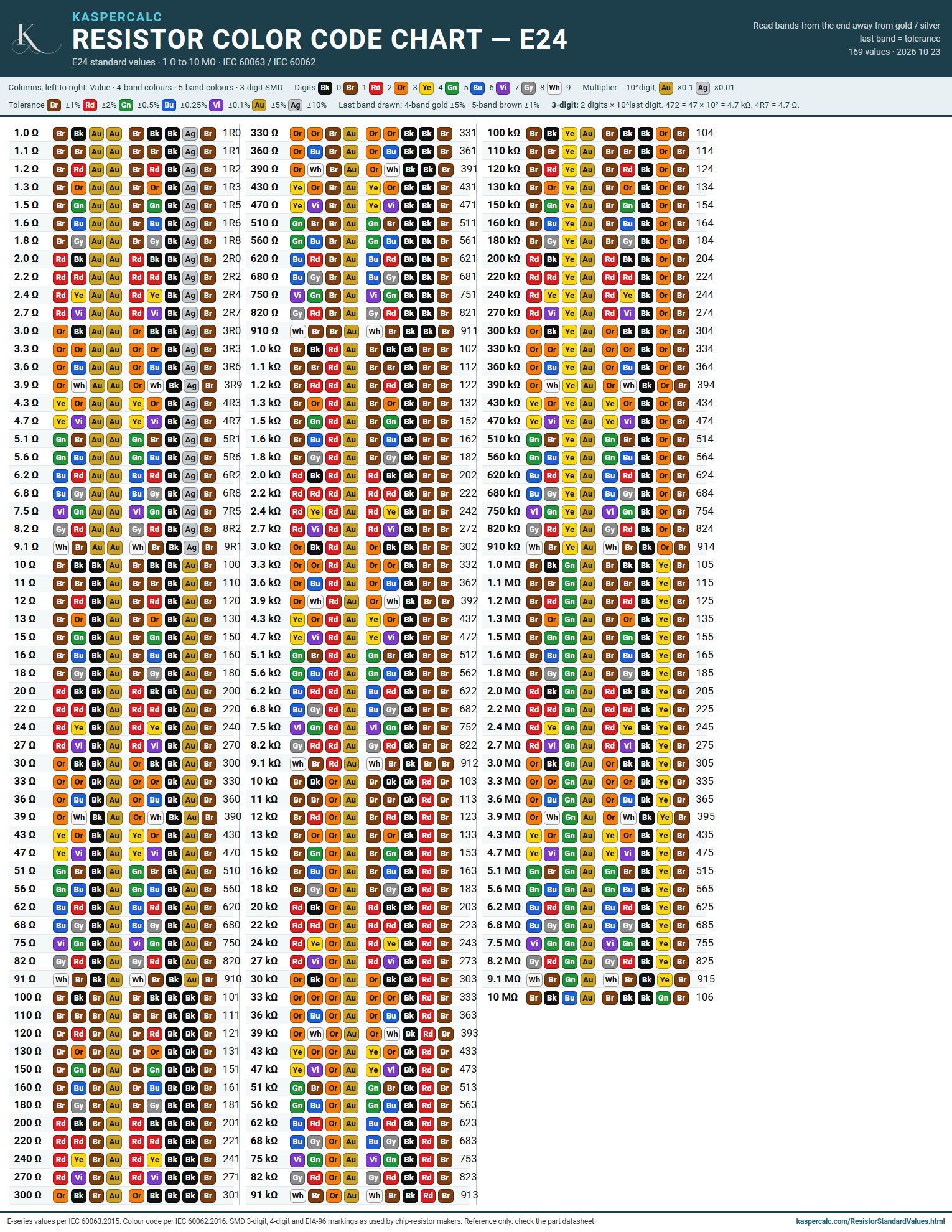
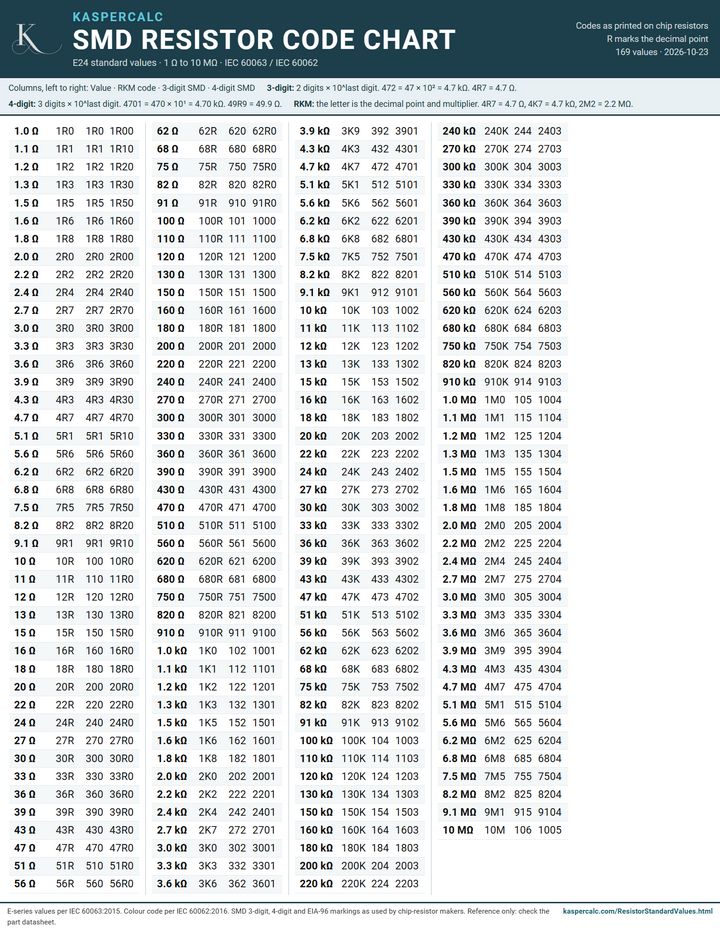
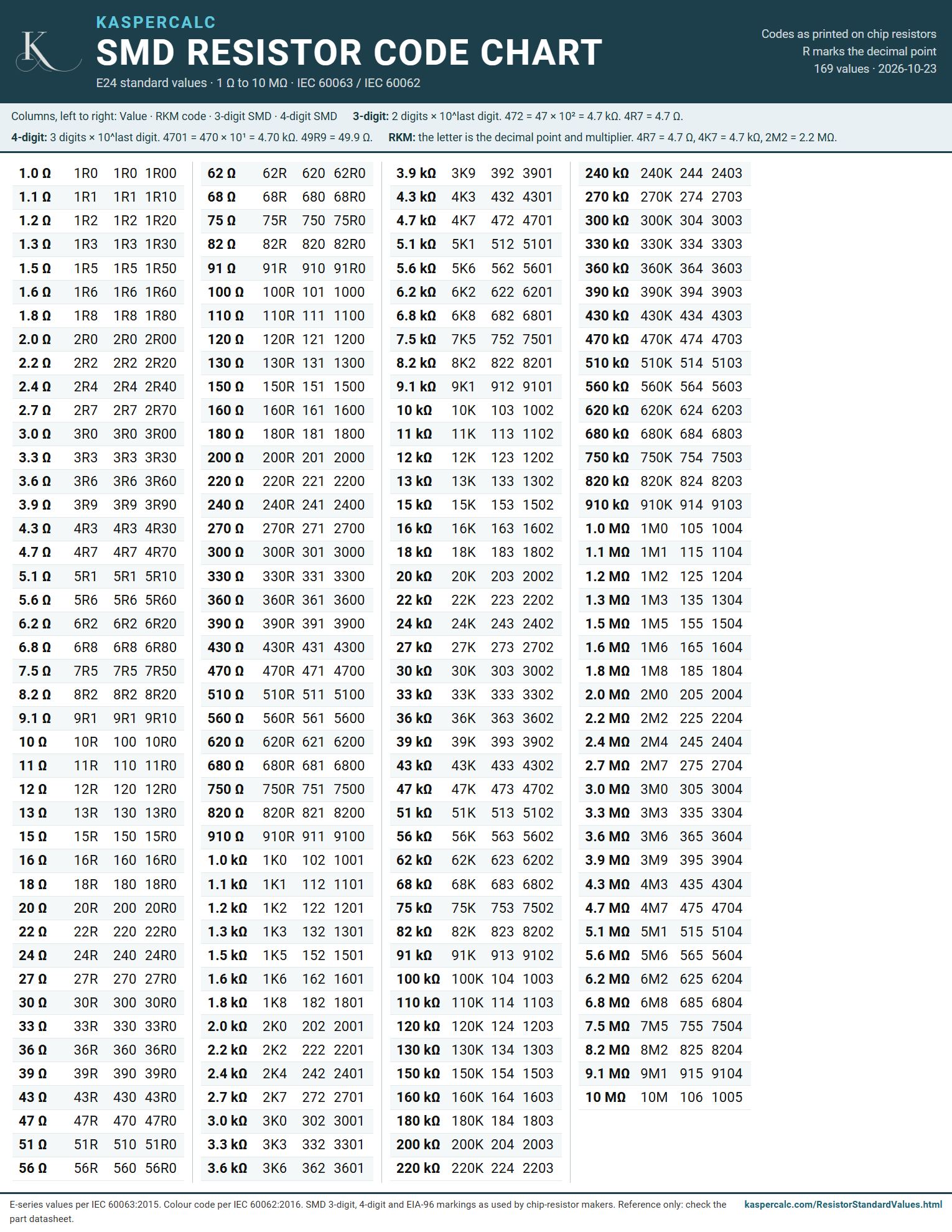
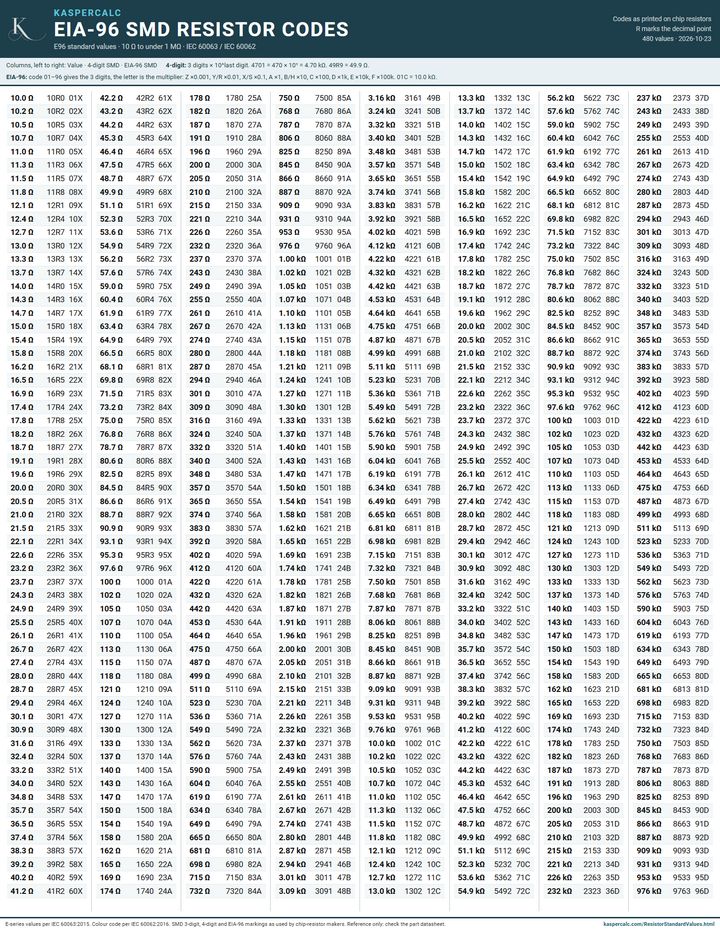
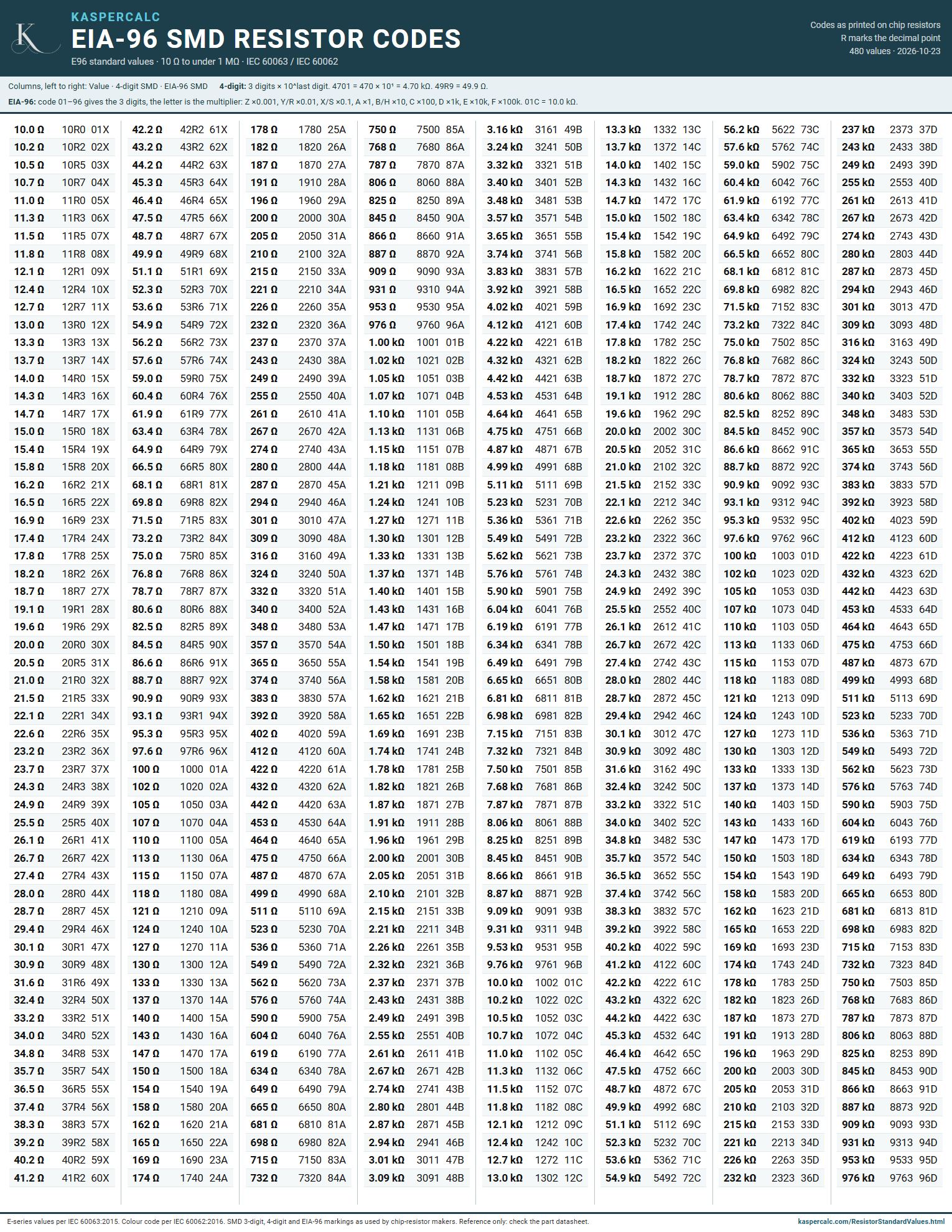
Print a wall chart for the bench: pick the series, value range, columns, paper size (Letter to ARCH E, A4 to A0) and colour or black and white. Or download one of the ready-made PDFs below.
Why Is 2.2k a Standard Value?
A resistor's error is a percentage. So the values are spaced by a constant ratio, not a constant step. Split a decade into n equal ratios and each value is 10i/n.
For three steps the ratio is the cube root of 10, which is 2.154. The three values are 1, 2.154 and 4.64. Rounded to two digits they are 1.0, 2.2 and 4.7. That is the whole story of 2.2k: it is one third of the way through a decade on a log scale.
E6 halves each step (×1.47). E12 halves it again (×1.21). E24 halves it again (×1.10). So every E6 value is also in E12 and E24.
The Tolerance Bands Touch
The step is matched to the tolerance. A ±20% E6 resistor marked 2.2 can be anything from 1.76 to 2.64. The next value, 3.3 ±20%, starts at 2.64. Laid end to end, the bands cover the whole decade with little gap or overlap.
Early carbon-composition makers needed exactly that. They could not hit a value precisely, so they measured each part and sold it under whichever value it fell into. Every part they made was sellable. Halve the tolerance and you need twice as many values to keep the bands touching. That is why E12 goes with ±10%, E24 with ±5% and E96 with ±1%.
Each bar is one value with its tolerance band, across one decade on a log scale (hover a bar for its range). The ±20%, ±10% and ±5% bands tile the decade. At ±2% and ±1% the 3-digit series do the same with more values.
Why 4.7 and Not 4.6?
Rounded honestly, 10i/24 gives 2.6, 2.9, 3.2, 3.5, 3.8, 4.2, 4.6 and 8.3. The standard says 2.7, 3.0, 3.3, 3.6, 3.9, 4.3, 4.7 and 8.2.
These values were in use long before the series was written down. The US Radio Manufacturers Association adopted preferred values in 1936. When the IEC standardised them (work began in 1948, and IEC 63 was published in 1952), it kept the established numbers rather than make the world's stock obsolete. Today's edition is IEC 60063:2015.
E3, E6 and E12 are subsets of E24, so they inherit the same values. That is why it is 4.7, not 4.6, and 3.3, not 3.2.
| Standard E24 value | 10i/24 | Rounded |
|---|
2-Digit vs. 3-Digit Series, and Why 10k Is Everywhere
E3 and E6 values are in every finer 2-digit series. So they are sold in every tolerance, power rating and package, by every maker. Distributors stock them deepest and assembly lines keep them loaded, which keeps them cheap.
When a circuit doesn't need an exact value (pull-ups, bias, LED current limits), use E6 or E12. When it does (dividers, gain setting, filters), use E96, a two-resistor combination, or a trimmer.
Reading a Resistor the Right Way Round
- Gold or silver is never the first band. If one end is gold or silver, start from the other end.
- On 5- and 6-band parts the tolerance band sits a little apart from the others. IEC practice makes it about 50% wider.
- Most 5-band parts are ±1% (brown last). If one end band is brown and the other isn't, the brown end is usually the tolerance, unless the value starts with 1.
- Check the result against the E-series tables. If it isn't a standard value, try reading it the other way.
- A single black band is a 0 Ω jumper.
- Military parts may carry a 5th band for failure rate on a 4-band code. That changes how the bands are counted.
- Memory aid: Black Brown Red Orange Yellow Green Blue Violet Grey White. “Betty Brown Runs Over Your Garden But Violet Gingerly Walks.”
SMD Resistor Codes: 3-Digit, 4-Digit and EIA-96
Two digits and a power of ten. 472 = 47 × 10² = 4.7 kΩ. 100 = 10 × 10⁰ = 10 Ω (not 100 Ω). 105 = 1 MΩ. Below 10 Ω an R marks the decimal point: 4R7 = 4.7 Ω, R47 = 0.47 Ω. 000 or 0 is a 0 Ω jumper.
Three digits and a power of ten. 4701 = 470 × 10¹ = 4.70 kΩ. 1002 = 10.0 kΩ. 1000 = 100 Ω. Below 100 Ω: 49R9 = 49.9 Ω, R010 = 10 mΩ (current-sense resistors).
Only three characters fit. The three digits of the E96 value become a two-digit index (01 to 96), and a letter sets the multiplier. 01C = 100 × 100 = 10.0 kΩ. 68X = 499 × 0.1 = 49.9 Ω. 30A = 200 Ω.
| Letter | Multiplier | Letter | Multiplier |
|---|---|---|---|
| Z | ×0.001 | A | ×1 |
| Y or R | ×0.01 | B or H | ×10 |
| X or S | ×0.1 | C | ×100 |
| D | ×1,000 | ||
| E | ×10,000 | ||
| F | ×100,000 |
Chip Resistor Sizes and Typical Power Ratings
| Inch code | Metric code | Size, mm | Typical power at 70 °C | Usual marking |
|---|---|---|---|---|
| 01005 | 0402M | 0.4 × 0.2 | 1/32 W | none |
| 0201 | 0603M | 0.6 × 0.3 | 1/20 W | none |
| 0402 | 1005M | 1.0 × 0.5 | 1/16 W (some 1/10 W) | usually none |
| 0603 | 1608M | 1.6 × 0.8 | 1/10 W | 3-digit (5%) or EIA-96 (1%) |
| 0805 | 2012M | 2.0 × 1.25 | 1/8 W | 3-digit (5%) or 4-digit (1%) |
| 1206 | 3216M | 3.2 × 1.6 | 1/4 W | 3- or 4-digit |
| 1210 | 3225M | 3.2 × 2.5 | 1/2 W | 3- or 4-digit |
| 2010 | 5025M | 5.0 × 2.5 | 3/4 W | 3- or 4-digit |
| 2512 | 6332M | 6.3 × 3.2 | 1 W | 3- or 4-digit |
Typical thick-film ratings. High-power and thin-film parts differ, and all derate above about 70 °C. Check the datasheet. For parts JLCPCB keeps in stock, see JLCPCB resistors.
Sources
Preferred values: IEC 60063:2015, Preferred number series for resistors and capacitors (first published as IEC 63, 1952). Colour code, tolerance letters and RKM codes: IEC 60062:2016, Marking codes for resistors and capacitors. EIA-96 marking: the E96 index and multiplier letters used by chip-resistor makers. The E24 deviations and the E192 9.20 value are computed on this page from 10i/n and compared with the standard lists.