MIL-PRF-87252 Volumetric Thermal Expansion Coefficient (β)
MIL-PRF-87252 PAO coolant thermal expansion coefficient versus temperature chart compared with 60/40 ethylene glycol and water

Canvas Element Not Working, Please Check Browser Settings or Contact KasperCalc to fix the issue.

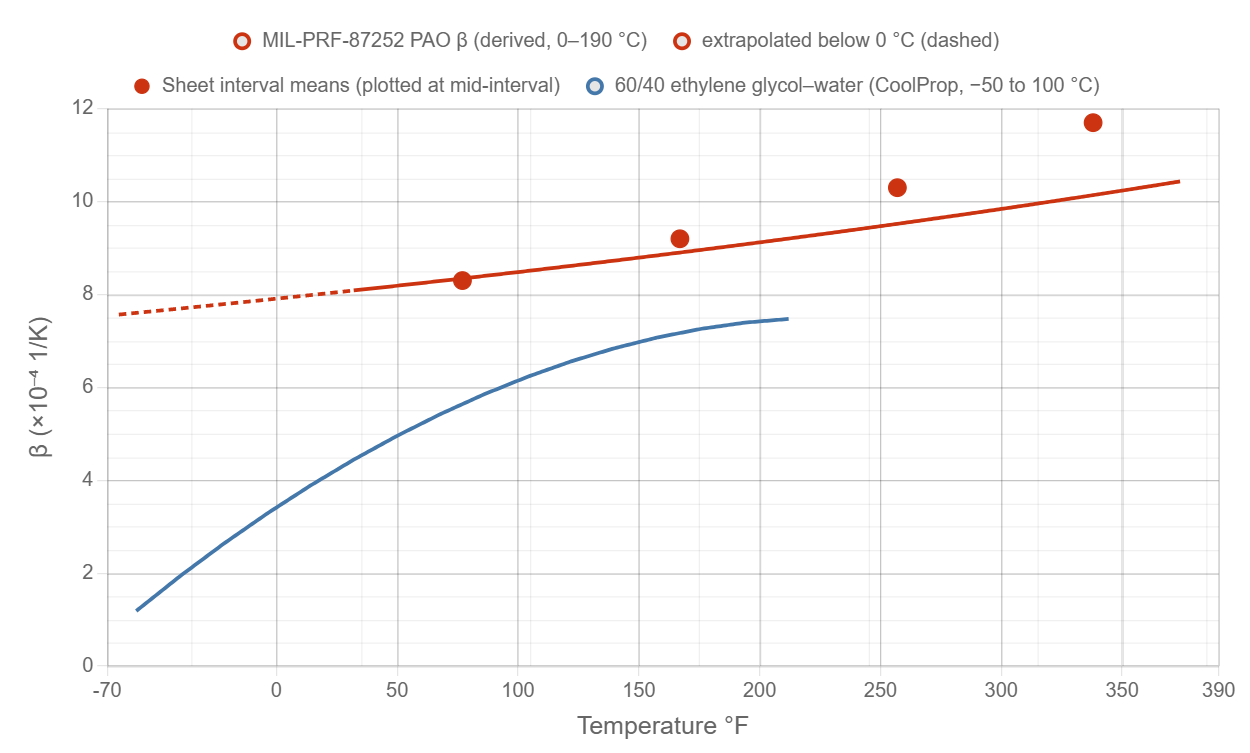
About the data: no government report or journal paper with measured MIL-PRF-87252 properties was found. β = −(1/ρ)(dρ/dT) is derived from the three manufacturer typical dilatometer densities on the ROYCO 602 sheet (identical in the AeroShell Fluid 602 listing). No uncertainty is stated.

The solid red line is valid from 0 to 190 °C (32 to 374 °F), the dilatometer range. The dashed line below 0 °C is extrapolated.

Circles are the four interval-mean coefficients printed on the sheet (0.00083, 0.00092, 0.00103, 0.00117 per °C), plotted at the middle of each interval (0–50, 50–100, 100–150, 150–190 °C). The blue line is 60/40 ethylene glycol–water from CoolProp, drawn from −50 °C to 100 °C only.

Data from: ROYCO 602 data sheet (ANDEROL, 2004) and AeroShell Fluid 602 (AeroShell Book, 2003); comparison from CoolProp 7.2.0 (Melinder 2010).

Toggle data sets by clicking the legend.

MIL-PRF-87252 Percent Volume Change Relative to 68 °F (20 °C)
MIL-PRF-87252 PAO coolant percent volume change versus temperature chart relative to 68 F compared with 60/40 ethylene glycol and water

Canvas Element Not Working, Please Check Browser Settings or Contact KasperCalc to fix the issue.

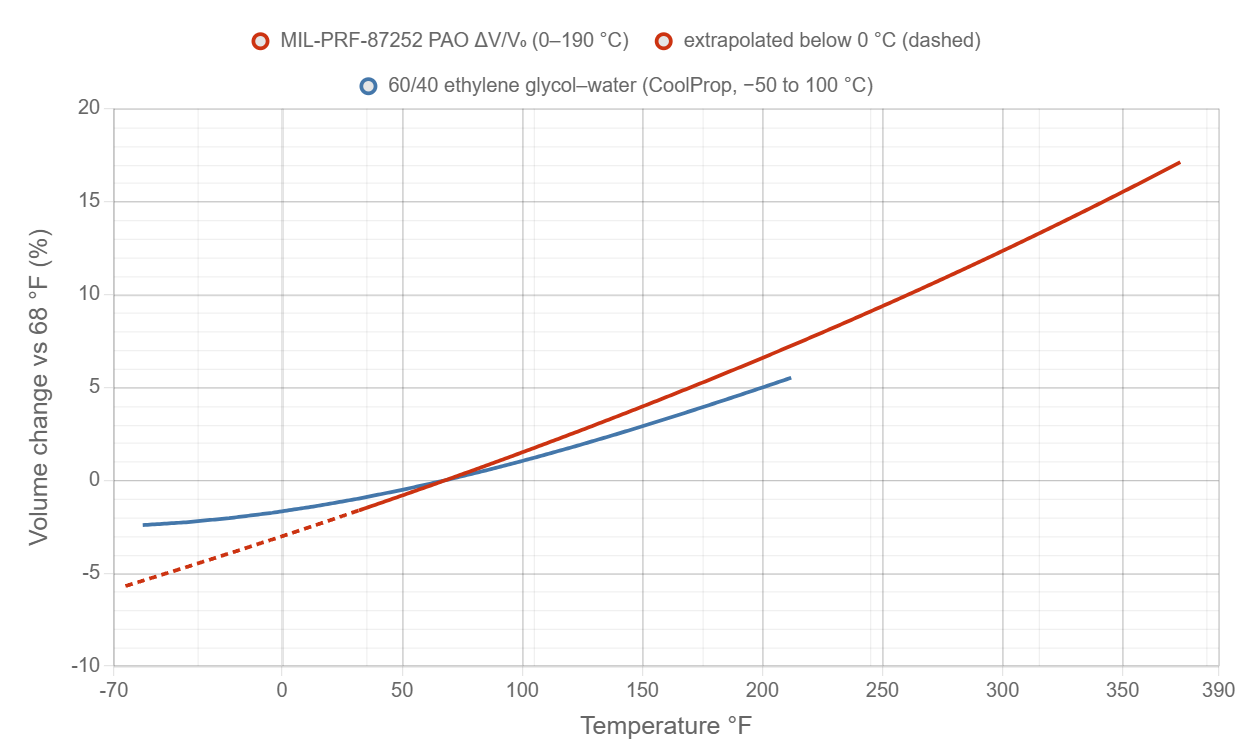
ΔV/V0 = (ρ20/ρ − 1) × 100 %, referenced to 20 °C (68 °F). Negative values mean the fluid has contracted. Use it to size an expansion tank.

Solid red line: 0 to 190 °C. Dashed: extrapolated below 0 °C. The blue line is 60/40 ethylene glycol–water from CoolProp (−50 to 100 °C only).

Toggle data sets by clicking the legend.

MIL-PRF-87252 Thermal Expansion Calculator
Degrees (°F):
Degrees (°C):
β × 10⁻⁴ (1/K):  
β × 10⁻⁵ (1/K):  
β × 10⁻⁶ (ppm/K):  
β (1/K):  
β (1/°R = 1/°F):  
Density, fit (kg/m³):  
% Vol. change from 68°F (20°C):  
Data basis:  
60/40 EG-water β × 10⁻⁴ (1/K):  

Calculator valid −54 °C to 190 °C (−65.2 °F to 374 °F), atmospheric pressure, from the quadratic density fit. Below 0 °C the “Data basis” row says Extrapolated. The glycol row is shown only from −50 to 100 °C.

Thermal Expansion of MIL-PRF-87252 PAO Coolant
Volumetric Thermal Expansion Coefficient: β (derived)

The volumetric expansion coefficient is β = −(1/ρ)(dρ/dT). For a liquid, a volume V0 grows by about β·V0·ΔT when it warms by ΔT. The PAO coolant has β near 8.3×10⁻⁴ 1/K at 20 °C, rising to 9.2×10⁻⁴ at 100 °C. That is about 8 % more volume at 100 °C than at 20 °C.

Data Source and Range

β is derived from the three dilatometer densities of the ROYCO 602 data sheet (see the density page). The sheet also prints interval-mean coefficients, shown as markers. MIL-PRF-87252D Table III lists a single typical value of 8.1×10⁻⁴ with no temperature. All are typical values for one product with no uncertainty.

The curve is solid from 0 to 190 °C and dashed (extrapolated) below 0 °C. Pair this page with the specific heat page to size an expansion volume and a heat exchanger.

MIL-PRF-87252 PAO Coolant — Thermal Expansion vs. Temperature
Temp (°C)Temp (°F)Density fit (kg/m³)β (×10−4 1/K)ΔV/V0 (%) vs 20 °CBasis
-54-65.2840.6*7.567*-5.69*Extrapolated
-40-40.0831.6*7.697*-4.68*Extrapolated
-20-4.0818.8*7.888*-3.18*Extrapolated
032.0805.88.087-1.62Measured range (fit)
2068.0792.78.2930.00Measured range (fit)
40104.0779.58.5071.69Measured range (fit)
60140.0766.28.7303.46Measured range (fit)
80176.0752.88.9625.31Measured range (fit)
100212.0739.29.2047.24Measured range (fit)
120248.0725.59.4579.26Measured range (fit)
150302.0704.89.85712.47Measured range (fit)

β = −(1/ρ)(dρ/dT) from the quadratic density fit (ρ measured from 0 to 190 °C). “*” marks extrapolation below 0 °C. ΔV/V0 = (ρ20/ρ − 1)×100, so the fluid is about 8 % larger at 100 °C than at 20 °C.

Cross-Check: Sheet Interval Means vs. Fitted β
Interval (°C)Sheet mean β (×10−4 1/°C)Mean of fitted β (×10−4 1/K)Difference
0–508.38.35+0.6 %
50–1009.28.91-3.2 %
100–15010.39.52-7.5 %
150–19011.710.14-13.3 %

Sheet values are the ROYCO 602 and AeroShell “Coefficient of Thermal Expansion, Dilatometer” entries (0.00083, 0.00092, 0.00103, 0.00117 per °C). The sheet’s three density points and its four printed expansion values do not agree above about 100 °C. The density-derived β is up to 13 % lower at 150–190 °C. The sheet does not say why. For sizing an expansion volume (accumulator, bellows or reservoir), use the larger sheet values, which give the bigger volume change. MIL-PRF-87252D Table III also gives a single typical cubical expansion of 8.1×10⁻⁴ cm³/(cm³·°C) with no temperature.
MIL-PRF-87252 vs 60/40 Ethylene Glycol–Water

The PAO coolant expands about 8.3 ×10−4 1/K at 20 °C. 60/40 glycol–water expands about 5.4 ×10−4 1/K. Over a −54 to 100 °C swing the PAO volume changes by about 14 % on the density-fit basis (extrapolated below 0 °C). On the sheet’s own β values, 0 to 100 °C gives about 8.8 % (density fit: 9.0 %) and 100 to 190 °C gives about 9.8 % (density fit: 9.2 %), so use the sheet values when you size an expansion volume (accumulator or bellows). See also ethylene glycol thermal expansion.

Temp (°C)Temp (°F)PAO β (×10−4 1/K)MEG-60 β (×10−4 1/K)PAO ΔV/V0 vs 20 °C (%)MEG-60 ΔV/V0 vs 20 °C (%)
-50-58.07.604*1.185-5.41*-2.42
-40-40.07.697*1.929-4.68*-2.26
-20-4.07.888*3.277-3.18*-1.75
032.08.0874.442-1.62-0.99
2068.08.2935.4270.000.00
40104.08.5076.2301.691.18
60140.08.7306.8443.462.51
80176.08.9627.2625.313.97
100212.09.2047.4747.245.52

“*” marks PAO values below 0 °C (extrapolated). MEG-60 values are CoolProp 7.2.0 (Melinder 2010) on a 10 K grid, valid here from −50 to 100 °C only. Near the freezing point the glycol values sit at the edge of the fitted data and are less certain.

Sources
  • ANDEROL Inc., ROYCO 602 Coolant for Aircraft Avionics Systems data sheet (edited 19 Oct 2004). Royco602.pdf. Manufacturer typical values: dilatometer density at 0, 100 and 190 °C and the interval-mean expansion coefficients.. Opened and read 25 Oct 2026.
  • Shell Aviation, AeroShell Fluid 602, The AeroShell Book, Edition 18 (2003), pp. 240–243. AeroShellfluid602.pdf. same density and expansion tables. Opened and read 25 Oct 2026.
  • US Department of Defense, MIL-PRF-87252D, Performance Specification: Coolant Fluid, Hydrolytically Stable, Dielectric, 23 November 2015. everyspec.com. Table III (p.8) typical cubical expansion 8.1×10⁻⁴. Opened and read 25 Oct 2026.
  • CoolProp 7.2.0, incompressible fluid INCOMP::MEG[0.6] (60 % ethylene glycol in water by mass), 1 atm. coolprop.org/fluid_properties/Incompressibles.html. The CoolProp page cites Å. Melinder, Properties of Secondary Working Fluids for Indirect Systems, IIF-IIR Publishing, 2010, as the source of the MEG data (Tmin −100 °C, Tmax 100 °C, mass fraction 0 to 0.60). The Melinder book itself was not opened. Density and expansion of the comparison fluid.

No measured expansion series from a government report or journal paper was found. The sheet gives no uncertainty. Values below 0 °C are extrapolated.

Cite This Work