No Avgas Measurement Was Found

These values are an estimate, not an avgas measurement. The only primary source we found is CRC Report 530 Fig 24. It is one line for jet and missile fuels (JP-4, JP-5, JP-7, JP-8, Jet A, Jet A-1, Jet B, RJ-4, RJ-5, RJ-6, JP-9 and JP-10). Aviation gasoline is not in its legend. CRC says the line is based on test data for eight of those fuels and is good to within 10 % of actual values for them. We do not know how close it is for avgas. Light hydrocarbon liquids of this kind usually have a similar thermal conductivity, but that is an assumption, not a result from a source.

About 0.11 W/(m·K) at 20 °C (0.067 Btu/(h·ft·°F)). Avgas is a poor conductor of heat: about one fifth of water (0.6 W/(m·K)).
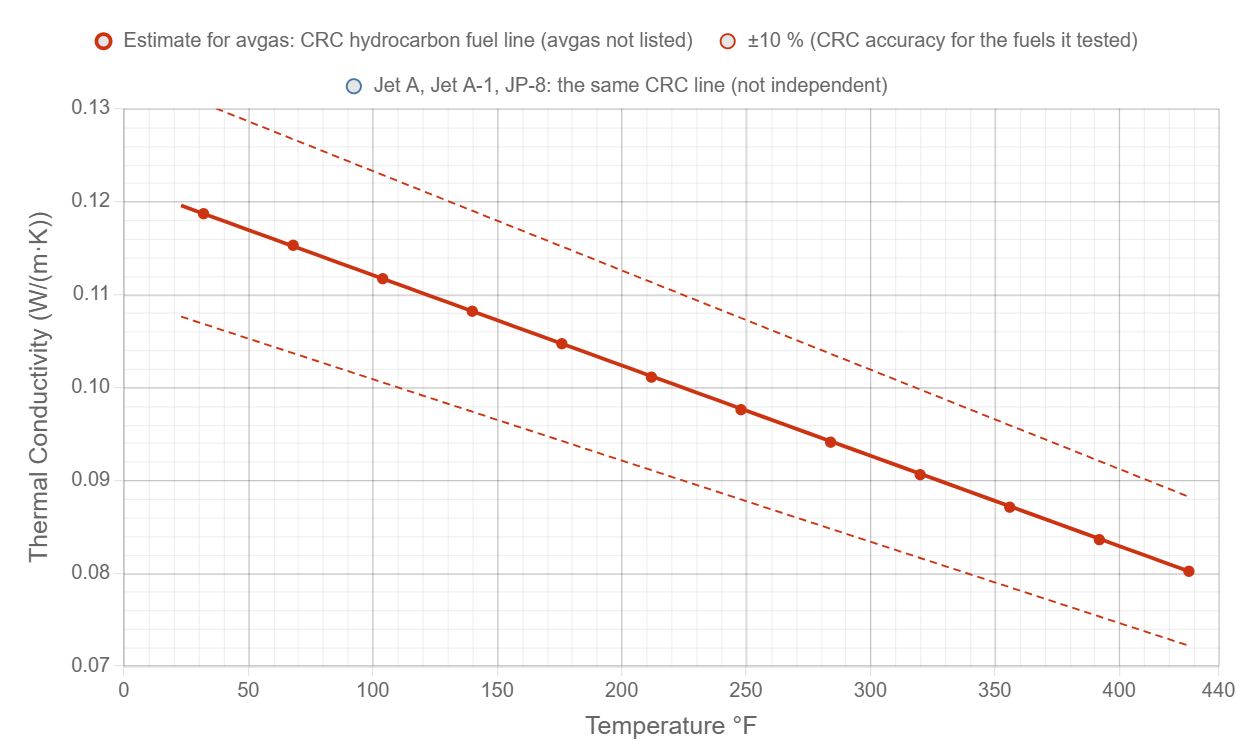
Avgas 100LL Thermal Conductivity Chart (Estimate)

Canvas Element Not Working, Please Check Browser Settings or Contact KasperCalc to fix the issue.

Avgas 100LL Estimated Thermal Conductivity vs Temperature Graph

Red line: CRC Report 530 Fig 24, the single curve for hydrocarbon-based fuels, read from the graph, −5 °C to 220 °C (23 °F to 428 °F). Avgas is not listed in the figure. Dashed red lines are ±10 %, the accuracy CRC states for the fuels it did test.

The blue Jet A, Jet A-1 and JP-8 line is the same CRC line (it lies under the red one), so it is not an independent comparison. Above about 65 °C avgas boils at atmospheric pressure, so the hot end applies to fuel kept liquid under pressure.

Data from: CRC Report 530 (1983), DTIC ADA132106, Fig 24 (printed p.57) and section 2.6.2.

Toggle data sets by clicking the legend.

Avgas 100LL Thermal Conductivity Calculator (Estimate)
Degrees (°F):
Degrees (°C):
W / (m·K):  
mW / (m·K):  
Btu / (h·ft·°F):  
Btu·in / (h·ft²·°F):  
W / (cm·K):  
±10 % range (W/(m·K)):  
Jet A (W/(m·K)), same line:  

Calculator valid −5 °C to 220 °C (23 °F to 428 °F), from the CRC line k = 0.1187 − 0.000175 · T°C W/(m·K) (read from the graph, departs from the read points by less than 0.0005). The result is an estimate for avgas. The ±10 % range is CRC's figure for the jet and missile fuels it tested.

Thermal Conductivity of Avgas 100LL
What Is Thermal Conductivity?

Thermal conductivity (k) is how fast heat moves through a material by conduction. In SI it is W/(m·K); in US units, Btu/(h·ft·°F). It is used in heat-transfer work for fuel that is heated or cooled in a tank, line or heat exchanger.

About This Data

Fig 24 of CRC Report 530 (Coordinating Research Council, 1983, DTIC ADA132106) plots one line for all hydrocarbon-based fuels it lists. The legend does not include aviation gasoline. The text of section 2.6.2 says the curve is based on experimental data for JP-4, JP-5, JP-7, JP-8, Jet A, Jet A-1, Jet B and RJ-6, and that values from the chart should be within 10 % of actual values. The line is straight. We read it at 20 °C steps: k = 0.1187 − 0.000175 T°C W/(m·K). We looked for avgas-specific data and found none in the sources listed below. If you need a firm value, measure your fuel or find a measurement.

Related Pages

Specific heat, density, viscosity, and general properties. For a petroleum fluid with measured values see MIL-PRF-5606 thermal conductivity.

Estimated Thermal Conductivity vs. Temperature
Temp (°C)Temp (°F)k (W/(m·K))k −10 % (W/(m·K))k +10 % (W/(m·K))k (Btu/(h·ft·°F))k (Btu·in/(h·ft²·°F))
032.00.11870.10680.13060.06860.823
2068.00.11520.10370.12670.06660.799
40104.00.11170.10050.12290.06450.774
60140.00.10820.09740.11900.06250.750
80176.00.10470.09420.11520.06050.726
100212.00.10120.09110.11130.05850.702
120248.00.09770.08790.10750.05640.677
140284.00.09420.08480.10360.05440.653
160320.00.09070.08160.09980.05240.629
180356.00.08720.07850.09590.05040.605
200392.00.08370.07530.09210.04840.580
220428.00.08020.07220.08820.04630.556

All columns come from the one CRC Fig 24 line for jet and missile fuels. Avgas is not listed in that figure, so these are estimates for avgas. ±10 % is CRC's stated accuracy for the fuels it tested. Btu/(h·ft·°F) = W/(m·K) × 0.577789; Btu·in/(h·ft²·°F) = W/(m·K) × 6.93347.

Sources
  • Coordinating Research Council, Aviation Fuel Properties (Handbook of Aviation Fuel Properties), CRC Report No. 530, 1983. DTIC ADA132106. apps.dtic.mil/sti/pdfs/ADA132106.pdf. Fig 24 (thermal conductivity of hydrocarbon-based fuels) and section 2.6.2. Values read from the printed graph; accessed 25 Oct 2026.

The CRC curve is read from a printed graph. Avgas is not named in Fig 24, so every value on this page is an estimate for avgas. No measurement of avgas thermal conductivity was found.

Cite This Work