How Much Does Avgas 100LL Weigh?

About 6.0 lb per US gallon (0.72 kg/L) is the usual planning figure. Real 100LL runs from about 5.8 to 6.1 lb/gal (700 to 730 kg/m³ at 15 °C), depending on the batch and the temperature. Cold fuel is heavier. Fuel at 90 °F (32 °C) is about 6 % lighter than fuel at 0 °F (−18 °C). Use the fuel weight calculator below, or enter your own lb/gal.

The FAA Weight and Balance Handbook (FAA-H-8083-1B) uses 6 lb/gal in its loading graph (Fig 5-6, “Fuel (6 lb/gal)”), and GAMI's FAA-approved flight manual supplement says to use 6.0 lb/gal for 100LL. The same FAA handbook also prints 6.01 lb/gal at 59 °F in Fig 3-4 and a specific gravity of 0.703 (5.86 lb/gal) in Fig 9-44. They differ by about 2.5 %. ASTM D910 does not set a density limit. It only requires the producer to report it. Always use the weight in your aircraft's own weight and balance data if it gives one.

Jet A weighs more: about 6.7 lb/gal (jet fuel properties). For fuel burn in pounds per hour, see the pounds per hour calculator.

Avgas 100LL Density and Weight Chart

Canvas Element Not Working, Please Check Browser Settings or Contact KasperCalc to fix the issue.

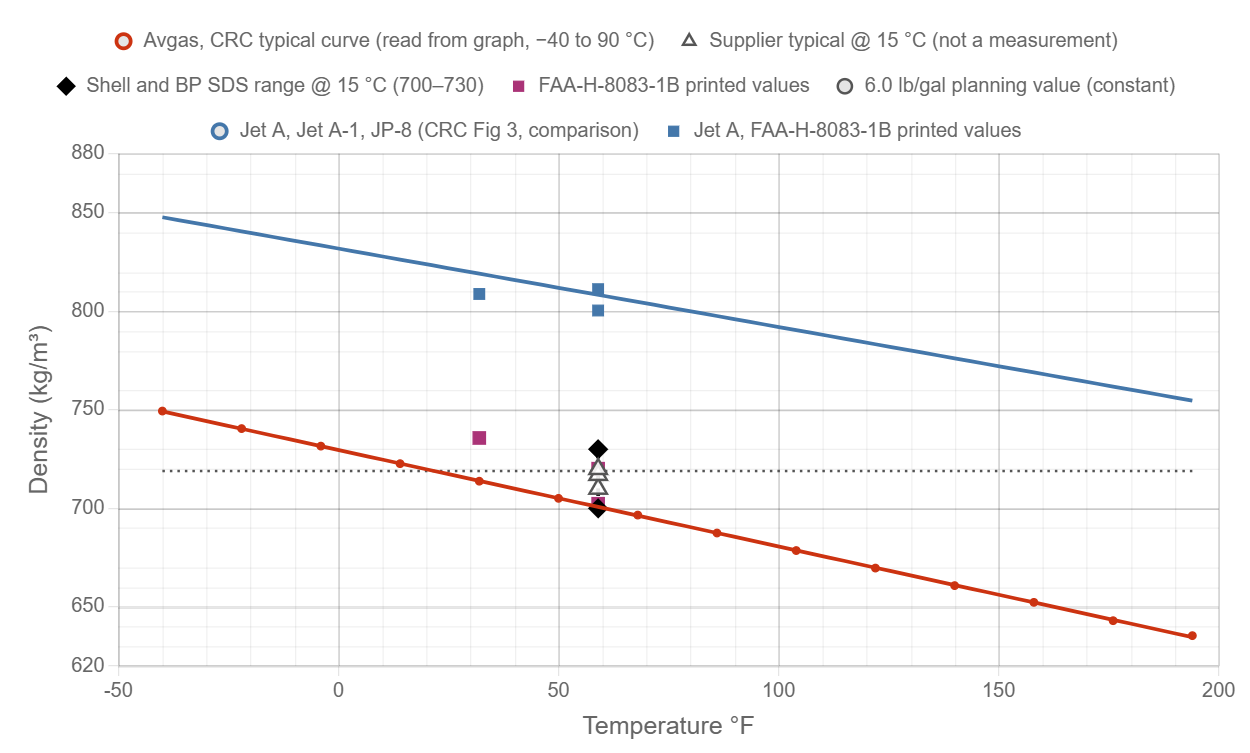
Avgas 100LL Density and Weight per Gallon vs Temperature Graph

Solid red line: CRC Report 530 Fig 3, typical “Av Gas” curve, read from the graph (about ±3 kg/m³), −40 °C to 90 °C (−40 °F to 194 °F). Solid blue line: Jet A, Jet A-1 and JP-8 from the same CRC figure. Nothing is drawn outside the CRC range.

Triangles are supplier typical values at 15 °C (not measurements made for this site). The vertical dashed bar is the 700 to 730 kg/m³ range printed on the Shell and BP safety data sheets. Squares are values printed in FAA-H-8083-1B. The grey dashed line is the 6.0 lb/gal planning value, which does not change with temperature.

Data from: CRC Report 530 (1983), DTIC ADA132106, Fig 3; supplier sheets and the FAA Weight and Balance Handbook as listed under Sources.

Toggle data sets by clicking the legend.

Avgas 100LL Density Calculator
Degrees (°F):
Degrees (°C):
Density (kg/m³):  
Density (g/cm³):  
Density (lb/in³):  
Weight (lb/gal):  
Density (lb/ft³):  
Specific Gravity*:  
Specific Gravity**:  
Specific Gravity***:  
°API****:  
Jet A (kg/m³):  
Jet A (lb/gal):  
Avgas 100LL Fuel Weight Calculator
Weight basis:
US gallons:
Litres:
Weight (lb):  
Weight (kg):  
Weight per gallon used (lb/gal):  
Density used (kg/L):  

Uses the temperature in the calculator above when the basis is “CRC typical”. US gallon = 3.785412 L.

Calculator valid −40 °C to 90 °C (−40 °F to 194 °F), atmospheric pressure, using the straight-line fit to the CRC typical curve: ρ = 713.96 − 0.8815 · T°C kg/m³ (largest departure from the read points 0.8 kg/m³). This is a typical value. Your batch can be 2 % higher or lower.

Specific Gravity is a Contentious Unit

* SG based on static density of water of 1000 (kg/m³) *

** SG based on static density of water of 998 (kg/m³) **

*** SG based on temperature dependent density of water ***

**** °API gravity at current temperature, referenced to water at 60°F (999.01 kg/m³): °API = (141.5 / SG60°F) − 131.5 ****

Density and Weight of Avgas 100LL
About This Data

The curve is the “Av Gas” line in Fig 3 of CRC Report 530, Aviation Fuel Properties (Coordinating Research Council, 1983, DTIC ADA132106). It is a typical curve. It does not name a grade or a batch. We read it from the printed graph at 10 °C steps and fitted a straight line: ρ = 713.96 − 0.8815 · T°C kg/m³. The fit gives 700.7 kg/m³ (5.85 lb/gal) at 15 °C. Read precision is about ±3 kg/m³. Fig 11 of the same report gives the lb/gal scale used for fuel weight.

Suppliers print higher values at 15 °C: 710, 717 and 720 kg/m³ (Z Energy, Viva, Eni), and two safety data sheets give a range of 700 to 730 kg/m³. So the 1983 typical curve sits at the low end of modern batches. The table below lists every value with its source.

Temperature Effect

Avgas expands about 0.13 % per °C (0.07 % per °F). A gallon of 100LL at 90 °F weighs about 6 % less than at 0 °F. The curve is steeper than Jet A, which falls about 0.09 % per °C. Volume gauges and fuel trucks measure gallons, so the weight of those gallons changes with fuel temperature.

Related Pages

Avgas 100LL general properties, viscosity, vapor pressure, distillation curve, jet fuel properties, and pounds per hour fuel flow.

Avgas 100LL Density vs. Temperature
Temp (°C)Temp (°F)Avgas density (kg/m³)Avgas density (g/cm³)Avgas weight (lb/gal)Avgas (lb/ft³)Avgas SG (water 15 °C)Jet A density (kg/m³)Jet A weight (lb/gal)
-40-40.0749.20.74926.25346.770.7500847.87.075
-35-31.0744.80.74486.21646.500.7456844.27.045
-30-22.0740.40.74046.17946.220.7411840.67.015
-25-13.0736.00.73606.14245.950.7367837.06.985
-20-4.0731.60.73166.10545.670.7323833.56.956
-155.0727.20.72726.06945.400.7279829.96.926
-1014.0722.80.72286.03245.120.7235826.36.896
-523.0718.40.71845.99544.850.7191822.76.866
032.0714.00.71405.95844.570.7147819.16.836
541.0709.60.70965.92244.300.7103815.56.806
1050.0705.10.70515.88544.020.7059812.06.776
1559.0700.70.70075.84843.750.7014808.46.746
2068.0696.30.69635.81143.470.6970804.86.716
2577.0691.90.69195.77443.200.6926801.26.687
3086.0687.50.68755.73842.920.6882797.66.657
3595.0683.10.68315.70142.650.6838794.16.627
40104.0678.70.67875.66442.370.6794790.56.597
45113.0674.30.67435.62742.090.6750786.96.567
50122.0669.90.66995.59041.820.6706783.36.537
55131.0665.50.66555.55441.540.6661779.76.507
60140.0661.10.66115.51741.270.6617776.26.477
65149.0656.70.65675.48040.990.6573772.66.447
70158.0652.30.65235.44340.720.6529769.06.418
75167.0647.80.64785.40740.440.6485765.46.388
80176.0643.40.64345.37040.170.6441761.86.358
85185.0639.00.63905.33339.890.6397758.36.328
90194.0634.60.63465.29639.620.6353754.76.298

Columns 3–7 use the fit to the CRC Report 530 Fig 3 “Av Gas” curve (read from graph, ±3 kg/m³). Jet A columns use the Jet A / Jet A-1 / JP-8 curve of the same figure: ρ = 819.13 − 0.7162 · T°C. lb/gal = kg/m³ × 0.0083454. SG uses water at 999.0 kg/m³ (15 °C). −40 to 90 °C only.

Supplier Typical Values (not measurements for this site)
SourcePrinted valueTemp (°C)Density (kg/m³)Weight (lb/gal)
Z Energy Avgas 100LL TDS (2016)0.710 kg/L (D1298 / D4052 / IP160), typical of current production157105.925
Viva Energy Avgas 100LL (2019)717 kg/m³ (ASTM D4052), typical157175.983
Eni Avgas 100 LL TDS (2016)Typical 720 kg/m³ (ASTM D1298, D4052)157206.008
Shell Avgas 100LL safety data sheet (2026)700.0 to 730.0 kg/m³ (range, not a measurement)15700 to 7305.84 to 6.09
BP Avgas 100LL safety data sheet (2022)700 to 730 kg/m³ (range, not a measurement)15700 to 7305.84 to 6.09
TOTAL Deutschland AVGAS 100 LL spec (2013)Density at 15 °C: to be reported (no limit)15report only—

Single-batch typicals and safety data sheet ranges. They carry no stated uncertainty. lb/gal = kg/m³ × 0.0083454.

What the FAA and Others Print
SourceWhat it printsTemp (°C)Density (kg/m³)Weight (lb/gal)
FAA-H-8083-1B Fig 3-4 (p.3-4)AVGAS 6.14 lb/gal at 32 °F; 6.01 lb/gal at 59 °F0 / 15735.8 / 720.16.14 / 6.01
FAA-H-8083-1B Fig 9-44 (p.9-14)AV gas grade 100/130: average specific gravity 0.703 at 15 °C (59 °F)15702.35.86
FAA-H-8083-1B Fig 5-6 (loading graph)Axis labelled “Fuel (6 lb/gal)”—719.06.00
GAMI flight manual supplement (G100UL)“For Grade 100LL, use 6.0 lbs/gal for weight and balance calculations.”—719.06.00
CRC Report 530 Fig 3 (this page, fit)Typical “Av Gas” curve, read from graph15700.75.848

FAA-H-8083-1B prints both 6.01 lb/gal at 59 °F (Fig 3-4) and SG 0.703 at 15 °C (Fig 9-44, 5.86 lb/gal). The loading graph rounds to 6 lb/gal. Fig 3-4 gives Jet A and A-1 as 6.75 (32 °F) and 6.68 lb/gal (59 °F). SG converted with 999.1 kg/m³ water at 15 °C.

Other Avgas Grades (weight as printed by each source)
GradeWeight printedSource
100LL (blue)6.0 lb/gal (planning)GAMI flight manual supplement p.6
UL94 (Swift Fuels)5.87 lb/gal, “identical to 100LL”Swift Fuels FAQ
UL91 (Hjelmco batch 095/2021)716.1 kg/m³ at 15 °C (5.98 lb/gal), measured on one batchHjelmco certificate of quality
G100UL (GAMI)6.25 lb/gal for weight and balance; 6.2 to 6.3 lb/gal typicalGAMI flight manual supplement p.6; GAMI ICA Rev C

Do not use the 100LL value for G100UL. GAMI says to use 6.25 lb/gal for G100UL or for a mixture.
Sources
  • Coordinating Research Council, Aviation Fuel Properties (Handbook of Aviation Fuel Properties), CRC Report No. 530, 1983. DTIC ADA132106. apps.dtic.mil/sti/pdfs/ADA132106.pdf. Fig 3 (typical density vs temperature, Av Gas and Jet A); Fig 11 (unit mass of aviation gasoline). Values read from the printed graph; accessed 25 Oct 2026.
  • FAA, Aircraft Weight and Balance Handbook, FAA-H-8083-1B, 2016. faa.gov Weight_Balance_Handbook.pdf. Fig 3-4 (p.3-4), Fig 5-6 (loading graph), Fig 9-44 (p.9-14).
  • GAMI, G100UL Avgas Airplane Flight Manual Supplement 06-6590007 Rev B, FAA approved 6 Oct 2022. g100ul.com AFMS. “For Grade 100LL, use 6.0 lbs/gal”; G100UL 6.25 lb/gal.
  • Z Energy, Avgas 100LL Technical Data Sheet, 4 Aug 2016. z.co.nz Avgas-100LL-TDS.pdf. Typical density 0.710 kg/L at 15 °C.
  • Viva Energy Australia, Avgas 100LL, Piston Engine Aircraft Fuel, Oct 2019. vivaenergy.com.au. Typical density 717 kg/m³ at 15 °C.
  • eni, Avgas 100 LL Technical Data Sheet EN101-01, 06/2016. oilproducts.eni.com. Typical density 720 kg/m³ at 15 °C.
  • Shell Trading (US), Safety Data Sheet AVGAS 100LL, version 14.0, 6 Sep 2026. epc.shell.com. Density 700.0 to 730.0 kg/m³ at 15 °C (range).
  • BP Portugal, Avgas 100LL (<0.1% Benzene) Ficha de Dados de Segurança SAV2103C, 2 Feb 2022. bp.com safety data sheet. Density 700 to 730 kg/m³ at 15 °C (range).
  • TOTAL Deutschland GmbH, AVGAS 100 LL Produktspezifikation für die Luftfahrt, valid from Oct 2013. content-center.totalenergies.com. Density to be reported (no limit).
  • Hjelmco Oil AB, Certificate of Quality, AVGAS 91/96 UL, batch 095/2021. hjelmco.com. UL91 batch density 716.1 kg/m³.
  • Swift Fuels, Frequently Asked Questions (UL94). swiftfuelsavgas.com/faq. UL94 weighs 5.87 lb/gal.

The CRC curve is a typical curve read from a printed graph, not a measurement made for this site. ASTM D910 and DEF STAN 91-090 were not opened; they are cited only through the supplier sheets above. Supplier values are typicals or ranges.

Cite This Work