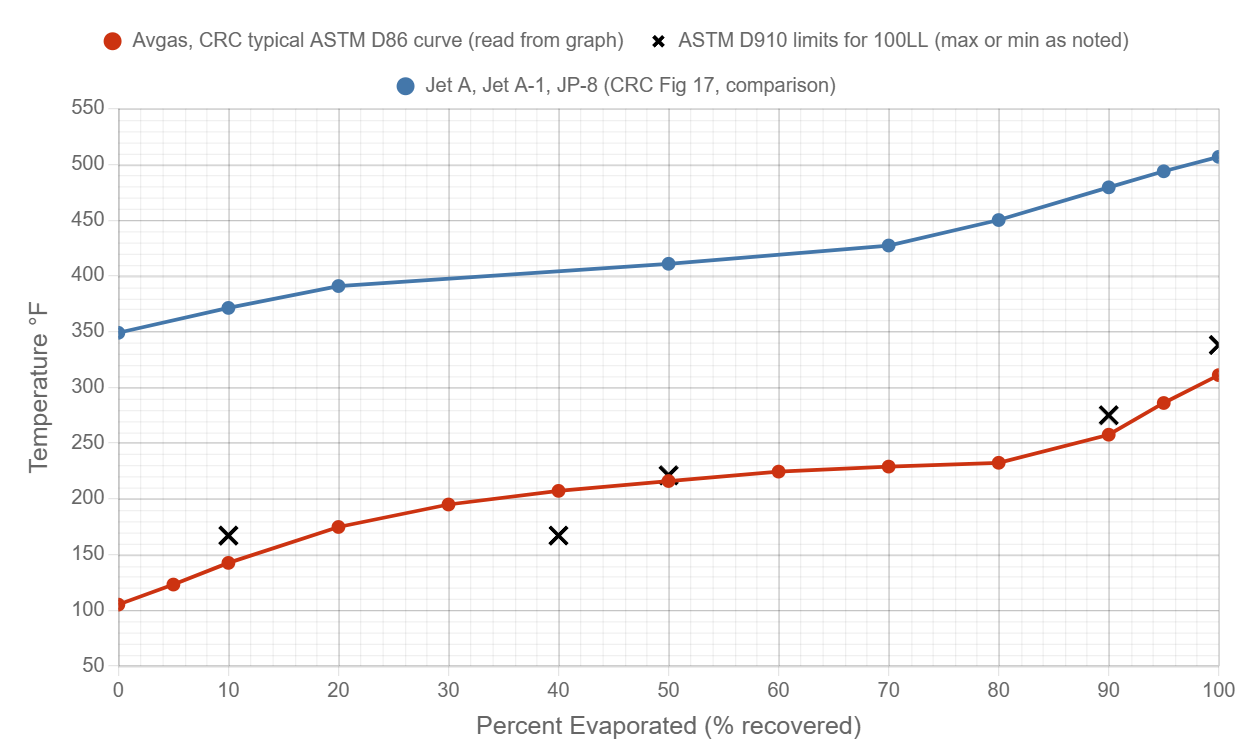
Avgas 100LL boils over a narrow band: it starts near 40 °C (104 °F), half of it is gone by about 102 °C (216 °F), and it is all gone by about 155 °C (311 °F). Jet A starts at about 176 °C (349 °F) and ends near 264 °C (507 °F). The ASTM D910 limits keep every batch inside a fixed window. A distillation test (ASTM D86) heats a sample and records the temperature when each share has boiled off.
Red line: CRC Report 530 Fig 17, typical “Av Gas” ASTM D86 curve, read from the graph (about ±2 °C, 4 °F). X-axis is the percent of the sample evaporated (recovered). Y-axis is temperature in °F. Blue line: Jet A, Jet A-1 and JP-8, same figure.
Black crosses are the ASTM D910 limits as printed on the ExxonMobil, Eni and TOTAL sheets: 10 % at 75 °C (167 °F) max, 40 % at 75 °C min, 50 % at 105 °C (221 °F) max, 90 % at 135 °C (275 °F) max, final boiling point 170 °C (338 °F) max. The typical curve is not a guarantee for any batch.
Data from: CRC Report 530 (1983), DTIC ADA132106, Fig 17 (printed p.43).
Toggle data sets by clicking the legend.
Calculator valid 0 to 100 % evaporated, straight lines between the points read from CRC Fig 17 (avgas at 13 points, Jet A at 9 points). The D910 limit is shown only at 10, 40, 50, 90 and 100 % (final boiling point). Typical curve, not a batch result.
The curves are Fig 17 of CRC Report 530, Aviation Fuel Properties (Coordinating Research Council, 1983, DTIC ADA132106). The figure is titled “Typical Distillation Curves, ASTM D 86” and has curves for Jet A, Jet A-1 and JP-8; JP-4 and Jet B; and Av Gas. The avgas curve does not name a grade or batch. We read it at 5 or 10 % steps from a high-resolution image. The limits are the ASTM D910 limits printed by ExxonMobil, Eni and TOTAL for Avgas 100LL. CRC Table 1 (the 1981 edition of D910) prints the same temperatures.
The sources list the limits but do not explain them. In general: the 10 % maximum makes sure enough light fuel is present to start the engine. The 40 % minimum and the 10 % + 50 % minimum keep the fuel from being too volatile, which helps against vapor lock and carburetor icing. The 50 % maximum keeps the middle of the fuel volatile enough for an even mixture and smooth power changes. The 90 % and end-point maximums limit heavy ends that burn poorly, which can leave deposits and foul spark plugs. Recovery, residue and loss show whether the sample is clean and has not lost light ends.
Vapor pressure, general properties and specifications, density and weight, and jet fuel properties.
| % evaporated (recovered) | Avgas typical (°C) | Avgas typical (°F) | Jet A typical (°C) | Jet A typical (°F) |
|---|---|---|---|---|
| 0 | 40.6 | 105.1 | 176.1 | 349.0 |
| 5 | 50.6 | 123.1 | — | — |
| 10 | 61.4 | 142.5 | 188.5 | 371.3 |
| 20 | 79.3 | 174.7 | 199.4 | 390.9 |
| 30 | 90.5 | 194.9 | — | — |
| 40 | 97.3 | 207.1 | — | — |
| 50 | 102.2 | 216.0 | 210.5 | 410.9 |
| 60 | 106.9 | 224.4 | — | — |
| 70 | 109.4 | 228.9 | 219.6 | 427.3 |
| 80 | 111.3 | 232.3 | 232.3 | 450.1 |
| 90 | 125.3 | 257.5 | 248.6 | 479.5 |
| 95 | 141.1 | 286.0 | 256.6 | 493.9 |
| 100 | 155.0 | 311.0 | 263.8 | 506.8 |
Read from CRC Report 530 Fig 17 (±2 °C). — means we did not read that point for Jet A (5, 30, 40 and 60 are on the curve but were not read).
| Point | Limit (°C) | Limit (°F) | ASTM D910 limit as printed on supplier sheets (°C unless stated) | CRC typical curve (°C) |
|---|---|---|---|---|
| 10 % evaporated | 75 | 167 | ≤ 75 (max) | 61.4 |
| 40 % evaporated | 75 | 167 | ≥ 75 (min) | 97.3 |
| 50 % evaporated | 105 | 221 | ≤ 105 (max) | 102.2 |
| 90 % evaporated | 135 | 275 | ≤ 135 (max) | 125.3 |
| Final boiling point | 170 | 338 | ≤ 170 (max) | 155.0 |
| Sum of 10 % and 50 % temperatures | — | — | ≥ 135 (min) | 163.6 |
| Recovery | — | — | ≥ 97 % (min) | — |
| Residue | — | — | ≤ 1.5 % (max) | — |
| Loss | — | — | ≤ 1.5 % (max) | — |
Limits as printed on the ExxonMobil Avgas Series page, the Eni 100 LL data sheet and the TOTAL Deutschland spec. The sheets agree. ASTM D910 itself was not opened.
| Source | IBP | 10 % | 40 % | 50 % | 90 % | FBP |
|---|---|---|---|---|---|---|
| CRC 530 Fig 17 typical Av Gas (°C) | 40.6 | 61.4 | 97.3 | 102.2 | 125.3 | 155.0 |
| Hjelmco UL91 batch 095/2021 (unleaded, D86, °C) | 34.7 | 67.1 | 99.7 | 102.6 | 109.2 | 133.4 |
| ASTM D910 limit (°C) | report | 75 max | 75 min | 105 max | 135 max | 170 max |
The Hjelmco row is a measured batch of the unleaded grade UL91, not 100LL, shown only to show that a real batch can differ from the typical curve (its 90 % point is 16 °C lower).
- Coordinating Research Council, Aviation Fuel Properties (Handbook of Aviation Fuel Properties), CRC Report No. 530, 1983. DTIC ADA132106. apps.dtic.mil/sti/pdfs/ADA132106.pdf. Fig 17 (typical distillation curves, ASTM D86); Table 1 (aviation gasoline specifications). Values read from the printed graph; accessed 25 Oct 2026.
- ExxonMobil, Avgas Series product page (Avgas 100LL limits). mobil.com. Distillation limits and final boiling point.
- eni, Avgas 100 LL Technical Data Sheet EN101-01, 06/2016. oilproducts.eni.com. Distillation limits (ASTM D86).
- TOTAL Deutschland GmbH, AVGAS 100 LL Produktspezifikation für die Luftfahrt, valid from Oct 2013. content-center.totalenergies.com. Distillation limits.
- Hjelmco Oil AB, Certificate of Quality, AVGAS 91/96 UL, batch 095/2021. hjelmco.com. UL91 batch D86 results.
The CRC curve is a typical curve read from a printed graph, not a measurement made for this site. ASTM D910 and DEF STAN 91-090 were not opened. The explanation of the limits is general knowledge, not taken from the sources.