MIL-PRF-87257 hydraulic fluid must flow at −54 °C (−65 °F): the limit is 2500 mm²/s (cSt) maximum at 3 and 72 hours. At −40 °C its limit is 550 cSt maximum. The MIL-PRF-83282 limit at −40 °C is 2200 cSt, four times higher, and 83282 has no −54 °C limit. Typical 87257 products read 447 to 492 cSt at −40 °C, against 2027 to 2089 cSt for typical 83282 products: about 4.1 to 4.7 times thinner. This page charts kinematic viscosity only. See the MIL-PRF-87257 general properties page for limits, products and single-point values.
MIL-PRF-87257 Kinematic Viscosity Chart
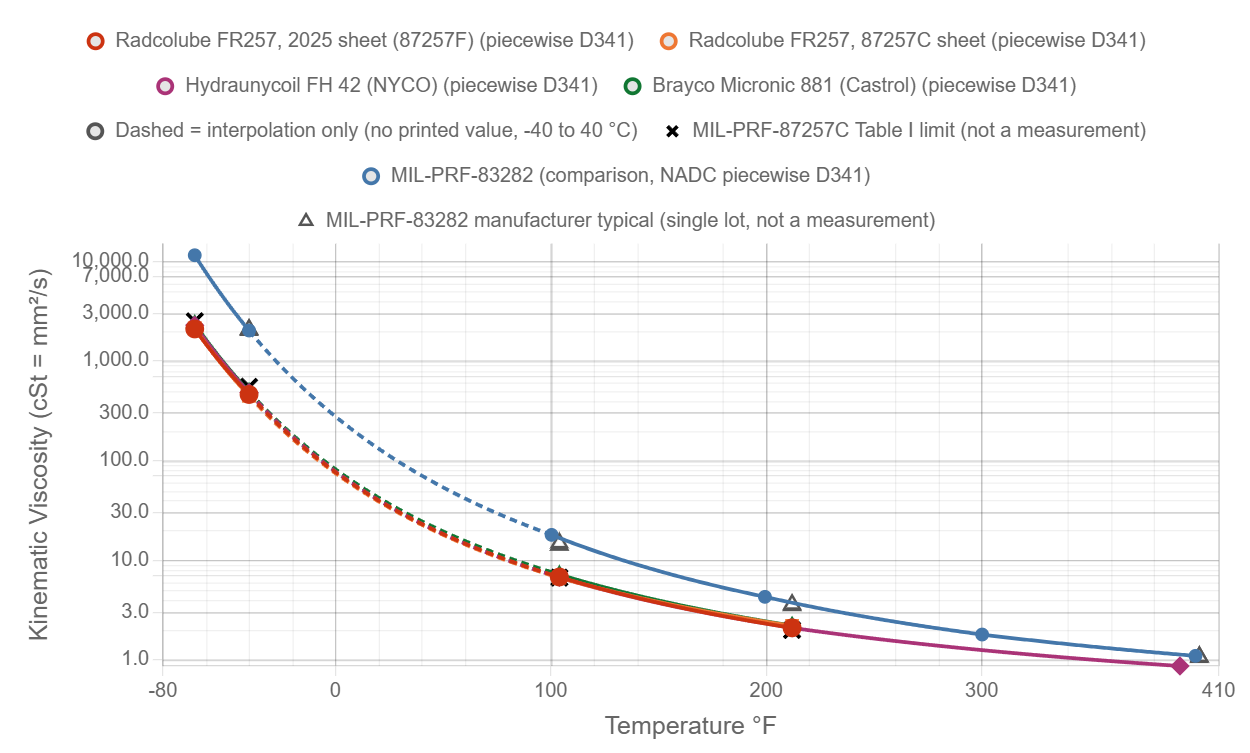
Markers are manufacturer typical values for four single lots (not measurements made for this site): Radcolube FR257 (2025 sheet, 87257F), Radcolube FR257 (87257C sheet), Hydraunycoil FH 42 and Brayco Micronic 881. Lines are piecewise ASTM D341 interpolation between the printed points. Y-axis is logarithmic.
Dashed line segments from −40 °C to 40 °C are interpolation across 80 °C with no value printed in between. Nothing is drawn below −54 °C. Above 100 °C only Hydraunycoil FH 42 has a value (200 °C), so the other lines stop at 100 °C.
Black crosses are the limits of MIL-PRF-87257C Table I (2500 cSt maximum at −54 °C, 550 maximum at −40 °C, 6.7 minimum at 40 °C, 2.0 minimum at 100 °C): not measurements. The blue MIL-PRF-83282 series is the NADC-79248-60 measurement of that fluid (1980 reference lot) with its own interpolation (dashed between −40 and 38 °C), copied unchanged from the MIL-PRF-83282 viscosity page. Grey triangles are single-lot typical values from three 83282 product data sheets (not measurements).
Data from: MIL-PRF-87257C Table I (limits); product data sheets listed under Sources; NADC-79248-60 (Conte & Hammond, 1980), DTIC ADA081597, Table 1 (83282 comparison).
Toggle data sets by clicking the legend.
MIL-PRF-87257 Viscosity Calculator
Degrees (°F):
Degrees (°C):
Kinematic Viscosity: Radcolube FR257 (2025 sheet)
mm²/s (= cSt):
Centistokes (cSt):
Stokes (cm²/s):
m²/s:
in²/s:
ft²/s:
Other Lots (kinematic, cSt)
Radcolube FR257 (87257C sheet):
Hydraunycoil FH 42:
Brayco Micronic 881:
MIL-PRF-83282 (comparison)
Kinematic (cSt):
83282 / 87257 (Radcolube 2025):
Each value comes from the piecewise ASTM D341 interpolation through that lot's printed points, and shows “Out of Range” outside the lot's own range: −54 to 100 °C (−65.2 to 212 °F) for the three Radcolube and Brayco lots, −54 to 200 °C (−65.2 to 392 °F) for Hydraunycoil FH 42 and −54 to 204 °C (−65.2 to 399.2 °F) for the MIL-PRF-83282 NADC curve. Between −40 and 40 °C every value is interpolation only. All 87257 values are single-lot manufacturer typicals, not measurements made for this site, and carry no stated uncertainty.
Viscosity of MIL-PRF-87257 Low-Temperature Hydraulic Fluid
About This Data
MIL-PRF-87257 is the U.S. military specification for a fire-resistant, synthetic hydrocarbon aircraft and missile hydraulic fluid for use from −54 °C to +200 °C (NATO code H-538). The spec suggests a base of 2 and 4 mm²/s polyalphaolefin (not mandatory) and bans viscosity index improvers and pour point depressants (MIL-PRF-87257C 3.2 and 3.2.1, pp.4–5). Blending fluids such as diesters, up to 35 % by weight, may be used to meet the −54 °C viscosity limit. No government test report with a measured viscosity curve for this fluid was found, so every point on the chart is a manufacturer “typical” value for one lot of one product, taken from the data sheets listed under Sources.
The lots agree within the spread of typical values: −40 °C readings run from 447 to 492 cSt (10 %) and −54 °C readings from 2094 to 2350 cSt (12 %), all inside the spec maximums of 550 and 2500 cSt. The Radcolube 87257C-sheet lot reads exactly the 6.7 cSt minimum at 40 °C. Values at 40 and 100 °C are printed to only two or three figures. The Radcolube sheet dated 2025-07-22 is headed MIL-PRF-87257F, but its test methods cite 87257E section numbers, and it prints the same limits as 87257C. Later revisions D, E and F were not opened (see general properties).
The curve for each lot is a piecewise ASTM D341 interpolation: between neighbouring printed points it is a straight line in Y = log10(log10(ν + 0.7)) against X = log10(T°C + 273.15), with ν in cSt, and it passes exactly through every printed point. A single D341 line through all points of a lot was not used: it misses the printed values by up to 7 %. The span from −40 °C to 40 °C has no printed value inside it, so values there are interpolation only. Nothing is extrapolated below −54 °C or above a lot's last printed temperature.
Why there is no dynamic viscosity. Dynamic viscosity is kinematic viscosity times density (μ = ν × ρ) at the same temperature. For MIL-PRF-87257 each data sheet gives density at only one temperature (15.6 or 20 °C), and no source gives density across the range. Without density at temperature, a dynamic viscosity curve would be a guess, so none is shown. The same gap rules out Prandtl number, thermal diffusivity and thermal expansion pages. For a fluid with those data see MIL-PRF-83282.
Dynamic (Absolute) vs. Kinematic Viscosity
Dynamic (Absolute) Viscosity: μ
Dynamic viscosity measures a fluid's resistance to shear: the internal force per unit area required to make one layer slide past another. It is independent of density. The SI unit is the pascal-second (Pa·s); the common engineering unit is the millipascal-second (mPa·s), numerically equal to centipoise (cP).
\[ \tau = \mu\,\frac{du}{dy} \]
Kinematic Viscosity: ν
Kinematic viscosity is the ratio of dynamic viscosity to fluid density. The SI unit is m²/s; the common unit is mm²/s, numerically equal to centistokes (cSt). Hydraulic fluid specifications grade viscosity kinematically because viscometers measure time-of-flow under gravity, which naturally yields kinematic viscosity. All MIL-PRF-87257 viscosity limits are kinematic (ASTM D445).
\[ \nu = \frac{\mu}{\rho} \quad\Rightarrow\quad \mu\ [\text{mPa}\cdot\text{s}] = \frac{\nu\ [\text{mm}^2/\text{s}] \times \rho\ [\text{kg/m}^3]}{1000} \]
MIL-PRF-87257: Manufacturer Typical Viscosity (not measurements)
| Temp (°C) | Temp (°F) | Radcolube FR257, 2025 (mm²/s) | Radcolube FR257, 87257C sheet (mm²/s) | Hydraunycoil FH 42 (mm²/s) | Brayco Micronic 881 (mm²/s) | Spec limit, 87257C (mm²/s) |
|---|
Single-lot typical values (ASTM D445), no uncertainty stated. The −54 °C values are the 3-hour viscosity stability results (ASTM D2532) for the two Radcolube lots, and the plain −54 °C row for FH 42 and Brayco 881. The 72-hour results are 2131 (Radcolube 2025), 2178 (Radcolube 87257C sheet) and 2377 cSt (Brayco), all under the 2500 limit. “—” means the sheet prints no value at that temperature.
Specification Limits (MIL-PRF-87257C Table I, p.8)
| Temp (°C) | Temp (°F) | MIL-PRF-87257C limit (mm²/s) | Radcolube FR257, 2025, curve (mm²/s) |
|---|
These are acceptance limits for the fluid, not measurements. The last column is the interpolated curve for the Radcolube 2025 lot at the same temperature, for reference only. The −54 °C limit applies at 3 and 72 hours (ASTM D2532).
Radcolube FR257 (2025 Sheet): Viscosity by Temperature
| Temp (°C) | Temp (°F) | Kinematic (mm²/s) | Basis |
|---|
Values from the piecewise ASTM D341 interpolation through the four printed points of the 2025 Radcolube sheet. “Interpolated, no value in span” marks temperatures between −40 and 40 °C.
MIL-PRF-87257 vs MIL-PRF-83282
Both are fire-resistant synthetic hydrocarbon fluids. MIL-PRF-83282 is written for −40 °C and above, with a maximum of 2200 cSt at −40 °C. MIL-PRF-87257 adds a −54 °C limit and cuts the −40 °C maximum to 550 cSt. The price is a thinner fluid when hot: the 87257 limit at 40 °C is 6.7 cSt minimum against 14.0 for 83282, and at 100 °C 2.0 against 3.45. The 83282 column below is copied unchanged from the MIL-PRF-83282 viscosity page (NADC-79248-60 Table 1, the 1980 reference lot). The 87257 column is the Radcolube FR257 2025 lot. They are different eras and lots, so treat the ratio as indicative. The two fluids must mix in all proportions from −54 to 200 °C (87257C Table I note 4, p.9). See also MIL-PRF-5606 and the MIL-PRF-87257 general properties.
| Temp (°C) | Temp (°F) | 87257 Radcolube 2025 (mm²/s) | 83282 NADC (mm²/s) | Ratio 83282 / 87257 |
|---|
Both columns use the piecewise D341 interpolation of their own printed points. At −40 °C the ratios between typical products run from 4.1 (2027 over 492) to 4.7 (2089 over 447). A dash means the 87257 lot has no printed value that high (it ends at 100 °C). Between −40 and 40 °C both columns are interpolation.
Sources
- US Department of Defense, MIL-PRF-87257C, Performance Specification: Hydraulic Fluid, Fire Resistant, Low Temperature, Synthetic Hydrocarbon Base, Aircraft and Missile, 30 June 2017. everyspec.com. Table I (pp.7–8) viscosity limits, note 4 (p.9), accessed 29 Oct 2026. Revisions D to F exist and were not opened.
- Radco Industries, Technical Data Sheet for RADCOLUBE FR257, MIL-PRF-87257F, product code FR257 (13056-A), revision date 22 Jul 2025. Radco data sheet. Typical viscosity at −40, 40 and 100 °C and viscosity stability at −54 °C (ASTM D445, D2532).
- Radco Industries, RADCOLUBE FR257 data sheet, MIL-PRF-87257C (undated). Radco data sheet (reseller copy). Typical viscosity, p.3.
- NYCO, HYDRAUNYCOIL FH 42 Technical Data Sheet, NATO code H-538 (undated). NYCO data sheet (reseller copy). Typical viscosity at −54, −40, 40, 100 and 200 °C, p.1.
- Castrol, Brayco Micronic 881 Low Temperature Hydraulic Fluid, Product Data, 10 Jun 2019. Castrol data sheet (distributor copy). Typical viscosity, p.1.
- A. A. Conte Jr. and J. L. Hammond, Development of a High Temperature Silicone Base Fire-Resistant Hydraulic Fluid, NADC-79248-60, Naval Air Development Center, Warminster PA, 5 Feb 1980. DTIC ADA081597. apps.dtic.mil/sti/tr/pdf/ADA081597.pdf. Table 1, MIL-H-83282 column (comparison series, copied from the MIL-PRF-83282 pages).
- US Department of Defense, MIL-PRF-83282D, 30 September 1997, Table II p.7, and the product data sheets (ROYCO 782, AeroShell Fluid 31, RADCOLUBE FR282) for the 83282 triangles: see the MIL-PRF-83282 viscosity page for links.
Every 87257 viscosity is a single-lot manufacturer typical, rounded to 2 to 3 figures at 40 and 100 °C, with no uncertainty stated. Qualification status of each product was not checked against QPL-87257. Data are also listed in tools/mil-prf-87257-sources.json and tools/mil-prf-87257-derived.json.