MIL-PRF-83282 Kinematic Viscosity Chart

Canvas Element Not Working, Please Check Browser Settings or Contact KasperCalc to fix the issue.

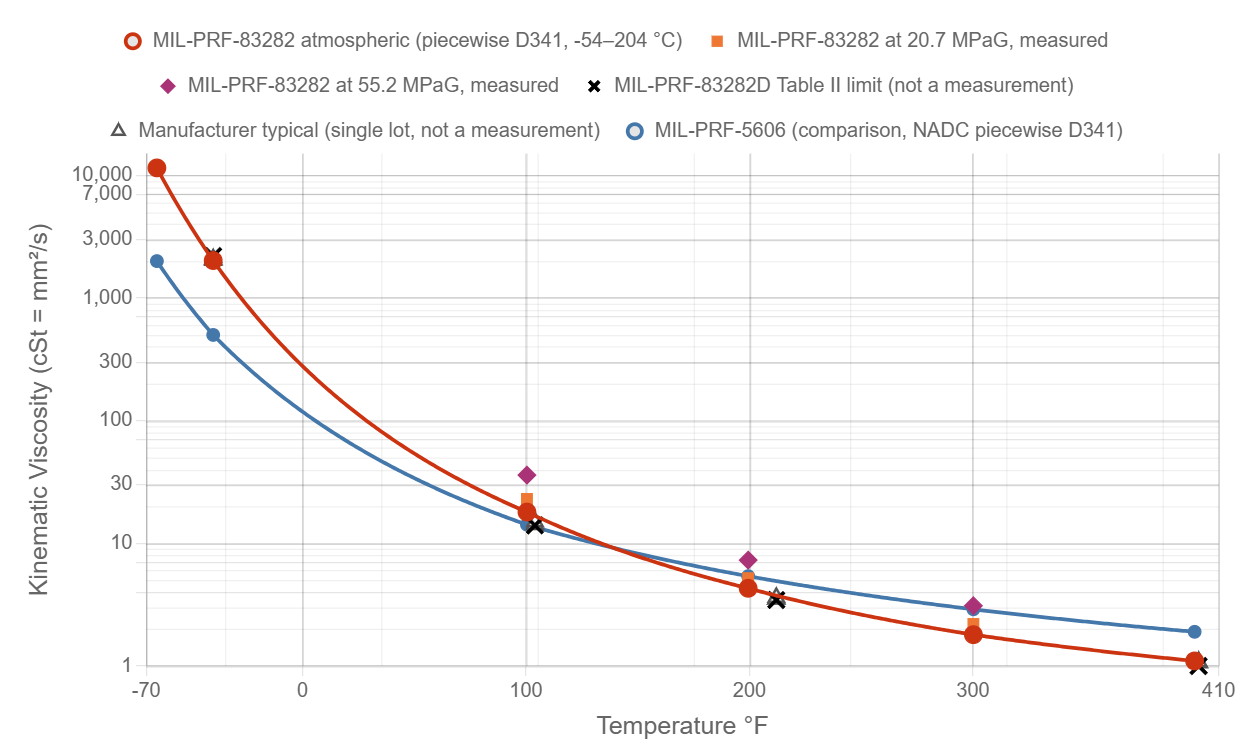
MIL-PRF-83282 kinematic viscosity vs temperature in degrees F, compared with MIL-PRF-5606

Measured values for MIL-H-83282 at atmospheric pressure, six points from −54 °C to 204 °C (−65.2 °F to 399.2 °F); the 20.7 MPaG (3000 psig) and 55.2 MPaG (8000 psig) rows are markers only. Y-axis is logarithmic.

The atmospheric curve is a piecewise ASTM D341 interpolation through the six measured points, drawn only from −54 °C to 204 °C; nothing is extrapolated. There is no measurement between −40 °C and 38 °C, so the curve in that span is interpolation only.

The measured NADC points are for the 1980 NADC reference lot of MIL-H-83282 (lot and revision not stated). That lot is more viscous at 38 °C (18.0 cSt) than current MIL-PRF-83282D products (14.2 to 15.0 cSt at 40 °C). Triangles are the single-lot typical values from three product data sheets (not measurements). Crosses are the limits of MIL-PRF-83282D Table II (maximum at −40 °C, minimum at 40, 100 and 205 °C), not measurements. The blue MIL-PRF-5606 series is the NADC measurement of that fluid, shown over its own −54 to 204 °C range.

Data from: NADC-79248-60 (Conte & Hammond, 1980), DTIC ADA081597, Table 1 (measured); MIL-PRF-83282D Table II (limits); product data sheets as listed under Sources.

Toggle data sets by clicking the legend.

MIL-PRF-83282 Dynamic (Absolute) Viscosity Chart

Canvas Element Not Working, Please Check Browser Settings or Contact KasperCalc to fix the issue.

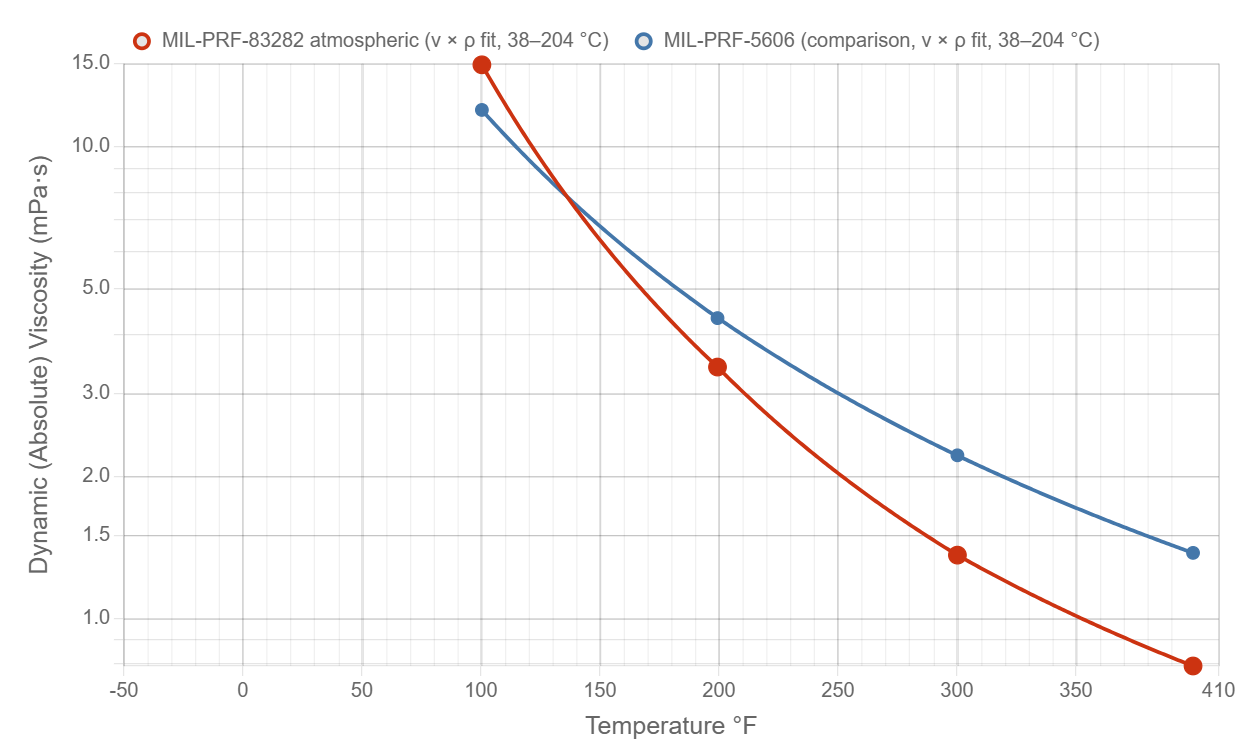
MIL-PRF-83282 dynamic viscosity vs temperature in degrees F, compared with MIL-PRF-5606

Computed from kinematic viscosity × density (μ = ν × ρ). Toggle data sets by clicking the legend. Y-axis is logarithmic.

Density source: straight-line fit to NADC-79248-60 Table 2 (atmospheric), valid only from 38 °C to 204 °C (100.4 °F to 399.2 °F). Dynamic viscosity is only computed within that range; no density was found below 38 °C. Circles are the four tabulated points (derived from Tables 1 and 2).

The blue MIL-PRF-5606 series is computed the same way from its own NADC Table 1 and Table 2 values, 38–204 °C only, with circles at the four tabulated points.

MIL-PRF-83282 Viscosity Calculator
Degrees (°F):
Degrees (°C):
Kinematic Viscosity
mm²/s (= cSt): 
Centistokes (cSt): 
Stokes (cm²/s): 
m²/s: 
in²/s: 
ft²/s: 
Dynamic (Absolute) Viscosity
mPa·s (= cP): 
Centipoise (cP): 
Poise (g/(cm·s)): 
Pa·s (Poiseuille): 
lbm/(ft·s): 
kg/(m·h): 
MIL-PRF-5606 (comparison)
Kinematic (cSt): 
Dynamic (mPa·s): 

Kinematic viscosity is valid −54 °C to 204 °C (−65.2 °F to 399.2 °F), atmospheric pressure, from the piecewise ASTM D341 interpolation; between −40 °C and 38 °C it is interpolation only. Dynamic viscosity is shown only from 38 °C to 204 °C, where the density fit is valid. The MIL-PRF-5606 rows use the same method on its own NADC data over the same ranges. These are the values for the 1980 NADC reference lot of MIL-H-83282 (lot and revision not stated).

Viscosity of MIL-PRF-83282 Fire-Resistant Hydraulic Fluid
About This Data

The kinematic viscosity values are the MIL-H-83282 columns of Table 1 in NADC-79248-60 (Conte & Hammond, Naval Air Development Center, 1980, DTIC ADA081597): atmospheric pressure at −54, −40, 38, 93, 149 and 204 °C, and 20.7 and 55.2 MPaG at 38, 93 and 149 °C. The report does not state the specification revision (MIL-H-83282 predates the MIL-PRF designation) or the lot tested, and it gives no uncertainty. Treat the data as the 1980 NADC reference lot of MIL-H-83282 (lot and revision not stated). It is more viscous at 38 °C (18.0 cSt) than current MIL-PRF-83282D products, which show 14.2 to 15.0 cSt at 40 °C. At −40 °C the NADC value (2020 cSt) matches the products (2027 to 2089 cSt) and the specification maximum (2200 cSt).

The smooth curve is a piecewise ASTM D341 interpolation: between neighbouring measured points it is a straight line in Y = log10(log10(ν + 0.7)) against X = log10(T°C + 273.15), with ν in cSt, and it passes exactly through every measured point. A single D341 line through all six points was not used because it misfits the data by +30 % at −54 °C, +11 % at −40 °C and −15 % at 38 °C. The span from −40 °C to 38 °C has no measurement inside it, so values there are interpolation only. Nothing is extrapolated outside −54 °C to 204 °C.

No dynamic viscosity is tabulated in any source used. It is derived as μ = ν × ρ, and only where the density fit (ρ = 854.002 − 0.65704 · T°C kg/m³, NADC Table 2 atmospheric) is valid, 38 °C to 204 °C. See also Density of MIL-PRF-83282.

MIL-PRF-83282 is a fire-resistant, synthetic hydrocarbon aircraft hydraulic fluid, dyed red. MIL-PRF-83282D is written for use from −40 °C to +205 °C. It sets a maximum of 2200 cSt at −40 °C and minimums of 14.0, 3.45 and 1.0 cSt at 40, 100 and 205 °C, and it bans viscosity index improvers. The triangles on the chart are single-lot “typical” values taken from manufacturer data sheets for products sold against the specification; they are not measurements made for this site and carry no stated uncertainty.

Dynamic (Absolute) vs. Kinematic Viscosity
Dynamic (Absolute) Viscosity — μ

Dynamic viscosity measures a fluid's resistance to shear — the internal force per unit area required to make one layer slide past another. It is independent of density. The SI unit is the pascal-second (Pa·s); the common engineering unit is the millipascal-second (mPa·s), numerically equal to centipoise (cP).

\[ \tau = \mu\,\frac{du}{dy} \]
Kinematic Viscosity — ν

Kinematic viscosity is the ratio of dynamic viscosity to fluid density. The SI unit is m²/s; the common unit is mm²/s, numerically equal to centistokes (cSt). Hydraulic fluid specifications grade viscosity kinematically because viscometers measure time-of-flow under gravity, which naturally yields kinematic viscosity.

\[ \nu = \frac{\mu}{\rho} \quad\Rightarrow\quad \mu\ [\text{mPa}\cdot\text{s}] = \frac{\nu\ [\text{mm}^2/\text{s}] \times \rho\ [\text{kg/m}^3]}{1000} \]
MIL-PRF-83282 — Measured Viscosity
Temp (°C) Temp (°F) Kinematic, atm. (mm²/s) 20.7 MPaG (mm²/s) 55.2 MPaG (mm²/s) Density, atm. (kg/m³) Dynamic, atm. (mPa·s)

Kinematic columns are NADC-79248-60 Table 1 (MIL-H-83282). Density is NADC Table 2 and dynamic viscosity is the product of the two at the same temperature (derived, not tabulated in any source). “—” means no value at that temperature. The lot and specification revision are not stated in the report and no uncertainty is given.

Specification Limits (MIL-PRF-83282D Table II, p.7)
Temp (°C) Temp (°F) Kinematic viscosity limit (mm²/s) Interpolated curve (mm²/s)

These are acceptance limits for the fluid, not measurements. The last column is the NADC-based curve on this page at the same temperature, for reference only (different lot, different era, no uncertainty stated). “—” means the curve does not reach that temperature (it ends at 204 °C). Amendment 1 (10 Dec 1997) did not change any viscosity limit.

Manufacturer Typical Values (not measurements)
Source Temp (°C) Temp (°F) Kinematic viscosity (mm²/s)

Single-lot typical values, no uncertainty stated. Sources: ROYCO 782 (LANXESS, 26 May 2016), AeroShell Fluid 31 (Shell TDS v1.3, 2021) and RADCOLUBE FR282 (Radco). All three are printed as qualified to MIL-PRF-83282D. At 40 °C the products (14.2 to 15.0 cSt) are below the NADC 1980 lot (18.0 cSt at 38 °C, 16.8 cSt interpolated to 40 °C).

MIL-PRF-83282 — Viscosity by Temperature
Temp (°C) Temp (°F) Kinematic (mm²/s) Dynamic (mPa·s) Basis

Values from the piecewise ASTM D341 interpolation through the six NADC measurements. Dynamic viscosity uses the density fit and is shown only from 38 °C to 204 °C. “Interpolated, no measurement in span” marks temperatures between −40 °C and 38 °C. The lot and specification revision are not stated in the report.

MIL-PRF-83282 vs MIL-PRF-5606

MIL-PRF-83282 is a synthetic hydrocarbon fluid; MIL-PRF-5606 is a petroleum (mineral oil) hydraulic fluid. Both columns below come from the same NADC Table 1 and Table 2, so the comparison is like for like. MIL-PRF-83282 is much thicker when cold (about 4 times the MIL-PRF-5606 viscosity at −40 °C) and thinner when hot (about 0.6 times at 204 °C). The curves cross between 38 and 93 °C. That is why 83282 needs a higher −40 °C limit (2200 cSt) than MIL-PRF-5606 (600 cSt). See MIL-PRF-83282 general properties.

Temp (°C) Temp (°F) 83282 kinematic (mm²/s) 5606 kinematic (mm²/s) Ratio 83282 / 5606 83282 dynamic (mPa·s) 5606 dynamic (mPa·s)

Both fluids use the piecewise D341 interpolation of their NADC-79248-60 Table 1 measurements, −54 to 204 °C (dynamic: 38 to 204 °C, from each fluid's own Table 2 density fit). The lot and specification revision are not stated for either fluid.

Sources
  • A. A. Conte Jr. and J. L. Hammond, Development of a High Temperature Silicone Base Fire-Resistant Hydraulic Fluid, NADC-79248-60, Naval Air Development Center, Warminster PA, 5 Feb 1980. DTIC ADA081597. apps.dtic.mil/sti/tr/pdf/ADA081597.pdf. Tables 1 and 2 (MIL-H-83282 and MIL-H-83282 columns), accessed 25 Oct 2026.
  • US Department of Defense, MIL-PRF-83282D, Performance Specification: Hydraulic Fluid, Fire Resistant, Synthetic Hydrocarbon Base, Metric, NATO Code Number H-537, 30 September 1997, with Amendment 1 (10 December 1997). everyspec.com. Table II viscosity limits, p.7.
  • LANXESS, ROYCO 782 Synthetic Fire Resistant Hydraulic Fluid Data Sheet, effective 26 May 2016. ROYCO 782 data sheet. Typical kinematic viscosity (ASTM D445). Printed claim: “qualified to MIL-SPEC: MIL-PRF-83282D Am 1”.
  • Shell, AeroShell Fluid 31 Technical Data Sheet, v1.3, 21 Jul 2021. AeroShell Fluid 31 TDS (reseller copy). Typical kinematic viscosity (ASTM D445). Printed specification: “MIL-PRF-83282D”.
  • Radco Industries, MIL-PRF-83282D(1) RADCOLUBE FR282 data sheet. RADCOLUBE FR282 data sheet. Typical kinematic viscosity (ASTM D445).

The NADC report does not state the specification revision or lot of the MIL-H-83282 tested, and gives no measurement uncertainty. Manufacturer values are single-lot typicals. Data are also listed in tools/mil-prf-83282-sources.json.

Cite This Work