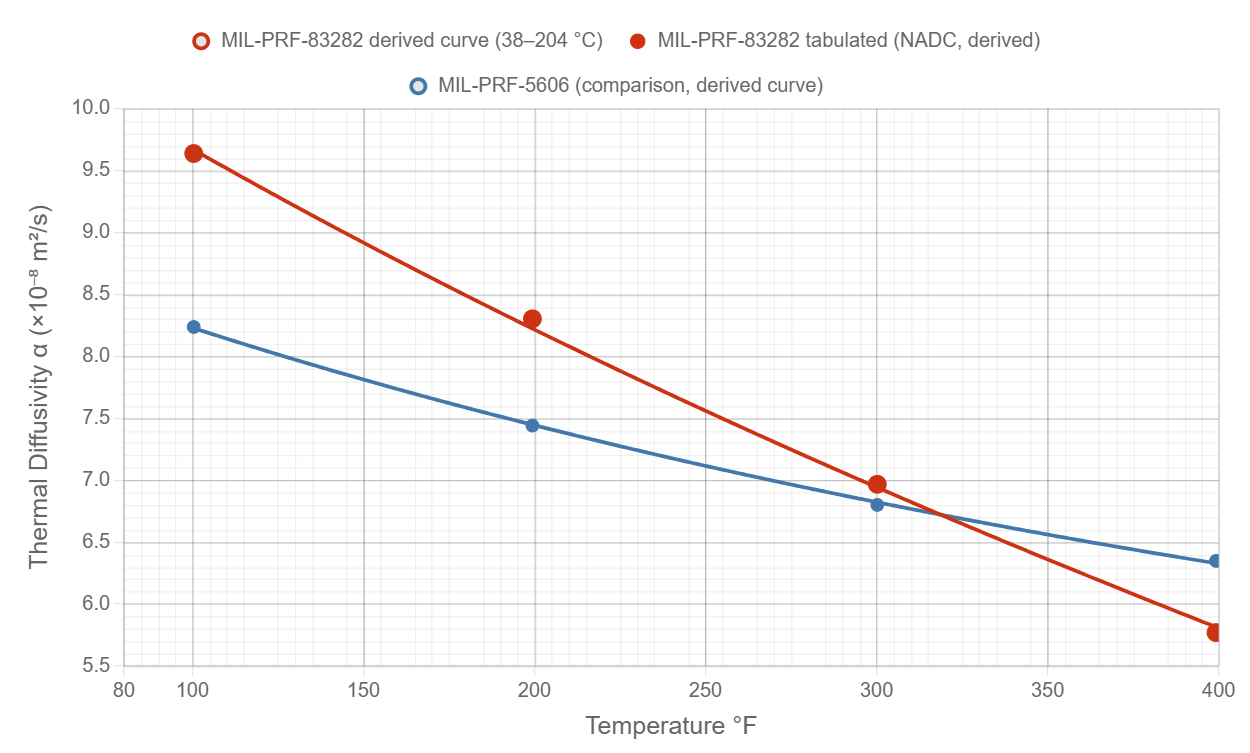
Thermal diffusivity (α) describes how quickly a material conducts heat relative to its ability to store thermal energy. It is derived, not measured: α = k / (ρ · cp), where k is thermal conductivity [W/(m·K)], ρ is density [kg/m³], and cp is isobaric specific heat capacity [J/(kg·K)]. NADC-79248-60 (Conte & Hammond, 1980, DTIC ADA081597) does not report thermal diffusivity; the inputs are its MIL-H-83282 columns of Table 2 (density), Table 7 (specific heat) and Table 8 (thermal conductivity), tabulated at 38, 93, 149 and 204 °C at atmospheric pressure.
The smooth curve is the ratio of three fits, with T in °C: ρ = 854.002 − 0.65704·T kg/m³; cp = 1946.01 + 3.6523·T J/(kg·K); k = 0.17956 − 0.000327925·T W/(m·K). The curve is used only between 38 °C and 204 °C. That is the density fit's range: the specific heat and conductivity fits extend down to −18 °C, but no density below 38 °C was found in the sources, so the derived diffusivity is not extended there. The curve departs from the four tabulated values by about 0.9 % at most.
MIL-PRF-83282 is a fire-resistant, synthetic hydrocarbon aircraft hydraulic fluid. It has a thermal diffusivity of roughly 9.6×10⁻⁸ m²/s at 38 °C, falling to about 5.8×10⁻⁸ m²/s at 204 °C. That is higher than MIL-PRF-5606 at 38 °C (by 18%) and lower at 204 °C (by 8%); see the comparison below. The NADC report gives no measurement uncertainty, and the derived values inherit the uncertainty of its Tables 2, 7 and 8. The 1980 lot is not the same as a current MIL-PRF-83282D product, so use the values as typical only.