MIL-PRF-83282 Prandtl Number Chart

Canvas Element Not Working, Please Check Browser Settings or Contact KasperCalc to fix the issue.

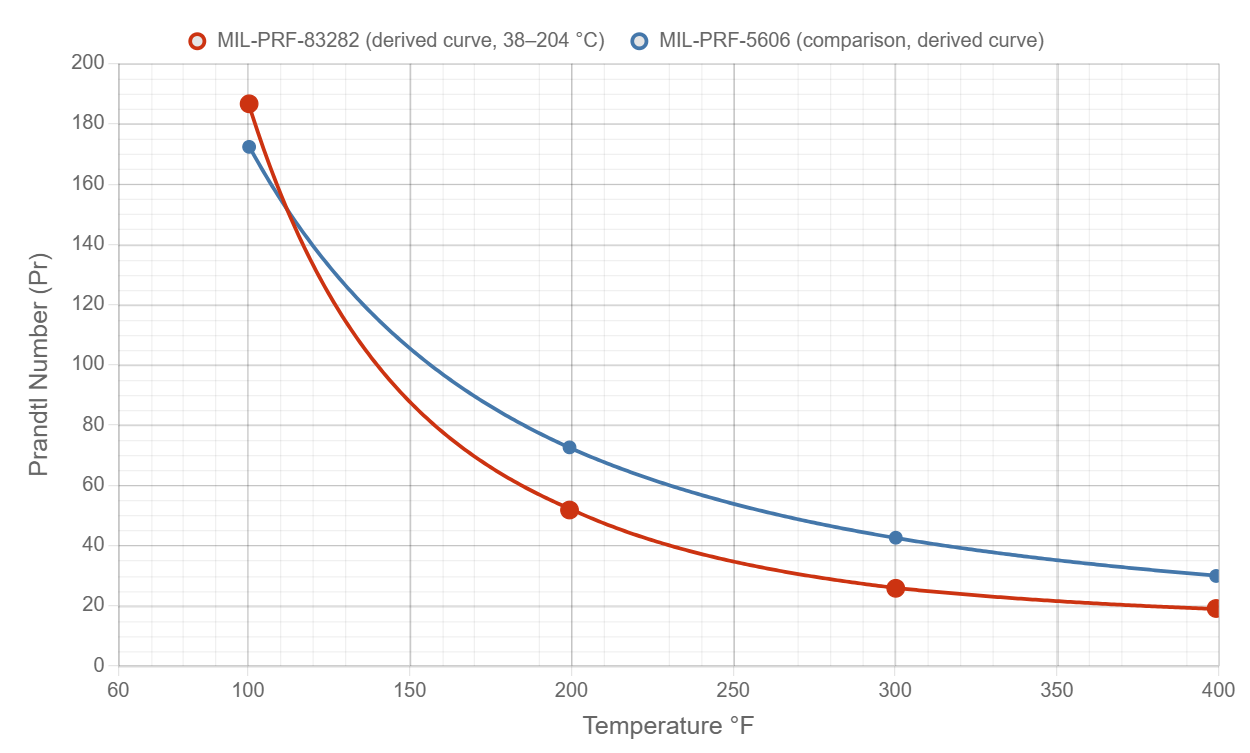
MIL-PRF-83282 Prandtl number vs temperature in degrees F, compared with MIL-PRF-5606

Derived: Pr = μ · cp / λ, with μ = ν · ρ. The curve covers 38 °C to 204 °C (100.4 °F to 399.2 °F) at atmospheric pressure. The four markers are the tabulated points at 38, 93, 149 and 204 °C.

The MIL-PRF-5606 series is derived the same way from the MIL-H-83282 columns of the same NADC tables, over the same 38–204 °C (100–399 °F) range. Nothing is extrapolated for either fluid. The inputs are for the 1980 NADC reference lot of MIL-H-83282 (lot and revision not stated).

Data from: NADC-79248-60 (Conte & Hammond, 1980), DTIC ADA081597, Tables 1, 2, 7 and 8 (measured inputs, MIL-H-83282 and MIL-H-83282 columns).

Toggle data sets by clicking the legend.

MIL-PRF-83282 Prandtl Number Calculator
Degrees (°F):
Degrees (°C):
Prandtl Number (Pr):  
μ (mPa·s):  
cp (kJ/kg·K):  
λ (W/m·K):  
MIL-PRF-5606 Pr:  

Calculator valid 100.4 °F to 399.2 °F (38 °C to 204 °C), atmospheric pressure. The MIL-PRF-5606 row is derived the same way over the same range.

Prandtl Number of MIL-PRF-83282 Fire-Resistant Hydraulic Fluid
About This Data

The Prandtl number (Pr) is a dimensionless quantity that characterizes the relative importance of momentum diffusion (viscosity) to thermal diffusion (thermal conductivity) in a fluid. It is defined as: Pr = μ · cp / λ, where μ is dynamic viscosity [mPa·s], cp is isobaric specific heat capacity [kJ/(kg·K)], and λ is thermal conductivity [W/(m·K)].

The Prandtl number is derived, not tabulated. NADC-79248-60 (Conte & Hammond, Naval Air Development Center, 1980, DTIC ADA081597) reports kinematic viscosity (Table 1), density (Table 2), specific heat (Table 7) and thermal conductivity (Table 8) for MIL-H-83282 (the 1980 NADC reference lot, lot and revision not stated), but no Prandtl number. Pr is calculated from those values with μ = ν · ρ, so Pr = ν · ρ · cp / λ. The four tabulated points at 38, 93, 149 and 204 °C (100, 200, 300 and 400 °F) are computed this way from the table values: Pr = 186.7, 51.8, 25.8 and 19.1. MIL-PRF-83282 is a fire-resistant, synthetic hydrocarbon aircraft hydraulic fluid. A high Pr means the fluid is poor at carrying heat away compared with how easily it flows, as with most oils.

The smooth curve is computed from fits to the same four tables. Kinematic viscosity uses piecewise ASTM D341 interpolation between the measured points (linear in log10(log10(ν + 0.7)) against log10(T + 273.15)), so it passes through each measured viscosity. Density is ρ = 854.002 − 0.65704 · T°C kg/m³, specific heat is cp = 1946.01 + 3.6523 · T°C J/(kg·K), and conductivity is λ = 0.17956 − 0.000327925 · T°C W/(m·K). The curve reproduces the tabulated Pr to within 1.0 % at all four temperatures.

The curve is limited to 38–204 °C because the density fit is valid only over that range, and μ needs density. The viscosity data reach down to −54 °C, but without density no Pr can be computed below 38 °C, so nothing is extended there. The NADC report gives no measurement uncertainty and does not state the lot or specification revision tested. The 1980 lot is more viscous at 38 °C than current MIL-PRF-83282D products, so Pr at the cool end is probably higher than a current fluid would show. See MIL-PRF-83282 viscosity.

MIL-PRF-83282 — Prandtl Number vs. Temperature
Temp (°C) Temp (°F) ν (cSt) ρ (kg/m³) μ (mPa·s) cp (kJ/kg·K) λ (W/m·K) Pr

Tabulated points. Computed: Pr = μ [mPa·s] × cp [kJ/(kg·K)] / λ [W/(m·K)], with μ = ν [cSt] × ρ [kg/m³] / 1000. Inputs: NADC-79248-60 Tables 1, 2, 7 and 8 (MIL-H-83282).

MIL-PRF-83282 vs MIL-PRF-5606

MIL-PRF-83282 is a synthetic hydrocarbon fluid; MIL-PRF-5606 is a petroleum hydraulic fluid. Both are derived from the same NADC tables over 38–204 °C. MIL-PRF-83282 has the higher Pr at the cool end (8 % higher at 38 °C) and the lower Pr when hot (37 % lower at 204 °C). The curves cross near 45 °C. The Pr gap follows the viscosity gap: 83282 is thicker when cold and thinner when hot.

Temp (°C) Temp (°F) MIL-PRF-83282 Pr MIL-PRF-5606 Pr Difference (Pr) Difference (% of MIL-PRF-5606)

Both columns use the derived curves, 38–204 °C only, each from its own NADC-79248-60 viscosity, density, specific heat and thermal conductivity data. The lot and specification revision are not stated for either fluid. Differences are computed from the values shown.

Sources
  • A. A. Conte Jr. and J. L. Hammond, Development of a High Temperature Silicone Base Fire-Resistant Hydraulic Fluid, NADC-79248-60, Naval Air Development Center, Warminster PA, 5 Feb 1980. DTIC ADA081597. apps.dtic.mil/sti/tr/pdf/ADA081597.pdf. Tables 1 (kinematic viscosity), 2 (density), 7 (specific heat) and 8 (thermal conductivity), MIL-H-83282 and MIL-H-83282 columns, accessed 25 Oct 2026.
  • US Department of Defense, MIL-PRF-83282D, Performance Specification: Hydraulic Fluid, Fire Resistant, Synthetic Hydrocarbon Base, Metric, NATO Code Number H-537, 30 September 1997, with Amendment 1. everyspec.com. Identification of the fluid.

The NADC report does not state the specification revision or lot of the MIL-H-83282 tested, and gives no measurement uncertainty. The Prandtl number is not reported in the NADC report; it is derived here from its Tables 1, 2, 7 and 8.

Cite This Work