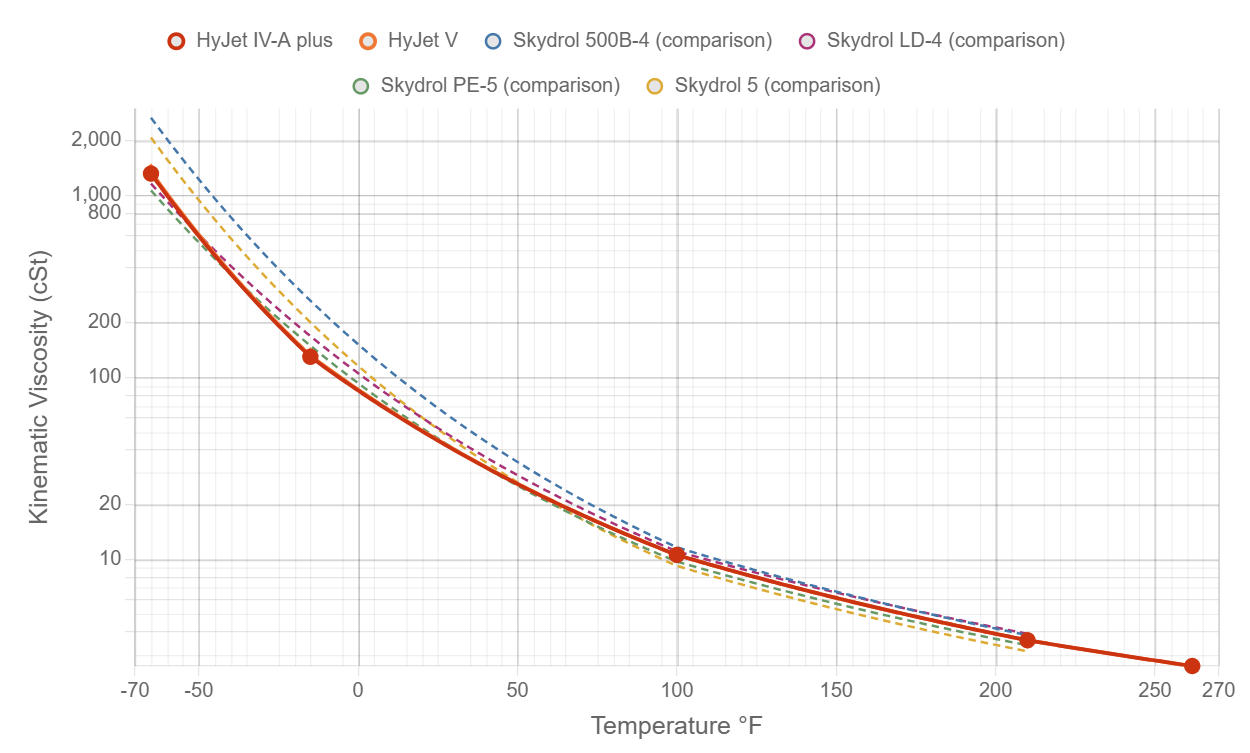
ExxonMobil prints kinematic viscosity (ASTM D445) at five temperatures for HyJet IV-A plus and HyJet V. These are typical values, not measurements. The cold end is the main difference between the grades: 1320 cSt for IV-A plus and 1350 cSt for V at −53.9 °C (−65 °F). From −26.1 °C up the two grades print the same values within 2 cSt. Both have a viscosity index of 280 (ASTM D2270).
Between the printed points the page interpolates on the ASTM D341 double-log scale, the usual straight-line scale for viscosity against temperature. A single D341 line does not fit all five points. It is off by about 190 cSt at −53.9 °C. So each pair of neighbouring points is joined separately. The calculator returns "Out of Range" below −65 °F and above the last printed point.
Note on the hot point. The sheets print "127.6 °C (260 °F)". Those two temperatures differ by 1 °C. It may be a typing error, but we could not confirm which is right. This page uses 127.6 °C as printed. The difference changes the curve by less than 0.1 cSt.
The table also shows the limits printed on the ExxonMobil data sheet. These are the maker's limits column, which follows SAE AS1241. We have not read the standard itself. Both HyJet grades sit inside those limits at every printed temperature.
Skydrol is a different brand from a different maker (Eastman). At −53.9 °C both HyJet grades are thinner than Skydrol 500B-4 (2678 cSt) and Skydrol 5 (2085 cSt). They are thicker than Skydrol LD-4 (1164 cSt) and Skydrol PE-5 (1068 cSt). See Skydrol General Properties.