HyJet Density Chart

Canvas Element Not Working, Please Check Browser Settings or Contact KasperCalc to fix the issue.

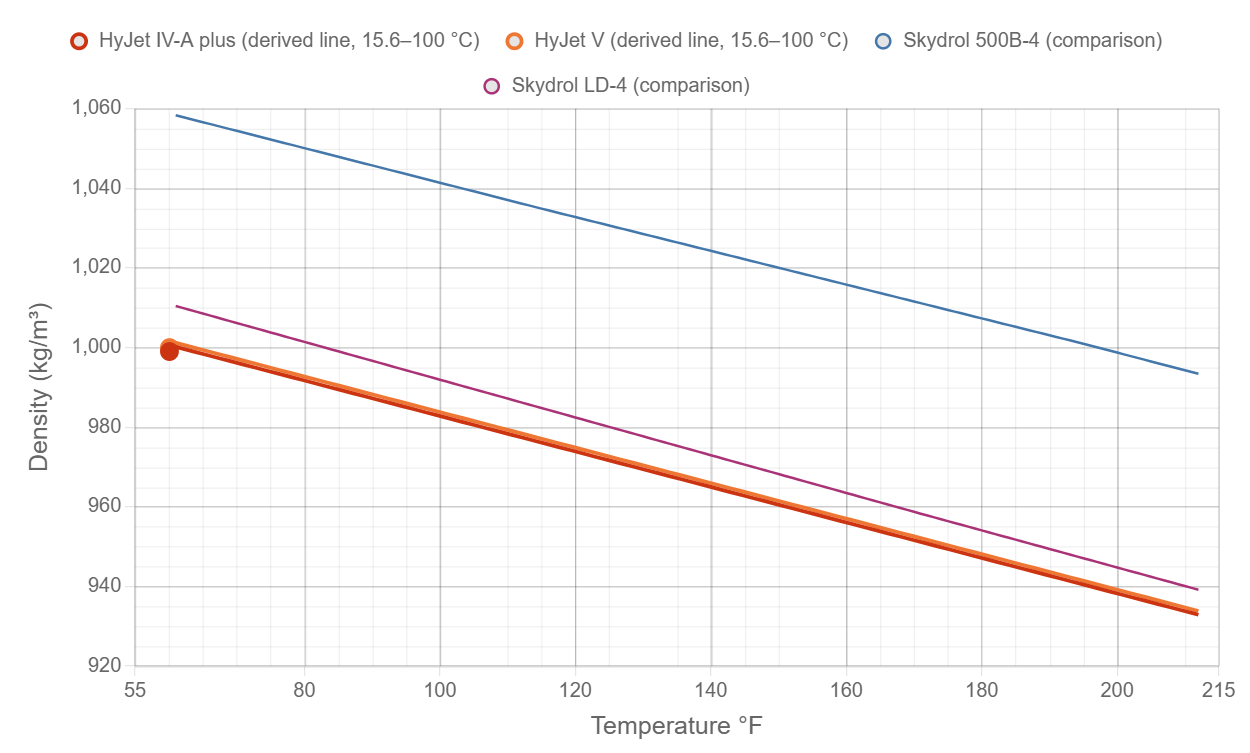
HyJet IV-A plus and HyJet V density vs temperature in degrees F, compared with Skydrol LD-4 and 500B-4

HyJet IV-A plus and HyJet V density, 15.6–100 °C (60–212 °F). Circles are the densities printed on the ExxonMobil data sheets at 15.6 °C.

The HyJet lines are derived from the maker's typical SG 25/25 °C and mean expansion coefficient (25–100 °C), not measured. They are drawn only across 15.6–100 °C. Nothing is extrapolated.

Skydrol 500B-4 and LD-4 are shown for comparison, copied unchanged from the Skydrol Density page (Lee Company chart).

Data from: ExxonMobil HyJet IV-A plus and HyJet V product data sheets (typical values, not measurements). Toggle data sets by clicking the legend.

HyJet Density Calculator
Grade:
Degrees (°F):
Degrees (°C):
Density (kg/m³):  
Density (lb/in³):  
Density (lb/gal):  
Density (lb/ft³):  
Specific Gravity*:  
Specific Gravity**:  
Specific Gravity***:  
°API****:  
Skydrol LD-4 (kg/m³):  
Skydrol 500B-4 (kg/m³):  

Valid 60.08 °F to 212 °F (15.6 °C to 100 °C). "Out of Range" outside it. The HyJet value is derived, not measured.

Specific Gravity is a Contentious Unit

* SG based on static density of water of 1000 (kg/m³) *

** SG based on static density of water of 998 (kg/m³) **

*** SG based on temperature dependent density of water ***

**** °API gravity at current temperature, referenced to water at 60°F (999.01 kg/m³): °API = (141.5 / SG60°F) − 131.5 ****

Density of HyJet Phosphate Ester Hydraulic Fluid
About This Data

HyJet is ExxonMobil's fire-resistant phosphate ester aviation hydraulic fluid. HyJet IV-A plus is an SAE AS1241 Type IV (low density) fluid. HyJet V is a Type V fluid. See the HyJet general properties page for the grades and approvals.

ExxonMobil prints two density facts for each grade. One is the density at 15.6 °C (60 °F): 0.999 g/mL for IV-A plus and 1.000 g/mL for V, both with 8.35 lb/gal. The other is the specific gravity at 25 °C/25 °C: 0.996 and 0.997. The sheets are typical values, not measurements, and they say values may vary within modest ranges.

The data sheets give no density table against temperature. So the line on this page is derived in three steps. First, the specific gravity is multiplied by the density of water at 25 °C (997.048 kg/m³). That gives 993.06 kg/m³ for IV-A plus and 994.06 kg/m³ for V. Second, the maker's mean expansion coefficient for 25–100 °C (0.00086 per °C, both grades) gives the density at 100 °C: ρ100 = ρ25 / (1 + 0.00086 × 75). Third, a straight line is drawn through the two points: ρ = 1013.117 − 0.80228 · T°C kg/m³ for IV-A plus and ρ = 1014.134 − 0.80309 · T°C kg/m³ for V.

As a check, the line gives 1000.6 and 1001.6 kg/m³ at 15.6 °C. The printed values are 999.0 and 1000.0 (8.35 lb/gal is 1000.5). The gap is 0.16 %, about what rounding to three decimals allows. The line is valid only from 15.6 to 100 °C. The mean expansion coefficient is printed with two significant figures, so treat the line as an engineering estimate and not as a specification.

Compared with Skydrol, HyJet IV-A plus is lighter than Skydrol LD-4 and much lighter than Skydrol 500B-4. HyJet V is close to the Eastman figure for Skydrol PE-5. See the table below. There is no density curve for the other Skydrol Type V grades, so only the 25 °C point is compared for them.

HyJet — Density vs. Temperature
Temp (°C)Temp (°F)IV-A plus (kg/m³)IV-A plus (lb/gal)V (kg/m³)V (lb/gal)Skydrol LD-4 (kg/m³)Skydrol 500B-4 (kg/m³)
15.660.11000.68.3501001.68.3591010.91058.8
2068.0997.18.321998.18.3291007.11055.3
2577.0993.18.287994.18.2961002.91051.4
3086.0989.08.254990.08.262998.61047.5
40104.0981.08.187982.08.195990.01039.7
50122.0973.08.120974.08.128981.51031.9
60140.0965.08.053965.98.061973.01024.3
70158.0957.07.986957.97.994964.41016.7
80176.0948.97.919949.97.927955.91009.0
90194.0940.97.852941.97.860947.51001.4
100212.0932.97.785933.87.793939.2993.4

HyJet columns are the derived straight lines, 15.6–100 °C (typical values, not measurements). Skydrol columns are copied from the Skydrol Density page (digitized from The Lee Company chart, engineering estimates).

Printed ExxonMobil Values (typical, not measurements)
GradePrinted valueTemp (°C)Density (kg/m³)Kind
HyJet IV-A plus0.999 g/mL (8.35 lb/gal), ASTM D405215.6999.0typical, printed
HyJet V1.000 g/mL (8.35 lb/gal), ASTM D405215.61000.0typical, printed
HyJet IV-A plusspecific gravity 0.996 (25/25 °C), ASTM D405225993.1typical, converted
HyJet Vspecific gravity 0.997 (25/25 °C), ASTM D405225994.1typical, converted

SG converted with water at 25 °C (997.048 kg/m³, a standard value, not from the data sheet).

HyJet vs Skydrol at 25 °C (77 °F)
FluidDensity at 25 °C (kg/m³)How obtainedSource
HyJet IV-A plus (Type IV)993.1derived from SG 0.996 (25/25 °C)ExxonMobil, typical
HyJet V (Type V)994.1derived from SG 0.997 (25/25 °C)ExxonMobil, typical
Skydrol LD-4 (Type IV)1008.0printed 1.0080 g/ccEastman EASAF7870, typical (Lee curve: 1002.9)
Skydrol 500B-4 (Type IV)1053.2printed 1.0532 g/ccEastman EASAF7870, typical (Lee curve: 1051.4)
Skydrol PE-5 (Type V)992.7printed 0.9927 g/ccEastman EASAF7870, typical (no curve)
Skydrol 5 (Type V)973.7printed 0.9737 g/ccEastman EASAF7870, typical (no curve)

Skydrol values are Eastman's typical 25 °C densities, as listed on the Skydrol General Properties page. HyJet IV-A plus is about 1.5 % lighter than Skydrol LD-4. HyJet V is about 0.1 % denser than Skydrol PE-5. Both HyJet grades are about 5.6 to 5.7 % lighter than Skydrol 500B-4.

Sources
  • Exxon Mobil Corporation, Exxon HyJet IV-A plus, Fire Resistant Phosphate Ester Aviation Hydraulic Fluid, product data sheet (3 pages, printed 31 Mar 2016). Reseller copy of the maker's PDF. Typical Properties table, pp.2–3. Accessed 29 Oct 2026. Re-checked against the Mobil web data sheet (2024 edition): same values.
  • Exxon Mobil Corporation, Exxon HyJet V, Fire Resistant Phosphate Ester Aviation Hydraulic Fluid, product data sheet (3 pages, printed 31 Mar 2016). Reseller copy of the maker's PDF. Typical Properties table, pp.2–3. Accessed 29 Oct 2026. Re-checked against the 2018 edition and the Mobil web data sheet (2024): same values.
  • Eastman Chemical Company, Skydrol aviation hydraulic fluids product comparison brochure, Publication EASAF7870. eastman.com. Skydrol comparison values, copied unchanged from the Skydrol Viscosity and Skydrol General Properties pages.
  • The Lee Company, Specific Gravity of Typical Fluids vs. Temperature chart, digitized for the Skydrol Density page. The Skydrol density curves here are copied unchanged from that page.
  • SAE International, AS1241, Fire Resistant Phosphate Ester Hydraulic Fluid for Aircraft. Cited by number only. Limits shown on this page are the limits printed on the ExxonMobil data sheets, not read from the standard.

All HyJet values are single typical values from the maker's data sheets. The density lines are derived by KasperCalc (method above). Data are also listed in tools/hyjet-sources.json and tools/hyjet-derived.json. Related pages: HyJet Viscosity, HyJet General Properties, Skydrol Density.

Cite This Work