Example: graded filter sand, 16 to 40 mesh. A fraction that passes the finest sieve can be entered with a lower opening of 0.
What the Ergun Equation Does
A packed bed is any column filled with loose particles that a fluid flows through: a sand filter, a catalyst reactor, an adsorber full of activated carbon or desiccant beads, a gravel pack, or a regenerator full of ceramic balls.
The fluid must squeeze through the twisting gaps between the particles. It rubs against a huge surface area and keeps changing direction, so it loses pressure. The Ergun equation, published by Sabri Ergun in 1952, predicts that loss from the particle size and shape, how tightly the bed is packed, the fluid properties and the flow rate.
It is the standard method for sizing packed beds. It tells you how much pressure a blower or pump must supply and how deep and wide a bed can be. It also sets the speed at which an upflow bed would lift and fluidize.
Typical results range from a few inches of water across an air filter or desiccant dryer to several bar across a deep catalyst bed carrying high-pressure gas.
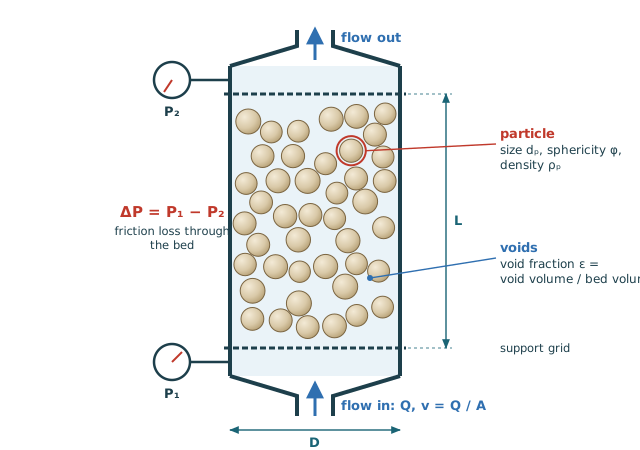
The Ergun Equation
The first term is viscous friction, which grows in proportion to velocity. It is the Blake-Kozeny (Carman-Kozeny) equation for slow flow. The second term is inertial loss, which grows with velocity squared. It is the Burke-Plummer equation for fast flow. Ergun added the two terms together and fitted the constants 150 and 1.75 to experiments, so one equation covers the whole range.
The factor \(\varepsilon^3\) in both denominators makes the result very sensitive to how tightly the bed is packed. So does the \((1-\varepsilon)\) in the numerators.
| Symbol | Meaning | SI unit |
|---|---|---|
| ΔP / L | Pressure drop per unit bed depth | Pa/m |
| v | Superficial velocity: flow ÷ empty-column area | m/s |
| ε | Void fraction (bed porosity) | – |
| dp | Volume-equivalent particle diameter | m |
| φ | Particle sphericity | – |
| μ | Fluid dynamic viscosity | Pa·s |
| ρ | Fluid density | kg/m³ |
1 cP = 0.001 Pa·s. The interstitial (actual) speed in the gaps is v/ε, about 2.5 times the superficial velocity.
Viscous vs. Inertial Flow
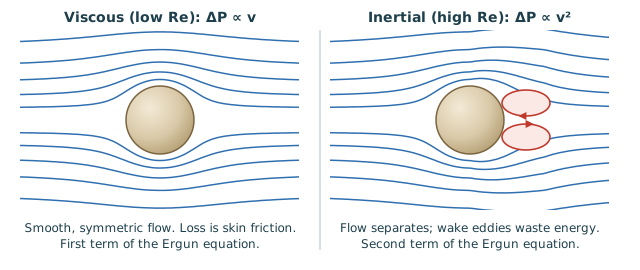
| Reₚ | Regime | ΔP grows with |
|---|---|---|
| < 10 | Viscous (laminar) | v |
| 10 – 1,000 | Transitional | between v and v² |
| > 1,000 | Inertial (turbulent) | v² |
Dividing through by the right groups collapses every packed bed onto one curve:
The Friction Factor graph above plots this curve and marks your design on it. Water filters usually run in the viscous regime, and gas flow through coarse catalyst usually runs in the inertial regime.
Particle Size & Sphericity
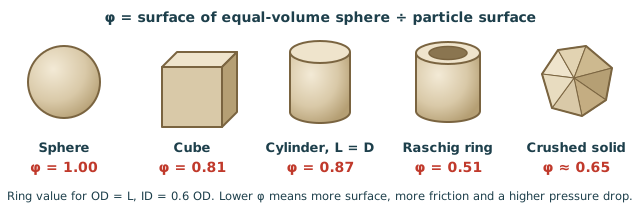
The product \(\phi\,d_p\) is the only size that enters the Ergun equation. It is the diameter of a sphere with the same surface-to-volume ratio as the particle. For cylinders and rings, the calculator works it out from the particle dimensions.
| Material | φ |
|---|---|
| Spheres, glass or ceramic beads | 1.00 |
| Ottawa sand (well rounded) | 0.95 |
| Cylinder, length = diameter | 0.87 |
| Crushed sandstone | 0.80 – 0.90 |
| Common salt | 0.84 |
| Rounded sand | 0.83 |
| Cube | 0.81 |
| Crushed coal | 0.75 |
| Crushed glass, flint sand | 0.65 |
| Berl saddles | 0.30 |
| Mica flakes | 0.28 |
Typical values from McCabe, Smith & Harriott and Perry's Handbook.
Trilobe & Quadrilobe Extrudates
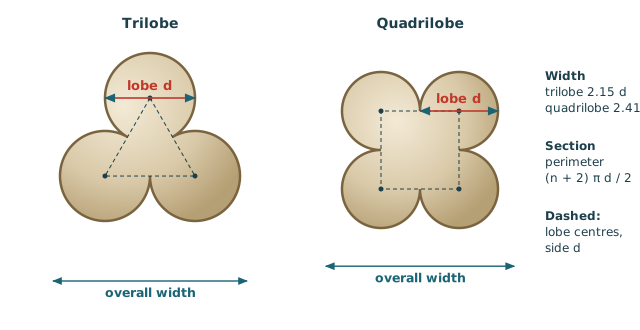
For n lobes of radius \(r = d/2\), the cross-section area \(A_c\) and perimeter \(P_c\) are
For an extrudate of length \(L\): \(V_p = A_c L\) and \(A_p = P_c L + 2A_c\). Then \(\phi\,d_p = 6V_p/A_p\), exactly as for any other shape.
Catalysts, desulfurizer sorbents and adsorbents are often extruded with a three- or four-leaf cross-section instead of as plain cylinders. The reaction happens near the outside of each pellet, so what matters is the distance from the surface to the centre. A lobed pellet keeps that distance short (about half the lobe diameter) without being as small, weak and dusty as a thin cylinder.
| Shape, 4 mm long | φ | φ·dᵥ, mm | ΔP, ε = 0.38 |
|---|---|---|---|
| Cylinder, 1 mm diameter | 0.73 | 1.33 | 9.8 kPa/m |
| Trilobe, 1 mm lobes | 0.60 | 1.59 | 7.5 kPa/m |
| Quadrilobe, 1 mm lobes | 0.62 | 1.81 | 6.2 kPa/m |
| Cylinder, 2.15 mm (trilobe width) | 0.84 | 2.55 | 3.8 kPa/m |
Air at 0.5 m/s. For the same diffusion distance, lobes give about a quarter less pressure drop than a thin cylinder. Lobed extrudates also tend to pack more loosely: at ε = 0.45 the trilobe drops to 3.8 kPa/m.
Commercial lobed extrudates are usually about 1 to 3 mm across and a few times longer than they are wide. Length varies from pellet to pellet, so use the average length.
Mixed Sizes & Sieve Analysis
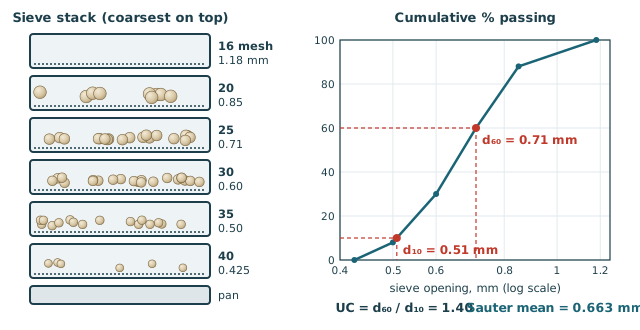
| Fraction, mm | Mass x | Mean d̄, mm | x / d̄ |
|---|---|---|---|
| 1.18 – 0.85 | 0.12 | 1.015 | 0.118 |
| 0.85 – 0.71 | 0.28 | 0.780 | 0.359 |
| 0.71 – 0.60 | 0.30 | 0.655 | 0.458 |
| 0.60 – 0.50 | 0.22 | 0.550 | 0.400 |
| 0.50 – 0.425 | 0.08 | 0.463 | 0.173 |
Σ x/d̄ = 1.508 mm⁻¹, so d₃₂ = 1/1.508 = 0.663 mm. This is the example loaded in the sieve panel.
Real media come in a range of sizes. Pressure drop is caused by surface friction, and fine grains carry far more surface per kilogram than coarse ones. So the right single size for the Ergun equation is the Sauter (surface-volume) mean, not the simple average:
\(x_i\) is the mass fraction caught between two sieves and \(\bar d_i\) the average of their openings. The Sauter mean is always smaller than the mass-weighted mean \(\sum x_i \bar d_i\). Using the larger mean underpredicts ΔP.
Filter media are specified by the effective size \(d_{10}\) (10% of the mass is finer) and the uniformity coefficient \(UC = d_{60}/d_{10}\). Typical rapid-filter sand specifications ask for an effective size of about 0.45 to 0.55 mm and a UC below about 1.6. The example sand has \(d_{10}\) = 0.51 mm and UC = 1.40.
Void Fraction (Bed Porosity)
The void fraction ε is the share of the bed volume not filled by solid. It is the input most likely to be wrong, and the one that matters most. In the viscous regime ΔP scales roughly with \((1-\varepsilon)^2/\varepsilon^3\). Changing ε from 0.40 to 0.36 raises the pressure drop by about 50%.
Weigh a known bed volume to get the bulk density. Then
Use the density of the solid itself for \(\rho_p\). For porous particles such as activated carbon, alumina or catalyst, use the particle (envelope) density, not the skeletal density: the pores inside the particles do not carry flow.
| Packing | Typical ε |
|---|---|
| Uniform spheres, dense random packing | 0.36 – 0.38 |
| Uniform spheres, loose random packing | 0.40 – 0.42 |
| Cylindrical pellets | 0.35 – 0.45 |
| Sand and granular media | 0.38 – 0.48 |
| Crushed or angular solids | 0.40 – 0.50 |
| Mixed sizes (small fill the gaps) | 0.25 – 0.35 |
Wall Effects, Constants & Compressible Gas
Particles cannot pack tightly against a flat wall, so there is a loose, high-void layer near the wall that adds wetted surface. In narrow columns this changes ΔP noticeably. Mehta and Hawley's correction uses
The viscous term is multiplied by \(M^2\) and the inertial term by \(M\). M is close to 1 when D is many particle diameters across.
Macdonald et al. (1979) refit a larger data set and recommend 180 in place of 150. The second constant is 1.8 for smooth particles and 4.0 for rough ones.
A gas expands as its pressure drops. The velocity rises toward the outlet, so the pressure gradient steepens. The mass flux \(G = \rho v\) stays constant. For an ideal gas at constant temperature, the Ergun equation integrates exactly:
where \(a = 150(1-\varepsilon)^2/(\varepsilon^3 \phi^2 d_p^2)\) and \(b = 1.75(1-\varepsilon)/(\varepsilon^3 \phi d_p)\). If ΔP is under about 10% of the absolute pressure, the simple incompressible result is close enough.
Fluidization Limits
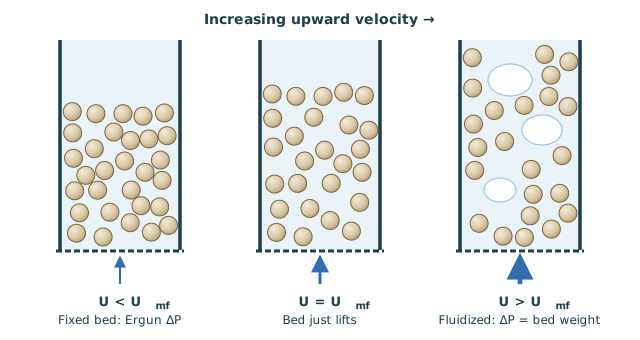
In upflow, the fluid pushes up on the particles. Once the pressure drop equals the bed's weight per unit area, the particles float apart and the bed fluidizes. Faster flow only expands the bed further; ΔP stays at the bed weight. Upflow adsorbers and filters must stay below Umf unless the bed is held down.
Above the terminal velocity, single particles are carried out of the column. Stokes' law, \(U_t = g\,d_p^2(\rho_p-\rho)/(18\mu)\), holds only for particle Reynolds numbers below about 1. For anything bigger than fine powder it overpredicts badly: for the 12.5 mm beads in the example it gives 11,700 m/s instead of 27 m/s. This calculator uses the Haider-Levenspiel correlation, which covers the full range and non-spherical particles. It also shows the Stokes value so you can compare.
Putting the Ergun equation on the left gives a quadratic in \(Re_{mf} = \rho\,U_{mf}\,d_p/\mu\):
Worked Example: Air Through a Bed of Glass Beads
1 kg/s of air (ρ = 1.156 kg/m³, μ = 0.0182 cP) flows up through a 1.25 m diameter, 2.5 m deep bed of 12.5 mm glass spheres (ρₚ = 2,500 kg/m³) with ε = 0.38. This is the calculator's Load Example.
- Area A = π(1.25)²/4 = 1.2272 m². Superficial velocity v = (1/1.156)/1.2272 = 0.7049 m/s.
- \( Re_p = \dfrac{1.156 \times 0.7049 \times 0.0125}{1.82\times10^{-5} \times 0.62} = 902.7 \), which is transitional and close to inertial.
- Viscous term: \( 150 \dfrac{(1.82\times10^{-5})(0.7049)(0.62)^2}{(0.38)^3 (0.0125)^2} \) = 86.3 Pa/m
- Inertial term: \( 1.75 \dfrac{(1.156)(0.7049)^2(0.62)}{(0.38)^3 (0.0125)} \) = 908.6 Pa/m
- ΔP/L = 994.9 Pa/m, so ΔP = 994.9 × 2.5 = 2,487 Pa (2.49 kPa, about 10 inH₂O).
| Check | Result |
|---|---|
| Friction factor, 150/902.7 + 1.75 | 1.916 |
| Inertial share of ΔP | 91% |
| Umf (εmf = 0.415) | 3.26 m/s |
| v / Umf | 0.22: stays a fixed bed |
| Terminal velocity | 27.5 m/s |
| Compressible gas, inlet 1 atm | 2,519 Pa (+1.3%) |
| Same bed with ε = 0.36 | 3,028 Pa (+22%) |
| Macdonald constants (180, 1.8) | 2,595 Pa (+4%) |
The flow is mostly inertial, so doubling the airflow would roughly quadruple ΔP. The ε row shows why measuring the void fraction matters more than which constants you pick.
Design Tips & Common Mistakes
- Using interstitial velocity. The Ergun equation uses the superficial velocity (flow ÷ empty-column area). The ε terms already account for the faster flow in the gaps.
- Ignoring sphericity. Leaving φ = 1 for crushed media can underpredict ΔP by a factor of 2 or more in the viscous regime, because φ enters squared.
- Wide size distributions. Fines fill the gaps and lower ε sharply. Screen out fines, or use the Sauter mean diameter and a measured ε.
- Forgetting the extras. Support grids, hold-down screens, distributors, inlet and outlet nozzles, and any fouling or dust cake all add pressure drop on top of the bed.
- Go wider, not deeper. ΔP is proportional to depth and rises with up to the square of velocity. For the same bed volume, doubling the diameter cuts both the velocity and the depth to a quarter, so ΔP falls 16 times (viscous flow) to 64 times (inertial flow).
- Upflow beds. Keep velocity well below Umf (often under 50 to 70% of it), or hold the bed down. Otherwise particles grind against each other and are carried out.
Packed Beds in Fuel Cell Systems
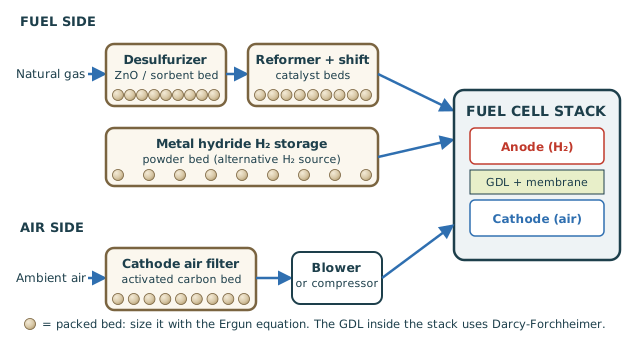
| Bed | Typical media | Watch for |
|---|---|---|
| Cathode air filter | Activated carbon granules, 1–4 mm | Every pascal costs blower power |
| Desulfurizer | ZnO, carbon or zeolite, 2–5 mm | Low velocity: check flow distribution |
| Reformer, shift, PROX | Catalyst pellets or rings, 2–6 mm | Use gas properties at bed temperature |
| Metal hydride store | Alloy powder, 1–50 µm after cycling | Very high ΔP per length; fines migrate |
A fuel cell stack is fed by blowers and regulators that have small pressure budgets, so every packed bed upstream matters. Tick Fuel cell tools in the calculator toolbar to load a typical bed or work out the flow from stack power, or enter your own.
\(P_e\) is the stack electrical power in W, \(V_c\) the average cell voltage and \(\lambda\) the stoichiometry. PEM cathodes typically run at λ = 1.5 to 2.5. Dead-ended anodes run close to 1.
- Air flow at λ = 2 and 0.65 V/cell: 3.57 × 10⁻⁷ × 2 × 50,000/0.65 = 0.0549 kg/s (198 kg/h).
- Through a 300 mm diameter, 75 mm deep bed of 3.5 mm carbon granules (φ = 0.70, ε = 0.42), v = 0.645 m/s and Reₚ = 181.
- The Ergun equation gives ΔP ≈ 310 Pa (1.2 inH₂O), about one third viscous and two thirds inertial.
- A 400 mm bed cuts this to 123 Pa. Widening the bed is the cheapest way to save blower power.
Frequently Asked Questions
- What is the Ergun equation used for?
- Predicting the pressure drop of a liquid or gas flowing through a packed bed of particles: filters, adsorbers, dryers, catalytic reactors, regenerators and soil or gravel layers. It also gives the minimum fluidization velocity of an upflow bed.
- How accurate is it?
- Typically ±20 to 30%, and mostly limited by how well you know the void fraction and sphericity. With measured ε and φ for spheres, it is usually within about 10%.
- What is the difference between Ergun and Kozeny-Carman?
- Kozeny-Carman (Blake-Kozeny) is only the viscous term. It is accurate for slow flow, Reₚ below about 10. Ergun adds the inertial term so it also works at high flow rates.
- Can I use it for a liquid?
- Yes. Enter the liquid's density and viscosity. Liquids are incompressible, so leave the compressible-gas option off.
- Does it work for structured or column packings like rings and saddles?
- Only roughly. Rings and saddles have internal voids and very high ε (0.6 to 0.95). For distillation and absorption packings, use the vendor's packing-factor correlations.
- What is the difference between superficial and interstitial velocity?
- Superficial velocity is the flow rate divided by the empty-column area. Interstitial velocity is the actual average speed in the gaps, the superficial velocity divided by ε.
- Why does the pressure drop stop rising in the ΔP vs. velocity graph?
- That flat line is an unrestrained upflow bed fluidizing. Once ΔP equals the bed weight per unit area, extra flow just lifts the particles apart.
- How do I handle trilobe or quadrilobe catalyst?
- Choose the Trilobe / quadrilobe tile and enter the lobe diameter and length. The calculator works out the sphericity and effective size from the cross-section geometry.
- What particle size should I use for sand or graded media?
- Use the Sauter mean diameter from a sieve analysis, not the average or the effective size. Choose Sieve analysis under the particle size and paste the fractions.
- How do I size a packed bed for a fuel cell system?
- Tick Fuel cell tools in the calculator toolbar and work out the reactant flow from the stack power, then enter the bed and media. Keep cathode filters to a few hundred pascals, because the air blower has to supply that pressure at full power.
- Can I use the Ergun equation for a gas diffusion layer?
- No. A GDL is a fiber mat, not a particle bed. Use Darcy's law with a measured permeability, as in the GDL permeability calculator.