Vessel Dimensions
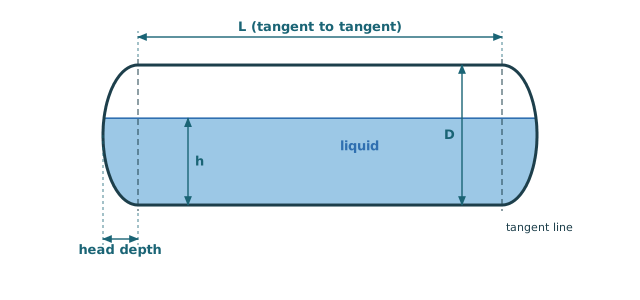
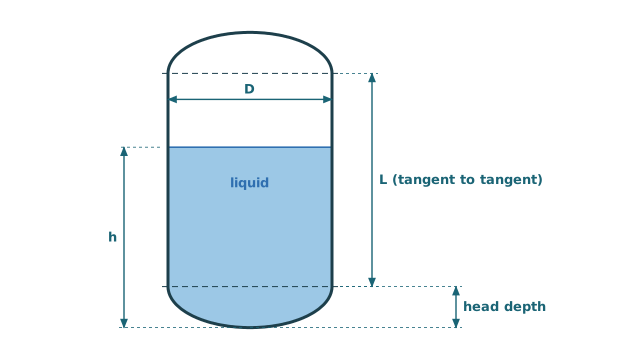
A pressure vessel or process tank is a cylindrical shell closed by a head at each end. The tangent line is where the straight shell stops and the curve of the head starts. Vessel drawings give the shell length tangent to tangent (T/T), which is the L this calculator uses.
Vessel Head Types
| Head | Depth | Volume | Inside area |
|---|---|---|---|
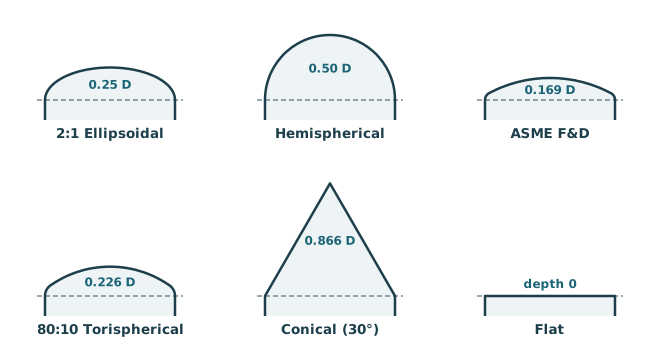
| 2:1 Ellipsoidal | 0.250 D | 0.1309 D³ | 1.084 D² |
| Hemispherical | 0.500 D | 0.2618 D³ | 1.571 D² |
| ASME F&D (f = 1, k = 0.06) | 0.169 D | 0.0810 D³ | 0.931 D² |
| 80:10 (f = 0.8, k = 0.1) | 0.226 D | 0.1099 D³ | 1.015 D² |
| Conical, 30° half-angle | 0.866 D | 0.2267 D³ | 1.571 D² |
| Conical, 45° half-angle | 0.500 D | 0.1309 D³ | 1.111 D² |
| Flat | 0 | 0 | 0.785 D² |
Per head, using inside diameter D. Computed by this calculator.
- 2:1 ellipsoidal: the most common head on pressure vessels. Depth is a quarter of the diameter.
- Hemispherical: strongest for its thickness, so used at high pressure. Deepest and most expensive to form.
- F&D and 80:10: torispherical heads. Shallow and cheap, common on low-pressure tanks.
- Conical: hoppers and bottoms that must drain solids or slurries completely.
Torispherical (F&D) Head Geometry
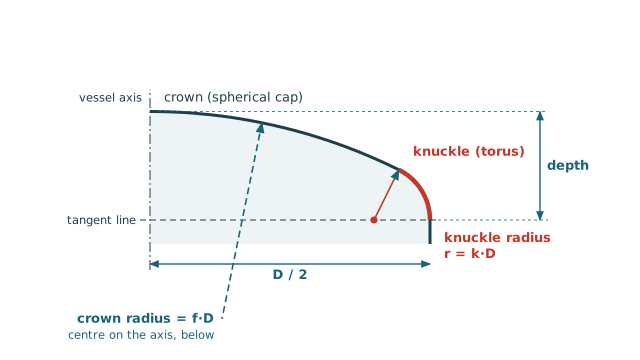
A torispherical head is set by two radii, both written as fractions of the diameter: the crown (dish) radius \(f\,D\) and the knuckle radius \(k\,D\).
\(c\) is the distance from the tangent line down to the centre of the crown sphere. The knuckle meets the crown at a height \(c\,k/(f - k)\) above the tangent line.
Partial Volume of a Horizontal Tank
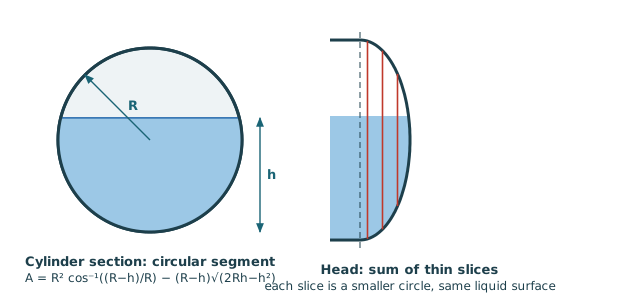
Every cross-section of the shell holds the same circular segment of liquid, so the shell's liquid volume is the segment area times L:
A head's slices get smaller toward the apex, but the liquid surface stays at the same height. For an ellipsoidal head of depth \(a\) (including hemispherical, \(a = R\)), the result has a closed form:
Torispherical and conical heads have no simple closed form. This calculator integrates the slices numerically for every head type, and matches the formula above to better than 0.002%.
Partial Volume of a Vertical Tank
A vertical tank is simpler: every horizontal slice is a full circle. With \(a\) the head depth, the liquid fills three zones in order:
- Bottom head, \(0 \le h \le a\): volume rises slowly at first, because the head is narrow at the bottom.
- Shell, \(a \le h \le a + L\): volume rises in a straight line, \(\pi D^2/4\) per unit of height.
- Top head, \(a + L \le h \le 2a + L\): volume rises more slowly again as the head narrows.
Worked Example: Horizontal Tank
A horizontal tank with 2:1 ellipsoidal heads, 96 in inside diameter and 240 in tangent to tangent, filled to 60 in. This is the calculator's Load Example.
- R = 48 in, head depth a = 96/4 = 24 in, and R − h = −12 in (more than half full).
- \( A = 48^2\cos^{-1}(-0.25) + 12\sqrt{2(48)(60) - 60^2} \) = 4,759.0 in²
- Shell: 240 × 4,759.0 = 1,142,160 in³ = 4,944.4 gal.
- \( V_{head} = \dfrac{\pi (24)(60^2)(144 - 60)}{6(48)} \) = 79,168 in³ = 342.7 gal per head.
- Liquid = 4,944.4 + 2 × 342.7 = 5,629.9 US gal.
| Quantity | Value |
|---|---|
| Shell volume | 7,520.2 gal |
| Each head | 501.3 gal |
| Total volume | 8,522.9 gal |
| Liquid at 60 in | 5,629.9 gal |
| Percent full | 66.1% |
1 US gal = 231 in³. The level is 62.5% of the diameter but the tank is 66.1% full.
Strapping Tables (Tank Calibration Charts)
Operators measure a tank's contents by level, using a dip stick, a gauge or a level transmitter. A strapping table turns that level into volume. The name comes from "strapping" a tank: measuring its circumference with a steel tape to find the real diameter.
The Strapping Table tab above builds one for any vessel. Set the level increment, then download it as CSV for a spreadsheet, a PLC lookup table or a printed gauge chart.
Volume Unit Conversions
| Unit | US gal | Liters | ft³ | m³ |
|---|---|---|---|---|
| 1 US gallon | 1 | 3.78541 | 0.133681 | 0.00378541 |
| 1 imperial gallon | 1.20095 | 4.54609 | 0.160544 | 0.00454609 |
| 1 oil barrel (bbl) | 42 | 158.987 | 5.61458 | 0.158987 |
| 1 ft³ | 7.48052 | 28.3168 | 1 | 0.0283168 |
| 1 m³ | 264.172 | 1,000 | 35.3147 | 1 |
| 1,000 in³ | 4.32900 | 16.3871 | 0.578704 | 0.0163871 |
Common Mistakes
- Outside diameter instead of inside. Volume goes with D², so a 1/4 in wall on a 96 in tank overstates the volume by about 1%.
- Overall length instead of tangent to tangent. Using the overall length as L counts the heads twice. For a 2:1 head, this adds half a diameter of shell.
- Reading level as percent full. Only a vertical flat-bottom tank is linear. A horizontal tank at 10% of its diameter is only about 5% full.
- The wrong level reference. In a vertical vessel, h starts at the bottom of the bottom head, not at the lower tangent line or a nozzle.
- Forgetting dead volume. Liquid below the outlet nozzle cannot be pumped out. Subtract it to get usable volume.
- Ignoring temperature. Liquids expand. Jet fuel grows about 1% for every 20 °F (11 °C). Correct volumes to a standard temperature for inventory.
Frequently Asked Questions
- How do I calculate the volume of a horizontal tank?
- Add the shell, π D² L / 4, to the volume of both heads. For a partly full tank, multiply the circular-segment area at the liquid level by L and add the liquid in each head. The calculator above does both for every head type.
- How do I find the liquid level for a given volume?
- Choose "Volume → level" or "% full → level". There is no closed-form inverse, so the calculator searches for the level that gives that volume.
- What is the volume of a 2:1 ellipsoidal head?
- π D³ / 24, or about 0.1309 D³. It is half of an ellipsoid of revolution with depth D/4.
- What is the volume of an ASME F&D head?
- About 0.0810 D³, with a depth of about 0.169 D, for crown radius D and knuckle radius 0.06 D.
- Does it work for spheres or capsules?
- Yes. Set L = 0 with hemispherical heads for a sphere. Use hemispherical heads with any L for a capsule-shaped tank.
- Can I use it for a vertical tank with a cone bottom and a flat roof?
- Both ends use the same head here. For a cone-bottom tank, choose Conical and keep the level below the top tangent line; the top head does not affect the volume below it.
- Is the wetted area useful?
- Yes. Fire-case relief sizing (API 521) and heat-loss calculations use the wetted surface. API 521 limits the fire-exposed wetted area to 25 ft (7.6 m) above grade, which you need to apply separately.