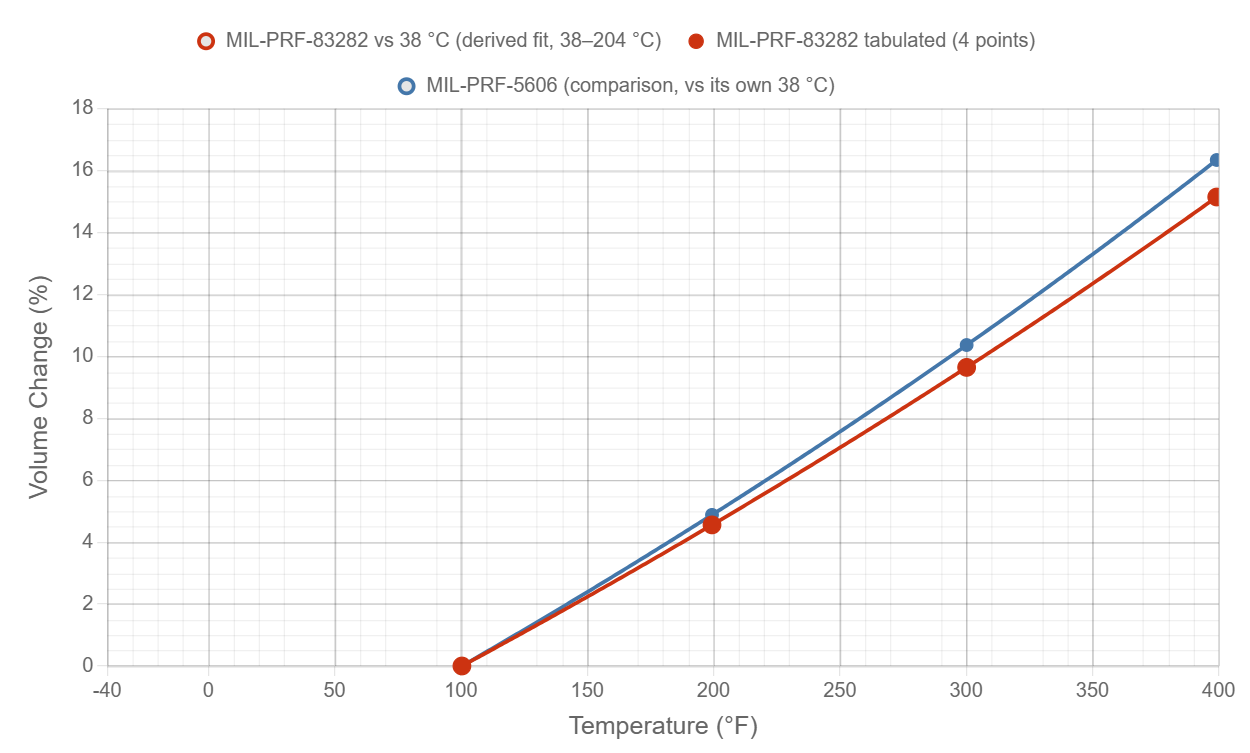
The volumetric thermal expansion coefficient β describes how much a fluid expands per degree of temperature rise at constant pressure:
NADC-79248-60 does not tabulate β for MIL-H-83282. β is therefore derived from its atmospheric density data. The four Table 2 densities are fitted with a least-squares straight line, ρ = 854.002 − 0.65704 · T°C kg/m³, and because the fit is linear the derivative is constant, giving
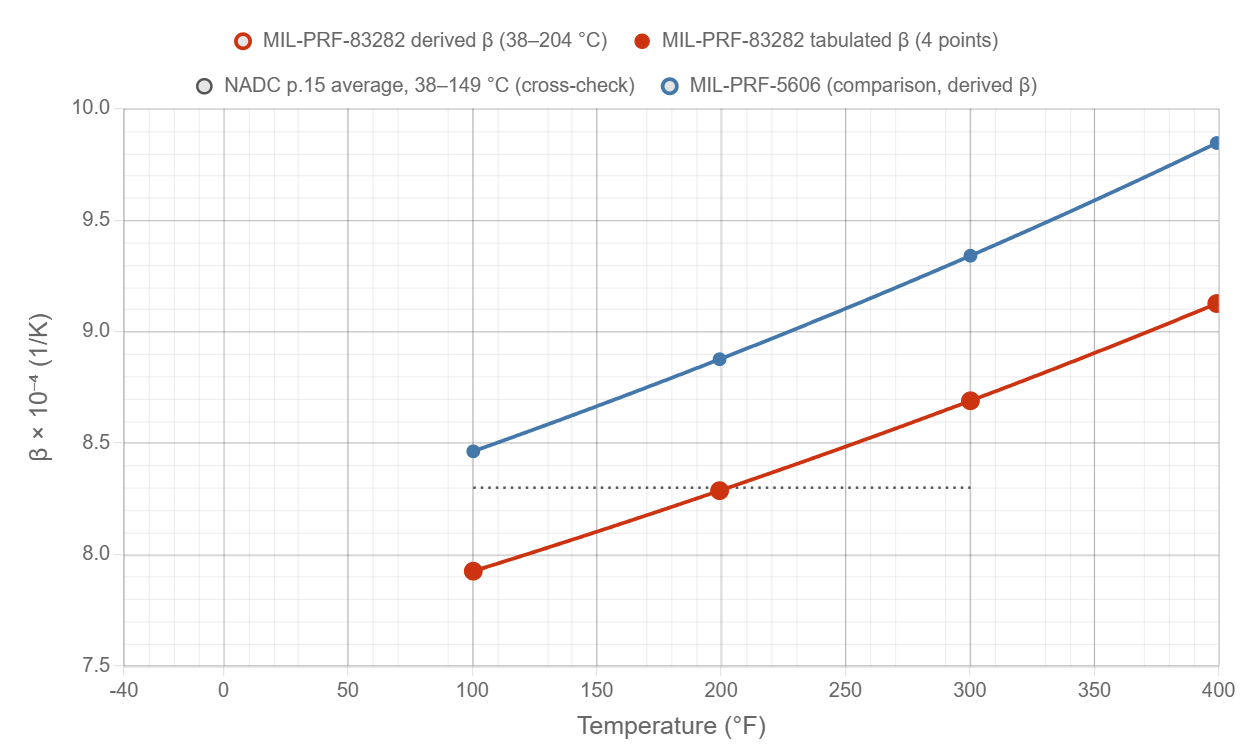
β rises slowly with temperature as density falls: about 7.925 × 10⁻⁴ 1/K at 38 °C (100 °F) and about 9.126 × 10⁻⁴ 1/K at 204 °C (399 °F). MIL-PRF-83282 is a fire-resistant, synthetic hydrocarbon aircraft hydraulic fluid. Like most oils it expands by about 0.08 to 0.09 % per kelvin. The curve is valid only between those two temperatures, the range of the measured densities.
NADC-79248-60 (p.15) gives a single average cubical expansion coefficient of 8.3 × 10⁻⁴ /°C (4.6 × 10⁻⁴ /°F) over 38–149 °C (100–300 °F), with no point values. The average of the derived β over the same interval is 8.296 × 10⁻⁴ /°C, which agrees with the report's value to within 0.1 %. The report does not state how its average was computed, so this is a consistency check only.
The density fit is built from the MIL-H-83282 atmospheric column of Table 2 in NADC-79248-60, at 38, 93, 149 and 204 °C (100, 200, 300 and 400 °F). The report's Table 9 covers Nadraul MS-6 rather than MIL-H-83282. No density or expansion data below 38 °C were found in the sources used, so the chart and calculator are not extended below 100.4 °F. Nothing is extrapolated above 399.2 °F either. The report gives no uncertainty for its measurements, and the lot and specification revision are not stated (the 1980 NADC reference lot of MIL-H-83282).