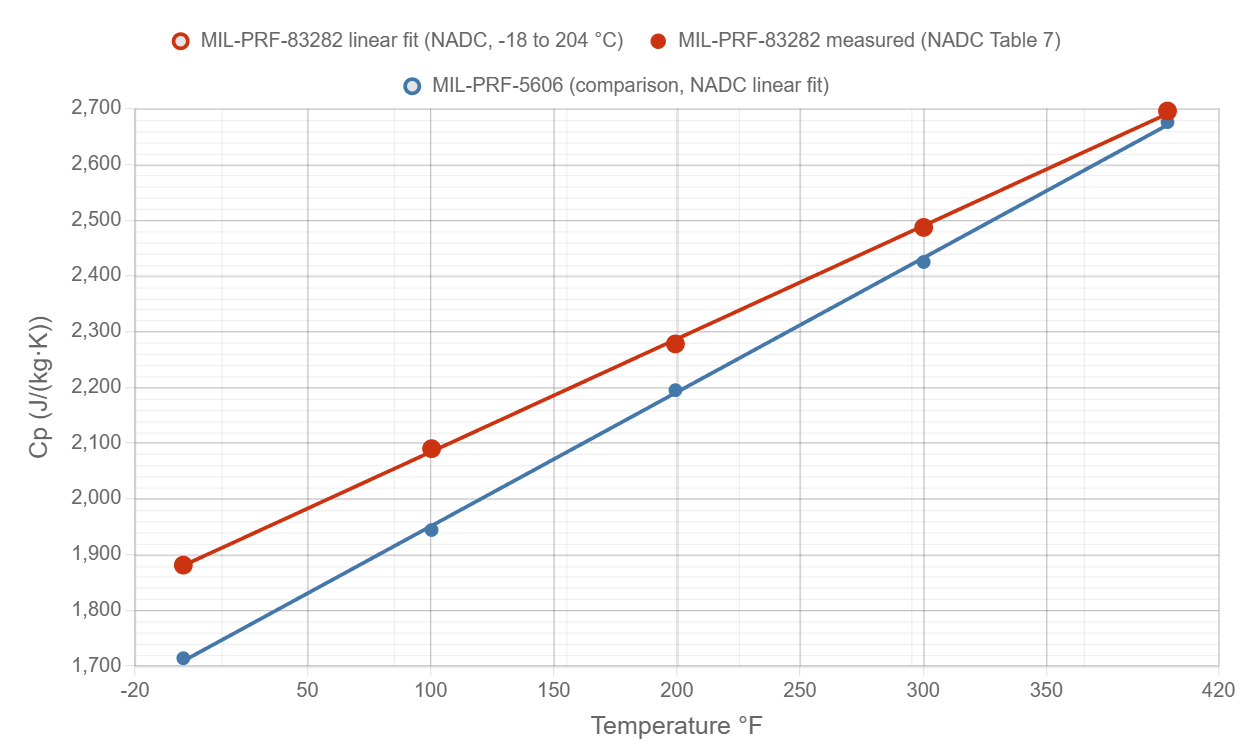
Specific heat capacity (Cp) is the amount of heat required to raise the temperature of a unit mass by one degree at constant pressure. For MIL-PRF-83282 it is measured in J/(kg·K) [SI] or Btu/(lbm·°F) [Imperial], and governs sizing of heat exchangers and thermal management systems. The heat transfer equation is:
where Q is heat flow (W or BTU/hr), ṁ is mass flow rate, and ΔT is the temperature difference across the heat exchanger or system boundary.
MIL-PRF-83282 is a fire-resistant, synthetic hydrocarbon aircraft hydraulic fluid. The specific heat values are the MIL-H-83282 entries of Table 7 in NADC-79248-60 (Conte & Hammond, Naval Air Development Center, 1980, DTIC ADA081597), tabulated at -18, 38, 93, 149 and 204 °C. The report does not state the measurement method, the specification revision (MIL-H-83282 predates the MIL-PRF designation) or the lot tested, and it gives no uncertainty. Treat the data as the 1980 NADC reference lot of MIL-H-83282 (lot and revision not stated).
The smooth curve is the straight-line fit cp = 1946.01 + 3.6523 · T°C J/(kg·K), used only between -18 °C and 204 °C. It departs from the five measured values by at most 7.7 J/(kg·K). Cp rises nearly linearly with temperature, from 1881 J/(kg·K) at -18 °C to 2696 J/(kg·K) at 204 °C. The steps between the measured points are slightly uneven (209, 188, 209 and 209 J/(kg·K)), so the table was probably read from a chart.